Key takeaways
- A virtual business address is a real commercial street address for your company, different from a home address, a post office box, and a registered agent address.
- It is accepted in most states for business formation filings, a federal tax ID, and business banking, but it does not replace an in-state registered agent and usually will not qualify for a Google Business Profile.
- The safest way to choose one is to confirm it is a real, deliverable commercial address before it goes on any form.
Before you start
- Know the difference between your principal business address and your registered agent address, since you may need both.
- Have a city in mind for your business address, because availability and state acceptance vary.
Who this is for
- Founders deciding what address to use for an LLC, banking, and filings.
- Remote and online businesses that want to keep a home address private.
- Anyone comparing a virtual business address with a virtual office or a mailbox.
A virtual business address is a real commercial street address you can use for your company instead of your home, even though you do not lease space there. Mail sent to it is received on your behalf, then scanned or forwarded, and the address works for filings and banking.
This guide explains what a virtual business address is, what it qualifies for, how it differs from a virtual office and a mailing address, and how to choose one that survives bank and state checks.
Setting up your LLC? See your US address options — no card →
What a Virtual Business Address Actually Is
A virtual business address is a real commercial street address at a staffed building, not a post office box, also called a PO box, and not your home. Because it resolves to an actual commercial location, it works on documents where a post office box is rejected, and it keeps your home address off public records.
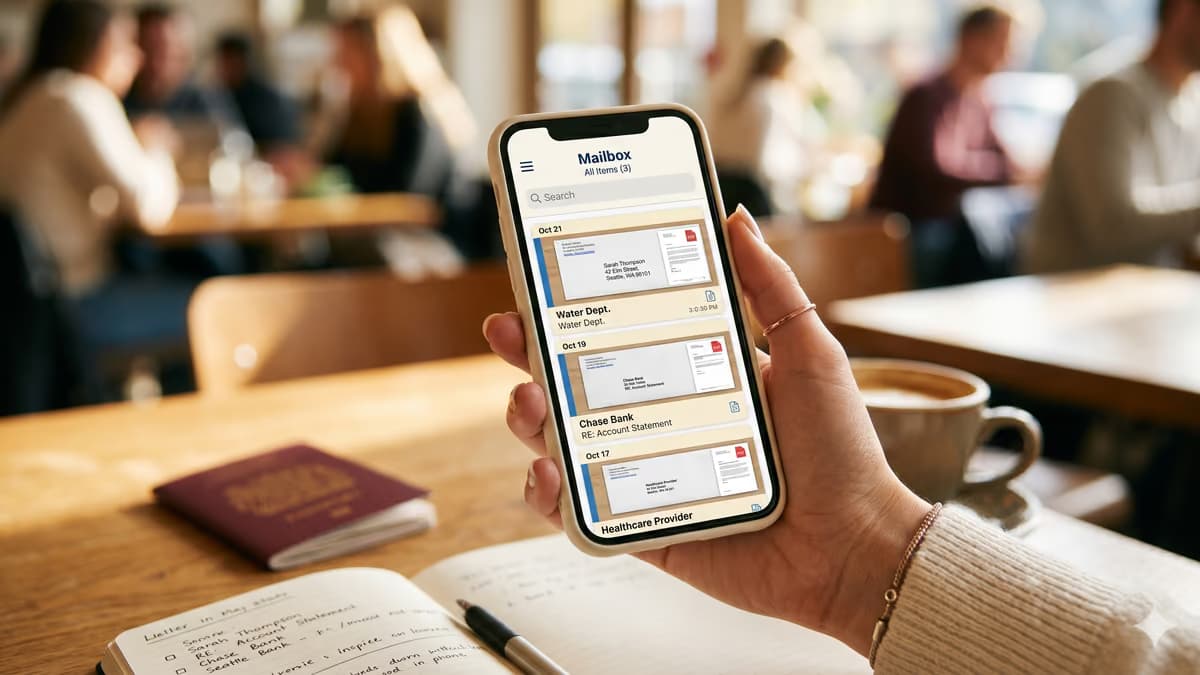
The address itself is the core of the service. You receive mail there, the provider scans or forwards it, and you list the address on your website, your filings, and your client-facing materials. What you are buying is a credible, deliverable place for your business to exist on paper.
Real street address, not a PO box
The distinction that matters most is commercial versus residential or PO box. Banks, state filing offices, and payment processors treat a real commercial street address very differently from a post office box, which is why the format of the address can decide whether an application is approved.
Virtual Business Address vs Virtual Office vs Mailing Address
These three terms overlap, and providers often use them loosely. The difference is in scope. A virtual business address is the address by itself. A virtual office bundles that address with added services. A virtual mailing address is aimed at personal mail rather than a business identity.
| Term | What it is | Best suited for |
|---|---|---|
| Virtual business address | A real commercial street address used as your company's address | Business formation filings, banking, and client-facing use |
| Virtual office | A business address plus added services such as phone answering and meeting rooms | Businesses that also want a receptionist or on-demand rooms |
| Virtual mailing address | An address for receiving and scanning mail, often personal | Individuals and travelers managing personal mail |
The three terms overlap, but the address is the core component each one shares.
If you also want the full service layer beyond the address, see what a virtual office includes. If your need is personal mail rather than a business identity, a virtual mailing address for individuals is the closer fit.
Ready to set up your business address?
See which US cities fit — about a minute, no card needed.
What a Virtual Business Address Qualifies For
A virtual business address covers most of the places a company needs an address. That includes your Limited Liability Company, or LLC, formation filing, applying for an Employer Identification Number, or EIN, from the Internal Revenue Service, or IRS, opening a business bank account, and setting up payment processors. Two places it does not cover are an in-state registered agent and, in most cases, a Google Business Profile.
| Where you use it | Does it work? | What to know |
|---|---|---|
| LLC principal or business address | Yes, in most states | The address goes on your state formation record. A few states apply specific rules, so confirm locally. |
| EIN application with the IRS | Yes | The IRS accepts a real, deliverable street address for the business. |
| Business bank account | Usually | A real commercial street address helps you pass Know Your Business checks. Some banks still ask follow-up questions. |
| Payment processors | Yes | Stripe and PayPal accept a real commercial street address for standard payment processing. Stripe's Issuing and Treasury products, used for money management, now require a physical operating presence and reject virtual mailbox addresses. |
| Registered agent | No | A registered agent needs a physical address in the state of formation and must be available during business hours. |
| Google Business Profile | Usually not | Google generally requires staff physically present at the address, which a pure virtual address does not provide. |
How a virtual business address maps to the main places a business address is used.
The two things it does not replace
A virtual business address is not a registered agent, and it usually will not pass a Google Business Profile check. See registered agent vs business address and how Google verifies a virtual address before you rely on it for either.
How a Virtual Business Address Works
Setting one up is mostly paperwork and a few decisions about how you want mail handled. The address can be ready quickly once the authorization is complete.
- 1Pick a city where you want your business based, since the address appears on public filings.
- 2Complete the mail authorization paperwork so the provider can receive mail on your behalf.
- 3Choose how mail is handled: scanned to a dashboard, forwarded to you, or held for pickup.
- 4Start using the address on filings, banking, your website, and invoices. Many providers activate within about 24 hours.
How to Choose a Virtual Business Address Provider
Providers vary widely in address quality, mail handling, and whether the address holds up under bank and state checks. The address is what clients and filing offices actually see, so start there and work outward.
- It is a real commercial street address, not a post office box or a residential unit.
- It is accepted for state business filings and for opening a business bank account.
- Mail handling is reliable, with scanning and forwarding you can manage from anywhere.
- Pricing is transparent and month to month, with no long lease.
- It offers the cities you care about, in case you expand to more than one state.
- You can confirm the address is real and deliverable before you commit.
A free address is rarely free of risk
Free virtual business addresses tend to fail exactly where it counts, at bank onboarding and state filing. If you are weighing one, read why a free virtual business address fails first.
save office provides real commercial street addresses in its US cities, accepted for LLC filings, IRS, and state compliance, with the address on file. You can run any address through the free Address Checker to confirm it is deliverable before it goes on a form.
Checklist: Before You Put a Virtual Business Address on Any Form
- Confirm the address is a real, deliverable commercial street address.
- Decide whether you also need a registered agent in the state of formation.
- Use the same address consistently across your state filing, EIN, and bank account.
- Keep a record of where the address is used, so re-verifications are easy to handle.
- Verify the address before it lands on any application, not after.
A virtual business address gives your company a real commercial street address without a lease, and for most founders it covers the places that matter: state filings, the EIN, business banking, and client-facing materials. The two exceptions worth flagging are an in-state registered agent and, in most cases, a Google Business Profile listing.
The simplest way to avoid a rejected application is to start from a real, deliverable address. Run any address through the save office Address Checker first, compare plans and cities, and set up a business address when you are ready.
Frequently Asked Questions
Not sure what you need?
Two short pages sort it out — what the products actually are, and which situation you're in.
Watch this in 60 seconds
Henry covers the same ground on video.