Key takeaways
- Free virtual addresses typically fail at four points: bank KYC, state LLC filing, Google Business Profile, and payment processor onboarding.
- The 2023 USPS rule classifies third-party mail receivers as commercial mail receiving agencies, which compliance systems flag.
- A 60-second commercial mail receiving check tells you whether an address will fail before you sign up.
Who this is for
- Founders evaluating free vs paid virtual address offers.
- Operators whose application stalled at an address that looked legitimate online.
A free virtual business address looks like a bargain on the signup page and a problem six weeks later. Banks decline the account during Know Your Customer (KYC) review. The state filing office rejects the LLC because the address sits on a list of mail-handling services. Google Business Profile suspends the listing the first time the algorithm crawls it. By the time the founder finds out, the address has already been printed on the operating agreement, the EIN application, and a stack of business cards.
This guide breaks down the five places a free address gets rejected, the four-quadrant framework banks and state offices actually use, and the 2023 USPS rule that quietly changed the math on which addresses are usable for an LLC at all.
Setting up your LLC? See your US address options — no card →
Why Free Virtual Business Addresses Get Marketed Everywhere
Free virtual address offers fall into three categories, and knowing which one is being pitched explains why each fails differently.
- Free trial periods from paid providers, usually 14 to 30 days. The address itself is real, but the trial is designed to convert into a paid plan once mail starts arriving. If the founder cancels, the address is reassigned and any in-flight mail bounces.
- Free tier offers from app-based mailbox networks. The address is shared across thousands of accounts, the mailbox suite number is recycled, and the address is almost always flagged in USPS data as a registered mail-receiving service.
- Free coworking and friend-of-a-friend addresses. A founder uses a coworking lounge address without a lease, or a relative's small business address as a placeholder. There is no formal mail-receiving authorization, so USPS may refuse delivery, and the state filing office can reject the LLC if the underlying business is not registered to receive mail for third parties.
All three categories share one structural problem. The address is not bound to the LLC through a documented agreement, which is exactly what banks, state offices, and the IRS want to see during onboarding.
The Five Places a Free Address Gets Rejected
Search engine results, public records, and small business forums all surface the same five rejection points. Each one has a different gatekeeper and a different cost when the address fails.
| Rejection point | Who checks | Why a free address fails | Cost to fix |
|---|---|---|---|
| Bank account onboarding | Mercury, Relay, Bluevine, Chase, and most digital banks during KYC | Free-tier addresses often sit at a delivery point classified residential, and the operator frequently has no third-party authorization paperwork on file, which is what the review actually turns on | Application denied or routed to manual review for 2 to 4 weeks; some banks may flag the address indefinitely for that address pool |
| State LLC registration | Secretary of State filing offices in CA, NY, FL, DE, and most other states | Some states reject filings tied to addresses that cannot meet physical street address requirements or where the underlying mail-receiving entity is not registered to receive mail for third parties | Filing fee forfeited, formation delayed 4 to 8 weeks, and the LLC has to refile with a new address |
| Google Business Profile (GBP) | Google's automated profile review | GBP guidelines explicitly prohibit using virtual offices or P.O. Box addresses without a staffed location during stated business hours, and free shared addresses fail the staffing test | Profile suspended, local search visibility dropped to zero, reinstatement appeals take 2 to 6 weeks |
| IRS form filings | Internal Revenue Service Form SS-4 and 1040 mailing systems | Free addresses without a signed third-party authorization can have IRS mail returned undeliverable, which delays the EIN confirmation letter and triggers compliance flags on later filings | EIN issuance delayed by weeks, and federal notices missed during the gap |
| Reputation and scam clustering | Domain reputation systems, business credit bureaus, and search algorithms | Free shared addresses host hundreds or thousands of unrelated businesses, including dropshippers and dormant shells, which pulls every business at that address into the same reputation cluster | Lower business credit scores, slower vendor approvals, and harder time clearing email deliverability checks |
Where free virtual business addresses fail, who runs the check, and what it costs to fix.
The pattern is consistent. Free addresses are not rejected because they are virtual. They are rejected because the underlying mail-receiving relationship is undocumented, the address sits in a high-risk USPS classification, or the address is shared so widely that automated systems treat it as a spam signal.
Ready to set up your business address?
See which US cities fit — about a minute, no card needed.
The 2023 USPS Rule That Changed Free Address Math
In July 2023, the United States Postal Service (USPS) updated its rules on third-party mail receipt. Any business that receives mail on behalf of someone else has to register as a Commercial Mail Receiving Agency (CMRA), and the receiving party has to file standard third-party authorization paperwork that the mail service stores.
Free address services rarely complete this paperwork because the volume of free signups makes it operationally impossible. The result is a gap. The address is technically deliverable, but the entity using it has no documented right to receive mail there, which means USPS can refuse delivery, and any downstream system that audits the chain of custody (banks, the IRS, state offices) treats the address as unverified.
Paid virtual office providers handle this paperwork during signup as part of the onboarding flow. Free services almost universally do not, which is why the same address can pass a quick deliverability check and still fail when a bank or state office runs a deeper audit.
The Four-Quadrant Test for Whether Your Address Survives KYC
Banks, payment processors, and state offices combine two USPS data points to score every address. The CMRA flag tells them whether the address is registered as a third-party mail service. The Residential Delivery Indicator (RDI) tells them whether the building is classified as residential or commercial. Together they form four quadrants, and free virtual addresses almost always land in the worst one.
| Quadrant | CMRA flag | RDI classification | How it scores |
|---|---|---|---|
| Tier A | Not flagged | Commercial | Best. Banks, states, and the IRS clear it without manual review. Real commercial buildings without third-party mail-handling fall here. |
| Tier B | CMRA flagged | Commercial | Mixed. Acceptable for IRS and most state filings, but banks may route to manual review. Most paid virtual office addresses sit here, and the documentation cleanup time is short. |
| Tier C | Not flagged | Residential | Risky. Home offices and unregistered residential addresses. Acceptable for some state filings, but banks and payment processors usually require a separate commercial address before issuing accounts. |
| Tier D | CMRA flagged | Residential | Worst. Free shared mailbox services, app-based virtual addresses without commercial buildings, and recycled suite numbers in mixed-use buildings. Banks reject during KYC, GBP suspends listings, and several states refuse the filing outright. |
How CMRA status and RDI classification produce four address tiers.
Free virtual business addresses almost always score Tier D because the building is part of a residential or mixed-use complex, the suite number is recycled across thousands of accounts, and the third-party authorization paperwork is missing. A paid commercial virtual office in a real office building scores Tier A or B, which is the band banks and state offices accept without friction.
Checklist: How to Tell in 60 Seconds Whether an Address Holds Up
Run any address through the save office address checker before it lands on a single form. The tool returns the CMRA flag, the RDI classification, and a plain-English grade in under a minute. It is free to use, with no payment required.
- 1Open the address checker and paste the full street address with the suite number.
- 2Read the CMRA flag. If it is green and the building is classified as commercial, the address is in Tier A or B.
- 3Read the RDI classification. Commercial scores best, residential is fine for some filings, vacant is a red flag.
- 4Check the bank, LLC, and IRS notes the tool surfaces. Each gatekeeper has slightly different tolerance for CMRA-flagged addresses.
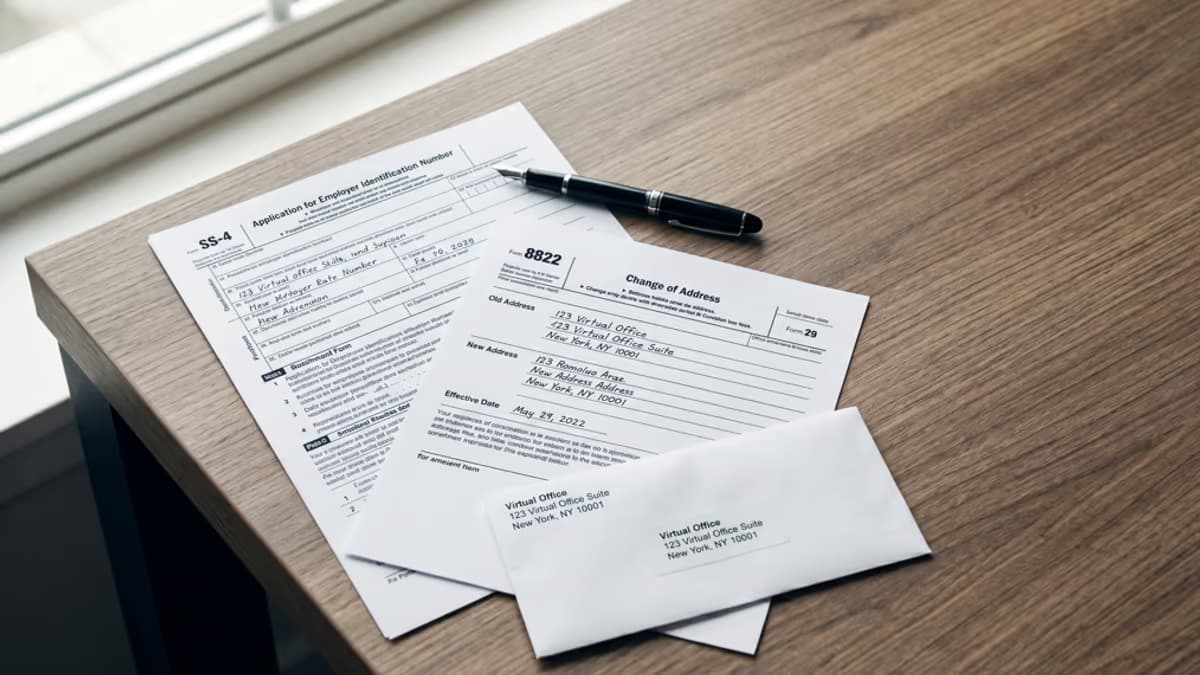
- 5If the address grades C or below, switch before the LLC formation, the EIN, and the bank account get linked to it. Switching afterward triggers Form 8822-B, an updated operating agreement, and a bank verification round.
What an Address That Holds Up Looks Like
An address that survives every gatekeeper has four properties. Each one is verifiable before the LLC ever forms.
- 1Real commercial street address in a building that USPS classifies as commercial through the Residential Delivery Indicator. Mixed-use and residential addresses score lower across every system.
- 2Documented third-party authorization kept on file by the mail service provider, which is what USPS requires after the 2023 rule update for any address that receives mail for someone else.
- 3Active mail handling with scanning or forwarding inside hours, not weeks, since the IRS, banks, and state offices send time-sensitive notices.
- 4Used consistently across filings, so the LLC formation, the EIN application, the bank account, and the marketplace seller account all reference the same address. Mismatches trigger compliance notices that take months to unwind.
save office provides real US street addresses in cities including New York, Washington DC, San Francisco, Wilmington (Delaware), Cheyenne (Wyoming), and Tampa. The address comes with the documents a reviewer asks for, and mail scanning reaches the inbox within hours of arrival.
Frequently Asked Questions
Not sure what you need?
Two short pages sort it out — what the products actually are, and which situation you're in.