Short answer
USPS does not offer a virtual address. The Postal Service provides PO Boxes, free Informed Delivery mail previews, mail forwarding, and Street Addressing for PO Boxes, but none of these is a virtual address. A virtual address, meaning a real US street address with all-carrier package acceptance and mail scanning to a digital inbox, comes from a third-party mailbox provider, not from USPS.
Key takeaways
- USPS does not sell a product called a virtual address. It offers PO Boxes, Informed Delivery, mail forwarding, and PO Box Street Addressing, which are different things.
- Informed Delivery is free, but it is a preview of mail heading to an address you already have, not an address of its own.
- A virtual address, a real US street address with mail scanning and all-carrier package acceptance, comes from a third-party mailbox service, and a free checker shows how USPS data classifies an address before you pay.
Before you start
- Separate two questions: where your mail physically arrives, and what address you can legally put on bank and business records.
- Know that "free" USPS options exist, but a free option and a real usable street address are not the same thing.
Who this is for
- Anyone who searched "USPS virtual address" and wants to know if the Postal Service actually offers one.
- People weighing a PO Box, Informed Delivery, and a real street address for their mail.
- Remote workers, travelers, and small business owners who need a US street address a PO Box cannot provide.
USPS does not offer a virtual address. The Postal Service provides PO Boxes, free Informed Delivery mail previews, mail forwarding, and Street Addressing for PO Boxes. None of these is the real street address with mail scanning that people usually mean, which comes from a third-party mailbox provider instead.
USPS, the United States Postal Service, runs the physical mail network, not a digital mailbox business. So when a search for "USPS virtual address" turns up mailbox services, those services are private companies, not a Postal Service product. This guide covers what USPS genuinely offers, why the confusion happens, and where the street address you are looking for actually comes from.
Did this answer your question?
What USPS Actually Offers
The Postal Service has four products people sometimes mistake for a virtual address. Each one solves a narrow problem, and none of them gives you a real commercial street address with remote mail scanning.
- PO Box: a locked box at a Post Office. You get a box number, not a street address, and you retrieve mail in person or through limited pickup options.
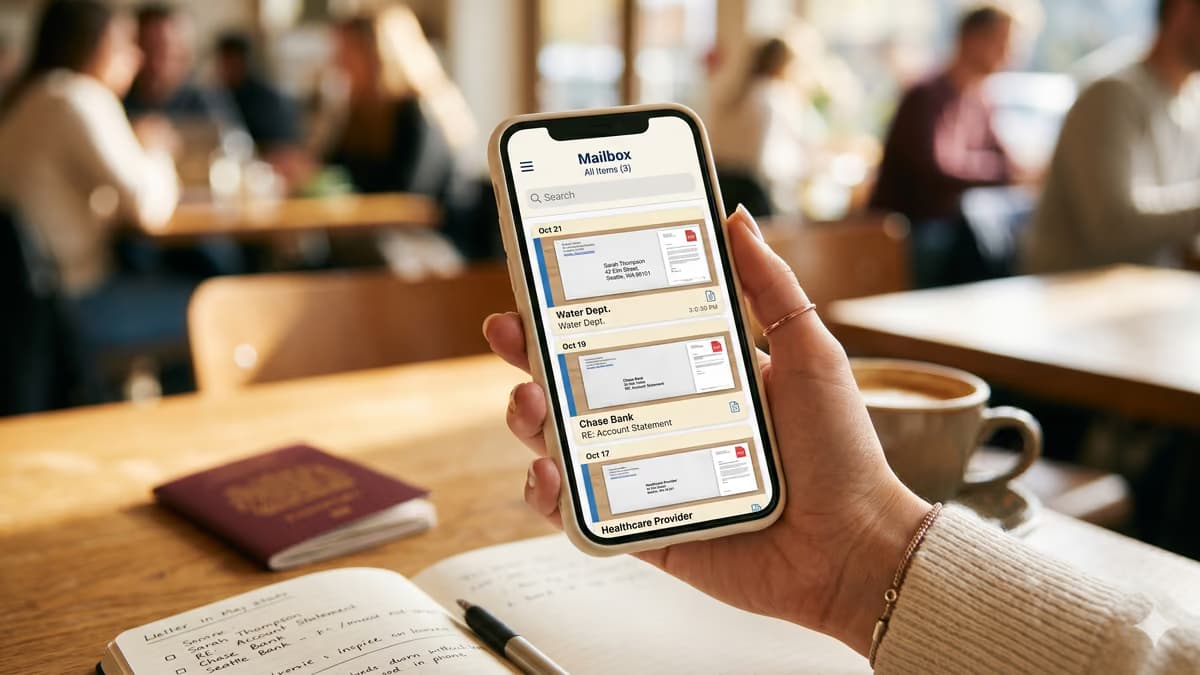
- Informed Delivery: a free service that emails you grayscale preview images of letter-size mail arriving at an address you already have. It shows mail, it is not an address.
- Mail forwarding: a Change of Address request, PS Form 3575, that redirects mail from one address to another for a set period. It moves mail, it does not create a new usable address.
- PO Box Street Addressing: an option that lets a PO Box holder use the Post Office's street address so private carriers can deliver there. The address belongs to the Post Office, not to you.
None of these is a virtual address
A virtual address is a real commercial street address where a provider receives your mail, scans it to a digital inbox, and accepts packages from every carrier. USPS does not sell that. It is a private mailbox service, which is why every "USPS virtual address" result is actually a third-party company.
Ready to set up your business address?
See which US cities fit — about a minute, no card needed.
Why People Expect USPS to Have a Virtual Address
The confusion is reasonable. Several real things point in this direction without adding up to a Postal Service virtual address.
- 1Informed Delivery already shows mail on a screen, so it feels like a digital mailbox even though it only previews mail going to your existing address.
- 2Mailbox providers often mention USPS Form 1583 and USPS delivery in their marketing, which makes the service sound like an official USPS offering.
- 3In 2013, the USPS Office of Inspector General published a white paper exploring a virtual PO Box concept: an address you could redirect wherever you choose, with possible extras such as images or scans of your mail. That paper describes a possible future service, not a product you can order today.
There is no consumer virtual address at usps.com
As of 2026, you cannot sign up for a virtual address directly from USPS. The Inspector General reports describe a concept, not a live service. Any working virtual address you can buy today is run by a private mailbox company.
Informed Delivery Is a Mail Preview, Not an Address
Informed Delivery is the USPS feature closest to a digital mailbox, and it is free, so it draws a lot of the "free USPS virtual address" searches. It is worth understanding exactly what it does and does not do.
- It emails you scanned images of the outside of letter-size mail before it arrives, tied to the address already on your USPS account.
- It does not open or scan the contents of your mail, and it does not handle packages the same way.
- It gives you no new address to put on a form. Your mail still goes to your home or existing address.
So Informed Delivery can tell you what is coming, but it cannot keep your home address private, cannot give you a street address in another city, and cannot scan the inside of a tax notice or a bank letter. Those are the jobs a virtual address is built for. Our guide on whether a business can use Informed Delivery covers what USPS says about business accounts and what the daily email shows.
PO Box Street Addressing: A Real Street Format, With Limits
PO Box Street Addressing is the option that comes closest to looking like a street address. It lets you write your PO Box using the Post Office's physical street address, so UPS, FedEx, and other private carriers can deliver to it. That solves the carrier problem, but it introduces others. If you need to know whether an address someone gave you is a PO Box, see how to tell if an address is a PO Box.
| Works | Falls short |
|---|---|
| Accepts UPS, FedEx, and other private carriers, not just USPS. | The address is the Post Office building, shared by every box holder there. |
| Looks like a street address on a label. | The address is still a PO Box, so a form rule against PO Boxes can apply to it. |
| Works with a PO Box you already rent, where the Post Office offers it. | No mail scanning, no digital inbox, no remote access. You still pick up mail at the Post Office. |
What PO Box Street Addressing does and where it falls short.
For someone who just wants package delivery to a local box, Street Addressing can be enough. If a form asks for a business location rather than a mailing address, read its rules on PO Boxes before you use one.
What a Virtual Address Actually Is and Who Provides It
A virtual address is a real commercial street address, in a real building, operated by a private mail service that is authorized to receive mail on your behalf. USPS Publication 28 says “Private companies offering mailbox rental services to individuals and businesses are considered commercial mail receiving agencies (CMRA).” When you sign up, you get your own box number at that address. Publication 28 says mail to a CMRA customer must include “either the PMB identifier or the #” and the box number, and “Use of any other identifier is prohibited.”
- A real street address with your own box number, not a PO Box number. At a CMRA, USPS requires that number to be written with PMB or #. Some forms limit private mailbox addresses, so read each form line before you enter one.
- Package acceptance from USPS, UPS, FedEx, DHL, and Amazon, because a person is there to sign and log deliveries.
- Mail scanning to a digital inbox, so you can read a letter from anywhere, then forward, shred, or store it.
- A choice of city, so your address can sit in a market that fits your business rather than wherever you happen to live.
A provider needs your written authorization
Because a provider receives mail for you, USPS requires you to sign a standard authorization form so a third party can accept your mail. It is a federal step handled with the provider, the same whether you are an individual or a business. If your goal is personal mail rather than a company, see the guide to a virtual mailing address for personal use.
USPS Options vs a Virtual Address, Side by Side
Laying the choices next to each other makes the gap clear. The first three columns are USPS options. The last is a third-party virtual address.
| Factor | USPS PO Box | Street Addressing | Informed Delivery | Virtual address |
|---|---|---|---|---|
| Real street address | No, a box number | Post Office's own address | No, a preview only | Yes, with your box number (PMB or # at a CMRA) |
| Accepts UPS and FedEx | No, USPS only | Yes | No | Yes, all carriers |
| Bank and business filing | Often rejected | Often rejected | Not applicable | Generally accepted, some banks also want a residential address |
| Mail scanning to digital inbox | No | No | Preview images only, not full scans | Yes |
| Remote access | In person | In person | Email previews | Full web dashboard |
| Cost | $21 to $389 for 3 months or $31 to $677 for 6 months (USPS Notice 123, effective October 4, 2026) | Added to a PO Box where the Post Office offers it | Free | Varies by provider |
USPS PO Box, Street Addressing, and Informed Delivery compared with a third-party virtual address.
How to Tell What You Are Actually Getting
The label on a service does not always match how USPS data records the address. Before paying for any address, you can check that classification in a few seconds.
The free address checker runs USPS Delivery Point Validation and flags whether an address is residential, commercial, or a registered commercial mail receiving location. The checker uses the same underlying data USPS uses, so the result shows how the address is classified rather than how it is marketed. The checker does not tell you whether a given bank or form will accept the address.
Check first, sign up second
Run any address you are considering, including one a provider gives you, through the checker. If it comes back as residential, expect the limits a residential address carries. The checker does not label PO Boxes, and a PO Box with Street Addressing can look like an ordinary street address. Check whether the street address belongs to a Post Office as well.
Where save office Fits
save office is a third-party virtual address service, not a USPS product. It provides a commercial street address in one of its US cities, with mail scanning to a digital inbox, so you can use it in place of your home address where a form accepts it. We cannot promise that a given bank or form will accept the address.
You can confirm any address with the free address checker, compare tiers on the pricing page, or start setup through onboarding. Activation follows once the standard mail authorization is complete. For the difference between this and a PO Box, see virtual office vs PO box.
Frequently Asked Questions
Next step
Reserve your US business address
Pick a city and a plan. Your mail goes to a real commercial address and is scanned when you ask.
Sources & References
Primary sources this guide is based on.
- 1United States Postal Service · Publication 28, section 285, Private Mailbox Addresses (accessed November 13, 2026)
- 2United States Postal Service · Rent a PO Box (accessed November 13, 2026)
- 3United States Postal Service · Notice 123, Price List, effective October 4, 2026 (accessed November 13, 2026)
- 4United States Postal Service · Domestic Mail Manual 508, Recipient Services (accessed November 13, 2026)
Not sure what you need?
Two short pages sort it out — what the products actually are, and which situation you're in.