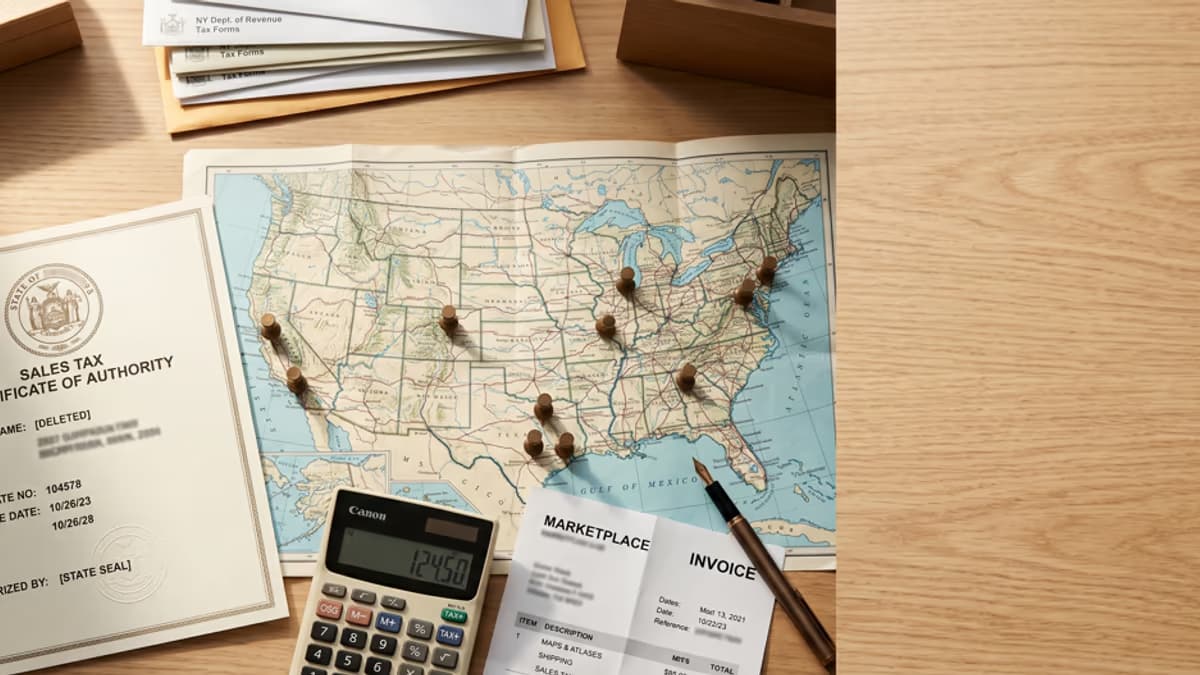
Key takeaways
- The restriction is real and it is published, just not where people look. The Wyoming Sales/Use Tax License Application (Rev 5/04/2023) says in bold at line 6 that the location address "cannot be a registered agent or virtual office address." It is an application instruction rather than a statute, and none of the answers we read for this question cites it.
- Before you solve that field, check whether you need the license. The Department of Revenue says forming a Wyoming entity does not by itself create the obligation, and that a registered agent or virtual office is not the physical presence that does. Wyoming's economic threshold is gross revenue from sales delivered into Wyoming over $100,000 in the current or immediately preceding calendar year; the separate 200-transaction test was repealed effective July 1, 2024.
- Our Cheyenne address is a virtual office, so it is excluded from that location field by name. We are not going to tell you otherwise. What the address checker does is show you how an address is classified before you put it on an application, not promise that an agency will take it.
Before you start
- Know whether you actually sell something Wyoming taxes, and whether you have any presence in the state beyond the entity itself.
- Know your revenue delivered into Wyoming for the current and prior calendar year, since that is what the economic threshold measures.
- If you already hold a license, know your filing frequency, because a zero-sales period still has to be filed.
Who this is for
- Owners of a Wyoming LLC who hit the location address field on the sales tax application and stopped.
- Remote and online sellers who formed in Wyoming but operate somewhere else entirely.
- Anyone holding a Wyoming sales tax license with no Wyoming sales, wondering what they still owe.
If you have gotten as far as searching this, you have probably already seen the answer: a registered agent address or a virtual office will not work in the location field on Wyoming's sales tax application. That answer is correct. What the threads we read never do is show you where it comes from, which is why it feels like folklore.
It is not folklore. It is a bolded sentence on a state form. And once you see the form, a second and more useful question opens up, which is whether you need the license at all.
Setting up your LLC? See your US address options — no card →
The Sentence Is Real, and It Is on Line 6 of a PDF
The Wyoming Department of Revenue's Sales/Use Tax License Application (Rev 5/04/2023) is linked from the Excise Tax Division registration page as the application for regular vendors. Line 6, Location Address, carries this instruction, with the second sentence in bold on the original form:
Wyoming Sales/Use Tax License Application, line 6
"This is the location of your business. It cannot be a registered agent or virtual office address. If you do not have a physical storefront, it needs to be the address where your business records can be inspected or where your customer can return an item. It may be your home address if you run an online store, attend various craft shows, have a food truck, or similar businesses."
Two things about that sentence are worth being precise about, because getting them wrong is how good information turns into bad advice.
- It is a published application instruction rather than a statute. We did not find it restated in the Department's rules, and the statutory layer is thinner: Wyoming Statutes 39-15-106 requires the application to state the business location, requires a separate license for each place of business, and requires the license to "be posted in a conspicuous place at the place of business for which it is issued." The specific exclusion of registered agent and virtual office addresses is the agency's instruction on its own form.
- It is not isolated. The Department's Excise Tax FAQs use the same exclusion when describing nexus, referring to a physical presence or connection to Wyoming "(outside of a registered agent or virtual office)." Two separate Department documents point the same direction.
The instruction also tells you what does work, which the answers we read leave out. If you have no storefront, the state asks for the address where your records can be inspected or where a customer could return an item, and it explicitly allows a home address for online stores, craft show sellers, and food trucks.
Why the Field Exists, and Why It Is Not About Your Tax Rate
A reasonable guess is that the state wants your physical location to work out which county rate to charge. For a remote seller that guess is wrong, and it is worth clearing up because it changes what the field is for.
Wyoming sources most sales to the customer, not to you. Under Wyoming Statutes 39-15-104(f)(i), a sale is sourced to the seller's business location when the purchaser receives the product there, and otherwise to the location where the purchaser receives it. The Department puts it plainly in its FAQs: rates are based on where the customer takes possession of the item or service. If you ship, your address is not setting the rate.
So the field reads as enforcement work rather than rate work, and the form and statute say what kind:
- Records inspection and customer recourse, which is what the form instruction itself names.
- A conspicuously posted license at the place of business it was issued for (39-15-106(c)(iii)), which presumes a place where something can be posted.
- A separate license for each place of business (39-15-106(b)), which presumes places rather than mailboxes.
- County-level licensing. The Department's vendor guidance treats a move to a different county as re-licensing: a new application in the new county, cancellation of the old license, and another fee.
The honest version for us
Our Cheyenne address is a virtual office and business mailbox. The Department's form excludes registered agent and virtual office addresses from that field by name, so it does not satisfy it, and no amount of framing changes that. This is the same category of answer as trademark domicile: some fields are asking for a place you occupy, and no mail address is a substitute. What the address checker is for is seeing how an address is classified before you put it on an application, not getting it through one.
Ready to set up your business address?
See which US cities fit — about a minute, no card needed.
First Question: Do You Need This License at All?
This is the part that gets skipped, and for a lot of Wyoming LLC owners it is the whole answer. The Department addresses it directly in its Excise Tax FAQs, in response to the exact question people arrive with:
Wyoming Department of Revenue, Excise Tax FAQs
"Q: I just created an LLC in Wyoming. Do I need a Wyoming sales tax license? A. It depends. If your company is selling something with an imposition statute and your company has a physical presence or connection to Wyoming (outside of a registered agent or virtual office) or meets our economic thresholds, the answer is yes. Simply creating a business entity in Wyoming doesn't automatically mean your company needs a Wyoming sales tax license."
Read that against your own situation. Forming in Wyoming is not the trigger. The triggers are a taxable sale plus either physical presence or the economic threshold.
| Trigger | What it means | Source |
|---|---|---|
| Physical presence | An office, warehouse, distribution or sales house or other place of business in Wyoming; soliciting sales or advertising in the state; inventory, equipment or leased equipment in Wyoming; deliveries into Wyoming in your own vehicles. A registered agent or virtual office is named as not being this. | Department vendor guidance and Excise Tax FAQs |
| Economic threshold | Gross revenue from sales delivered into Wyoming exceeding $100,000 in the current or immediately preceding calendar year. This is now the only economic prong. | W.S. 39-15-501(a)(i) |
| Transaction count (repealed, no longer a trigger) | The separate 200-transaction test was repealed by HB 197 (2024 Budget Session, ch. 67), effective July 1, 2024. It is listed here only because older answers still quote it. | 2024 Wyo. Sess. Laws ch. 67, sec. 2 and 3 |
What actually creates a Wyoming sales tax obligation. Confirm your own facts with the Department of Revenue or a tax professional before relying on any of it.
No Wyoming obligation is not the same as no obligation
If you conclude you do not need a Wyoming license, that conclusion is about Wyoming only. Sales tax follows where you sell and where you operate, and if you run the business from another state you very likely have nexus there. Working out that you are clear in Wyoming is the start of the question, not the end of it. Our guide to economic nexus thresholds by state covers the rest.
The Two Address Fields Are Not the Same Field
The application asks for a mailing address and a location address separately, and the restriction people run into applies to one of them. California handles the location field by definition rather than by naming excluded address types: it treats the location as the place where sales are customarily negotiated, and we set the two states side by side in our California seller's permit address fields guide.
| Field | What the form says | What that leaves open |
|---|---|---|
| Line 5, Mailing Address | Labeled for a street or PO Box. It is where the Department sends returns, the license certificate, and time-sensitive notices. | The form does not restrict this field the way it restricts the location field. That is silence, not permission, so treat it as a question for the Department rather than a settled yes. |
| Line 6, Location Address | "The location of your business." Cannot be a registered agent or virtual office address. If no storefront, the address where records can be inspected or a customer can return an item. A home address is expressly allowed for online stores and similar businesses. | Nothing. This one is stated directly, and a mail-only address does not satisfy it. |
How the Wyoming Sales/Use Tax License Application treats each address field.
The filing system is a separate question again. Wyoming's online system is WYIFS, the Wyoming Internet Filing System, and the return itself does not ask you to re-enter a physical location. The return works from the license record and from taxing jurisdictions carried over from your prior period; the location address is set when you license and changed afterward through license maintenance rather than on a return. Our copies of the Department's WYIFS instructions predate the current interface, so treat the flow as the reliable part and the exact on-screen labels as something to confirm when you are in it.
If You Already Have a License and No Sales
A license you stop using does not quietly lapse, and this is where people who registered defensively get caught.
- Zero returns are mandatory. The Department's vendor guidance is explicit that every licensed vendor files on its established frequency even with no tax due, and that a period with no sales still requires a return showing zero sales and zero tax. WYIFS has a checkbox for exactly this that takes you to the signature page.
- Silence has a penalty. The same guidance warns that failing to file on time produces late penalties, interest, and in extreme cases a lien.
- Three years of zeros starts a process. Under 39-15-106(a) the Department sends any vendor reporting no gross sales for three consecutive years a form to show cause why the license should not be revoked, with 30 days to respond. An appeal to the State Board of Equalization is available to a vendor whose license is actually revoked, so it is the step after that one, not part of it.
- Closing is an act, not an omission. Under 39-15-106(f), a person discontinuing business notifies the Department, returns the license for cancellation, and preserves business records in the state until the Department issues a receipt showing all taxes have been paid. You can also enter a closure date on the return in WYIFS.
Read that record-preservation clause before you register defensively
The cancellation provision asks you to preserve business records in the state until the Department issues its receipt. If your entire connection to Wyoming is a formation and a mailing address, that is a commitment worth understanding before you take on a license you may not have needed. We are describing what the statute says here, not predicting how the Department applies it.
Where That Leaves You
The field that stopped you is real, it is published, and it is asking for something a mail address cannot be. That is the small answer. The larger one is that the state has already told you that forming a Wyoming LLC is not what creates the obligation, and that a virtual office is not the presence that does.
- Work out whether you sell something Wyoming taxes and whether anything of yours is actually in Wyoming.
- Check your revenue delivered into Wyoming against the $100,000 threshold for this year and last, and ignore transaction counts for Wyoming. Other states still use them, so do not carry that rule across state lines.
- If you do need the license, put an address in line 6 that matches what the form describes: where your records can be inspected, or where a customer could return an item, which for many online sellers is their home.
- If you do not need it, the more useful next step is figuring out which state you do owe, which for most remote sellers is not the state on the formation certificate.
save office gives you a real Wyoming street address for filings, banking, and mail through our Cheyenne location, and you can check how any address is classified with the free address checker before you commit it to a form. Neither of those makes an address into a place of business, and for this particular field the state has said as much.
Frequently Asked Questions
Not sure what you need?
Two short pages sort it out — what the products actually are, and which situation you're in.