Key takeaways
- Sales tax permit acceptance of virtual addresses varies by state; some require proof of physical business presence beyond just an address.
- The 'physical place of business' test in some states (notably TX, FL) asks for a lease agreement or utility bill, which a virtual office may not provide.
- The Amazon FBA inventory exception triggers sales tax nexus in any state where the marketplace stores inventory, regardless of the seller's address.
Before you start
- Identify the states where your business has sales tax nexus (sales threshold, employees, property, or FBA inventory).
- Confirm whether your virtual office provider issues a lease agreement that satisfies state proof-of-presence rules.
Who this is for
- E-commerce sellers registering for sales tax permits across multiple states.
- LLC operators whose sales hit economic nexus thresholds in non-formation states.
Sales tax permit registration is a separate compliance system from foreign LLC qualification. The two systems use different state agencies (the Department of Revenue or Department of Taxation for sales tax, the Secretary of State for foreign qualification), different nexus rules, and different address requirements. An LLC can owe a sales tax permit in a state without owing foreign qualification, and vice versa, which surprises most founders the first time they cross a state line.
The shared question across all states is whether a virtual office address counts as a business location for the sales tax permit application. The answer in most states is yes, with documentation: the application asks for a business address, the state's Department of Revenue verifies that the address is real (often through a USPS commercial classification check or a follow-up letter), and the LLC supplies a lease or license agreement when asked. A handful of states still ask for a posted Certificate of Authority at the business location, which adds a separate documentation step.
This guide covers the cross-state framework that most states share, the state-by-state comparison for save office locations, the marketplace seller nexus question that has shifted significantly since 2018, the display requirement, and the local-versus-state layer that some cities and counties add on top of the state permit.
Setting up your LLC? See your US address options — no card →
Sales tax permit and foreign qualification: two systems, two registries
The single most common compliance mistake among multi-state LLCs is conflating the sales tax permit with foreign LLC qualification. The two registrations sit in different state offices, follow different rules, and carry different consequences for missing the filing.
| Sales tax permit | Foreign LLC qualification | |
|---|---|---|
| State agency | Department of Revenue or Department of Taxation | Secretary of State |
| Trigger | Economic nexus ($100K revenue or 200 transactions in most states), physical nexus (employees, inventory, office) | Doing business in the state (physical office, employees, regular client meetings) |
| Cost | Free in most states, $20-$100 in a few | $50-$750 plus annual report fees |
| Penalty for skipping | Back sales tax + interest + penalties (up to 25% in some states) | Back qualification fees + loss of court access + voided contracts in some states |
| Renewal | Often perpetual once issued; some states require renewal every 1-5 years | Annual or biennial report required in every state |
The two systems run in parallel. An LLC can owe a sales tax permit in a state without owing foreign qualification, and vice versa.
Both systems can apply at the same time
The companion guide on foreign LLC qualification covers the doing-business test that triggers Secretary of State registration. Sales tax permits use a different test, with economic nexus driven by revenue or transaction thresholds in addition to physical nexus. Most LLCs operating in a state will eventually need both, but in different orders depending on which threshold is hit first.
The address requirement most states share
The sales tax permit application in every state asks for a business address. The address has three roles: the state uses it to send official mail and notices, the state's economic nexus determination uses it as the physical location of the business, and in a handful of states the address is where the Certificate of Authority gets displayed.
- 1A real street address for the location field. States ask for a physical business location rather than a PO Box, since the state needs to be able to send a deliverable letter that someone signs for. Note that this is the location field specifically: Wyoming's application, for example, labels its separate mailing-address line 'Street or PO Box.' A virtual office address that is USPS-classified as commercial gives the location field a commercial street address and a suite. That works where the state defines the field by address type. Where it defines the field by activity, as California does, the location has to be the place where sales are customarily negotiated.
- 2A lease or license agreement on file. Most states do not ask for the lease at the application stage, but the Department of Revenue auditor can request it if the address gets flagged. A virtual office license agreement that names the LLC as the licensee is the standard documentation that satisfies the request. Many states accept a virtual office license agreement as supporting documentation if requested during review, though specific requirements vary.
- 3A consistent address across the application stack. The address on the sales tax permit application has to match the address on the IRS EIN records and the state's Secretary of State filing for the LLC. A mismatch flags the application for manual review and slows the permit issuance from same-day to 4-6 weeks.
The 'physical place of business' test
Several states (including New York, Texas, and Pennsylvania) ask whether the business address is a physical place of business where business activity actually occurs. Whether a virtual office satisfies this test typically depends on the activity associated with the address (mail receipt, meeting use, or staffing) and the state's interpretation of its own rule. Texas defines 'place of business' more narrowly under 34 Tex. Admin. Code §3.334 (the sales personnel's principal fixed operating location), while New York and Pennsylvania take broader views. A residential address used only for receiving mail with no business activity generally does not qualify. Confirm specific treatment with the state's Department of Revenue if the business hits inventory, customer-facing, or sourcing-sensitive scenarios.
Ready to set up your business address?
See which US cities fit — about a minute, no card needed.
Step-by-step: registering for a sales tax permit
The application process is broadly similar across states, with state-specific variations in the questions asked and the documentation required. The five steps below cover the common path.
- 1Determine where the LLC has nexus. Physical nexus comes from employees, inventory, an office, or regular in-person business activity in the state. Economic nexus comes from crossing a state's revenue or transaction threshold; $100K in annual revenue is the most common threshold, with some states also using a 200-transaction test (though many have removed or are phasing out the transaction-based trigger). Both kinds of nexus trigger a sales tax permit obligation. The state-by-state table below summarizes the thresholds for save office locations.
- 2Gather the documentation. Standard requirements are the LLC's EIN, the LLC's legal name and entity type, the business address with USPS commercial classification, the North American Industry Classification System (NAICS) code for the LLC's primary activity, the names and SSNs (or Individual Taxpayer Identification Numbers (ITINs) for non-resident owners) of officers or members above a certain ownership threshold, and a short description of products or services sold. The full requirements vary by state.
- 3File the application online. Almost every state has an online portal for sales tax permit registration. Single-state filings typically take 15 to 45 minutes. Multi-state filings can be batched through the Streamlined Sales Tax (SST) program for the 24 states that participate, but most LLCs file each state separately.
- 4Wait for the permit number. Issuance is often same-day for clean applications and can extend to several weeks for applications flagged for review. The most common reason for review is an address mismatch between the application and the IRS EIN records, which is fixed by re-filing IRS Form 8822-B if the address recently changed.
- 5Set up sales tax collection. Once the permit issues, configure the LLC's e-commerce platform (Shopify, WooCommerce, Stripe, or marketplace settings on Amazon and Etsy) to collect sales tax at the correct rate. Filing frequencies range from monthly to annually depending on the state and the LLC's revenue volume.
Sales tax software handles the rates, not the permits
Sales tax software (TaxJar, Avalara, Anrok) handles the rate calculation and filing automatically once permits are in place. The software does not file the permit applications themselves, which still has to be done manually with each state. Plan for the permit step before turning on automated tax collection in a new state.
State-by-state comparison for save office locations
| State | DOR portal | Permit cost | Economic nexus | Display required? |
|---|---|---|---|---|
| California (CDTFA) | cdtfa.ca.gov | Free | $500K revenue | Yes |
| New York | tax.ny.gov | Free | $500K + 100 transactions | Yes (Certificate of Authority) |
| Delaware | revenue.delaware.gov | No state sales tax | N/A | N/A |
| Wyoming | revenue.wyo.gov | $60 | $100K revenue (200-transaction threshold repealed July 1, 2024 via HB 197) | Yes (W.S. 39-15-106(c)(iii)) |
| Florida | floridarevenue.com | Free | $100K revenue | Yes (signage at location) |
| Washington DC (OTR) | otr.cfo.dc.gov | Free | $100K + 200 transactions | Yes (D.C. Code 47-2026(b)) |
Sales tax permit costs and economic nexus thresholds across save office states. Delaware has no general sales tax, which is one reason Delaware-formed LLCs that operate in other states often have permit obligations only in the operating states.
Delaware is the outlier in the table because Delaware imposes no general sales tax. A Delaware-formed LLC with operations entirely in Delaware has no sales tax permit obligation. The same Delaware LLC operating in California, New York, or Florida has permit obligations in those states once economic or physical nexus triggers. The other five save office jurisdictions all have a sales tax system, with thresholds and display requirements summarized above.
California's $500K revenue threshold is high relative to the $100K threshold most states use, which means smaller LLCs hit the threshold later. New York's $500K plus 100 transactions threshold is similar but adds the transaction count test, which is reached faster by lower-ticket high-volume sellers. Florida's $100K revenue threshold has no transaction component, which means a Florida LLC that crosses $100K in annual revenue from out-of-state sales triggers the permit obligation immediately. For how California defines the permit's location field, and where a P.O. box or a mail-only address fits, see our California seller's permit address fields guide.
Marketplace facilitator law: Amazon, Etsy, eBay nexus shift
The biggest shift in sales tax compliance since 2018 is the wave of marketplace facilitator laws. All 45 states with a sales tax, plus the District of Columbia, now require marketplaces (Amazon, Etsy, eBay, Walmart Marketplace, and similar platforms) to collect and remit sales tax on behalf of third-party sellers. Missouri was the last to enact the rule, effective January 1, 2023. The laws shifted the compliance burden from millions of small sellers to a handful of large platforms, and they changed what most marketplace sellers need to do for sales tax permits.
- Pure marketplace sellers (100% of sales through Amazon, Etsy, eBay, or similar). The marketplace handles the sales tax in every state with a sales tax where the marketplace has facilitator obligations. The seller does not need a sales tax permit in those states unless the seller has physical nexus (FBA inventory, employees, office) in the state separately.
- Hybrid sellers (marketplace plus own website). The marketplace handles tax on marketplace orders. The seller is responsible for tax on direct website orders. A sales tax permit is required in every state where the seller hits economic or physical nexus from the direct sales side, with the marketplace orders excluded from the threshold calculation in most states.
- Direct-to-consumer sellers (own website only, no marketplace). Standard rules apply. Sales tax permits are required wherever the seller hits the economic nexus threshold from the website sales.
The Amazon FBA inventory exception
Even pure marketplace sellers have one important exception: Amazon FBA inventory creates physical nexus in the state where the warehouse is located. An LLC that uses FBA and ships to Amazon's California, Texas, Florida, or Washington warehouses has physical nexus in those states regardless of the marketplace facilitator law. The companion guide on marketplace seller addresses covers the FBA inventory question in detail, including which warehouses are publicly disclosed and how to handle the resulting permit obligations.
FBA inventory nexus across save office states
The Amazon FBA inventory exception above raises a practical question for a marketplace seller choosing where to anchor a business address: do the address state and the FBA inventory state line up, or are they separate permit obligations? The two are independent inputs. A business address creates a record the state can verify, while FBA inventory creates physical nexus wherever Amazon stores it. When both fall in the same state, one sales tax permit covers them. When they fall in different states, each is its own filing.
| save office state | State sales tax | If FBA inventory also sits in this state |
|---|---|---|
| California (San Francisco) | Yes | One California permit covers both the address record and the FBA inventory nexus |
| Florida (Tampa) | Yes | One Florida permit covers both the address record and the FBA inventory nexus |
| New York | Yes | One New York permit covers both the address record and the FBA inventory nexus |
| Washington DC | Yes, at the district level | Amazon fulfillment capacity generally sits in nearby states rather than the District, so FBA nexus is usually a separate filing |
| Wyoming | Yes | FBA inventory in Wyoming is uncommon, so the address and the FBA nexus questions usually stay separate |
| Delaware | No state sales tax | No sales tax permit applies in Delaware, so FBA inventory in Delaware creates no permit obligation |
How a business address and FBA inventory interact across save office states. Amazon's fulfillment footprint changes periodically, so confirm current inventory locations in Amazon Seller Central before relying on any single state.
The takeaway for an FBA seller is that the business address does not create FBA nexus, and FBA inventory does not satisfy the address requirement. They are two separate inputs to the same permit map. A seller whose FBA inventory sits in California, Texas, and Florida already has physical nexus in those three states, and choosing a save office address in California or Florida consolidates the address record into a state where a permit is owed anyway. Delaware is the one save office state where neither input produces a sales tax permit, because Delaware has no general sales tax.
Display requirement: states that still ask for a posted Certificate of Authority
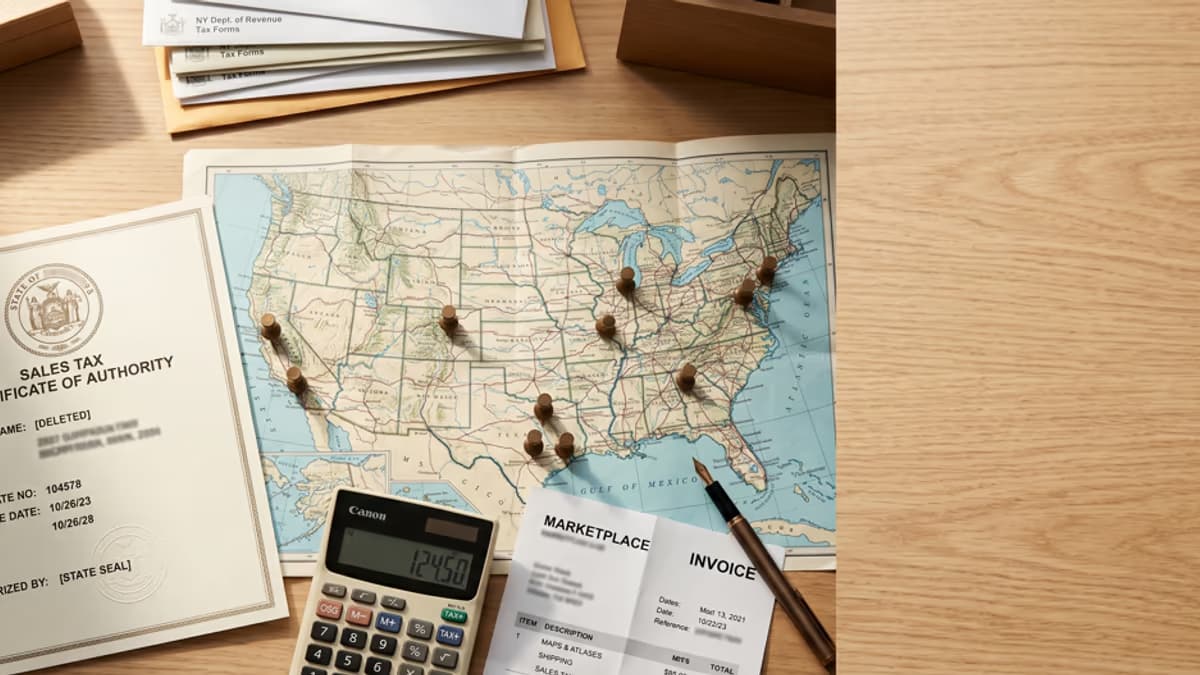
A handful of states still require the sales tax permit (called a Certificate of Authority in some states, a Sales Tax License in others) to be physically posted at the business location. The requirement is a holdover from the era when sales tax permits applied primarily to brick-and-mortar retailers, and it is being phased out in most states, but a few still enforce it.
- New York. Sales Tax Certificate of Authority must be posted at the place of business. Physical sign at the address, viewable by the public during business hours.
- California. Seller's Permit must be displayed at each location where sales are made.
- Florida. Certificate of Registration (Form DR-11) must be displayed in a clearly visible place at the business location. The separate Annual Resale Certificate (DR-13) is for tax-exempt purchases by registered dealers and is not the display document.
- Texas. Sales Tax Permit must be displayed prominently at the place of business. No save office address here; it is listed because founders who operate from Texas ask about it.
The practical handling at a virtual office is to ask the provider, in writing, what it will actually do with a permit you send it. Some sites will hold a copy and produce it on request; others handle mail and nothing else. save office sells an address and mail handling, so treat on-site display as something to confirm with us case by case rather than as something the plan already includes. The display requirement is rarely enforced for online-only businesses with no walk-in customer traffic, but the documentation has to be in place in case a state inspector visits the address.
Local versus state: cities and counties with separate permits
Most states have a single state-level sales tax permit. A few have an additional local layer where cities or counties impose separate sales tax obligations with separate registration.
- Colorado, Louisiana, Alabama, Alaska. Home-rule states where cities and counties have independent sales tax authority. An LLC selling into multiple cities in these states often needs separate local permits in addition to the state-level permit.
- California (limited). Most California sales tax is collected at the state level through the CDTFA, but a few cities (San Francisco, Oakland) have additional business tax registration that overlaps with sales tax.
- New York City. The city does not have a separate sales tax permit, but NYC adds a separate business income tax registration on top of the state-level Certificate of Authority. The combined effect is that an NYC-located LLC files two registrations, even though only one is for sales tax.
Sales tax software handles the local rates automatically
The local layer adds complexity for multi-city operators. Sales tax software (TaxJar, Avalara) handles the rate calculation across local jurisdictions, but the permits themselves still have to be filed manually with each city or county that requires one. For most save office tenants, the city-level layer is limited to whichever state the tenant has nexus in, since the marketplace facilitator law absorbs the local sales tax obligations on platform sales.
Where save office fits the sales tax permit workflow
A save office address carries a USPS commercial classification, comes with a license agreement naming the LLC as the licensee. Those are the two things the permit applications in this guide ask an address to produce. Whether a given Department of Revenue accepts a given address is that agency's call, and the display step in New York, California, and Florida is a separate arrangement that the address by itself does not cover.
save office operates commercial-classified addresses across its US cities (New York, San Francisco, Wilmington Delaware, Cheyenne Wyoming, Tampa Florida, and Washington DC) and issues the license agreement that a flagged permit application usually asks for. The companion guide on marketplace seller addresses covers the Amazon FBA inventory question and the marketplace facilitator law shift, and the foreign qualification guide covers the parallel Secretary of State registration that runs alongside the sales tax permit in every state where the LLC has physical nexus. The address-checker tool flags whether a current or proposed address has the commercial USPS classification that the sales tax permit application asks for.
Frequently Asked Questions
Not sure what you need?
Two short pages sort it out — what the products actually are, and which situation you're in.