Short answer
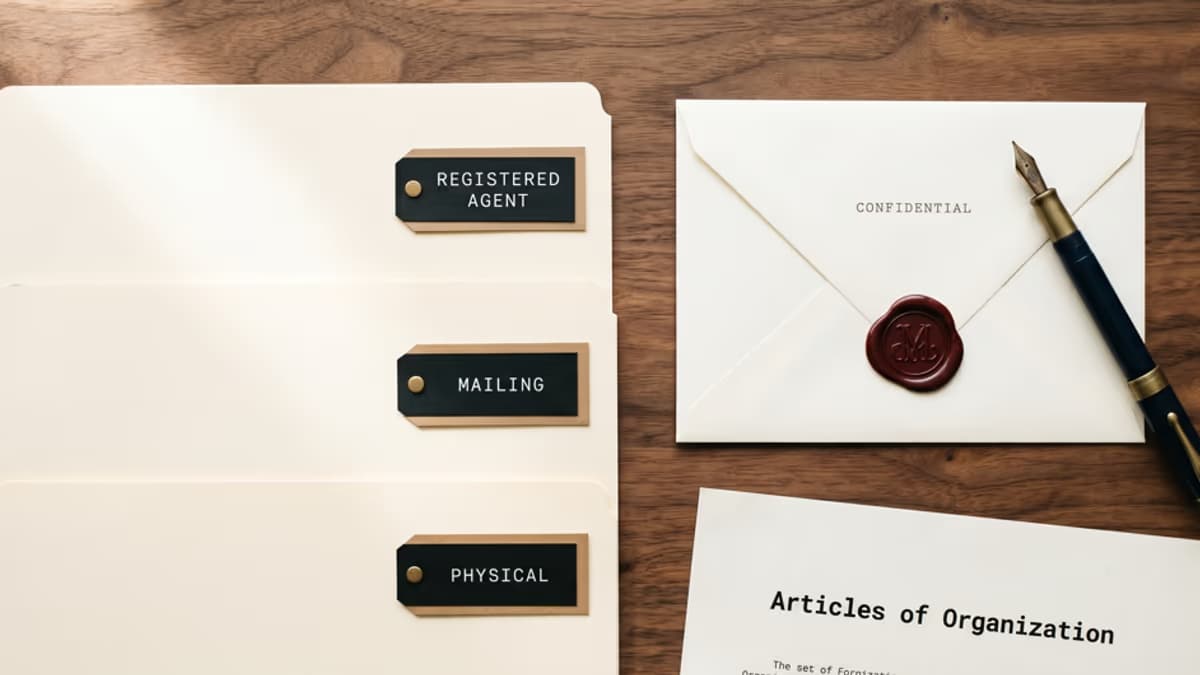
A business address is the address a business uses as its location or contact point on filings, accounts, and public listings. One company can have more than one, such as a mailing address, a principal office, and a registered agent address. Each line on a form has its own rules, so read the label before you enter an address.
Key takeaways
- A business address is the address a business uses as its location or contact point on filings, accounts, and public listings. One company can have more than one.
- California’s Form LLC-12 has an item called “Business Addresses” with separate lines for the principal office and the mailing address. The IRS separates a “business mailing address” from a “business location” on Form 8822-B.
- PO Box rules depend on the line. The mailing line on IRS Form SS-4 lists a “P.O. box.” The instructions for the street address line say “Don’t enter a P.O. box number here.”
- A home can be a business location if you run the business from it. IRS Publication 587, which covers the business use of a home, says “You can have more than one business location, including your home, for a single trade or business.” The Small Business Administration says zoning ordinances can still apply to home-based businesses.
- State filings can make an address public. California’s Form LLC-12 instructions say the agent’s name and street address are “a public record, open to all (as are all the addresses of the LLC provided in filings).”
What is a business address?
A business address is the address a business uses as its location or contact point on filings, accounts, and public listings. One company can have more than one, such as a mailing address, a principal office, and a registered agent address.
California’s Statement of Information for LLCs, Form LLC-12, shows how the term splits. Its Item 4 is titled “Business Addresses,” in the plural. The item has separate lines for the “Street Address of Principal Office” and the “Mailing Address of LLC.”
The IRS makes the same split. Form 8822-B is for telling the IRS that “you changed your business mailing address, your business location, or the identity of your responsible party.”
So the useful question on any form is what the line is for. A mailing line asks where letters should go. A location line asks where the business is. A registered agent line asks where legal papers can be delivered. Our guide to mailing address vs physical address looks closer at the first two.
Did this answer your question?
What is an example of a business address?
A business address looks like any other US address. A street address has a street number and name, an optional suite or room, a city, a state, and a ZIP code. IRS Form SS-4 lists the parts of its mailing line this way: “Mailing address (room, apt., suite no. and street, or P.O. box).”
Here are made-up examples. Each one shows a different kind of business address.
- Office or shop: 123 Main Street, Suite 200, Anytown, CA 90000. The company works from this space, so this address describes where the business is.
- Home office: 45 Oak Court, Anytown, CA 90000. The owner runs the company from home, so the home is the business location.
- PO Box: PO Box 100, Anytown, CA 90000. The company collects letters from this box, so this address can go on a mailing line that allows a P.O. box.
- Registered agent: 500 Center Avenue, Anytown, CA 90000. The agent named by the company accepts legal papers here.
Ready to set up your business address?
See which US cities fit — about a minute, no card needed.
What are the main types of business address?
Forms use different words for the place where a business is located. Form SS-4 says “street address.” California says “principal office.” Form 8822-B says “business location.” Our guide to the principal office address explains that label.
The table below gives real examples from government forms and from Google. Read each row on its own, because a rule on one form may not apply to another form or another state.
| Address type and example form | What it is for | Who sees it | Can it be a PO Box? |
|---|---|---|---|
| Mailing address: IRS Form SS-4, line 4a | Where the IRS writes to you. The instructions say to enter “the mailing address for the entity’s correspondence.” | The IRS, because you file the form with the IRS. | Yes on this form. The line reads “Mailing address (room, apt., suite no. and street, or P.O. box).” |
| Mailing address: California Form LLC-12, Item 4b | The instructions say “This address will be used for mailing purposes.” | Anyone. The instructions say all the addresses of the LLC provided in filings are a public record. | Yes on this form. The instructions say it “may be a P.O. Box address or “in care of” an individual or entity.” |
| Street address: IRS Form SS-4, line 5a | The physical address of the entity, if it is different from the mailing address. | The IRS, because you file the form with the IRS. | No. The instructions say “Don’t enter a P.O. box number here.” |
| Principal office: California Form LLC-12, Item 4a | The LLC’s principal office. The instructions say “Address must be a physical address.” | Anyone. The instructions say all the addresses of the LLC provided in filings are a public record. | No. The line says “Do not list a P.O. Box.” |
| Registered agent address: California Form LLC-12, Item 6b | The street address of an individual agent for service of process. Service of process means the formal delivery of court papers. | Anyone. The instructions call it “a public record, open to all.” | No. The line says “Do not enter a P.O. Box.” |
| Listing address: Google Business Profile | Shows customers your business location. Google says to use “a precise, accurate address and/or service area.” | People who see your profile on Google, if the address is shown. | No. Google says “P.O. boxes or mailboxes located at remote locations aren’t acceptable.” |
Wording quoted from each form or page as read on November 7, 2026.
What do I put for my business address?
Read the exact label first, then read the form’s instructions. Each label asks a different question, so use the steps below to match your answer to the label.
- 1“Mailing address.” Enter a place where you will receive letters. The Form SS-4 instructions add that “Generally, this address will be used on all tax returns.”
- 2“Street address,” “physical address,” or “principal office.” Enter the physical location of the business. Line 6 of Form SS-4 asks for the county and state, and the instructions say “Enter the entity’s primary physical location.”
- 3“Registered agent” or “registered office.” Enter the address of the agent you named. If you hired an agent company, ask it what to enter. California Form LLC-12 takes a registered corporate agent by name only, in Item 6c.
- 4Only “business address.” Look for instructions near the line. If there are none, ask the agency or company what it will use the address for. Then follow the matching step above.
State forms can differ from these examples. Texas says the initial mailing address on its LLC certificate of formation “may be a post office box or street address.” Texas also says the registered office “must be located at a street address where service of process may be personally served on the entity’s registered agent during normal business hours.” Our guide to registered agent address vs business address compares those two lines.
If the entity’s mailing address is outside the United States, Form SS-4 asks for more detail. The instructions say “you must enter the city, province or state, postal code, and the name of the country.”
If an address changes later, tell each agency that holds it. For the IRS, use Form 8822-B. The form warns that if you fail to give the IRS your current mailing address, “you may not receive a notice of deficiency or a notice of demand for tax.” Both notices are IRS letters about tax you may owe.
Can a business address be your home?
Yes, a home can be a business location if you run the business from it. IRS Publication 587, which covers the business use of a home, says “You can have more than one business location, including your home, for a single trade or business.” The home office deduction has its own tests, so listing your home as an address does not qualify you for it.
California’s Form LLC-12 also names a home directly. Item 5 asks for the “complete business or residential address” of each manager, or of each member if no manager was appointed.
Local rules can still limit what you do at home. The Small Business Administration (SBA) says “zoning ordinances can still apply even to home-based businesses.” It tells owners to check with their “department of city planning, or similar office.”
What becomes public if you use a home address?
A state filing can make your home address public. California is one example. The Form LLC-12 instructions say “The individual agent should be aware that the name and the physical street address of the agent for service of process is a public record, open to all (as are all the addresses of the LLC provided in filings).”
So in California, a home address you give as an address of the LLC in a filing is open to all. The same is true if you name yourself as the agent and enter your home on the agent line.
What a state shows can differ. The Delaware Division of Corporations says the information in its free online search “includes the entity name, file number, incorporation/formation date, registered agent name, address and phone number along with the entity kind, type, and residency.” Check what your own state publishes before you file.
Each line is separate, so one choice does not decide the others. On Form LLC-12, the mailing line may be a P.O. Box, but the principal office line must be a physical address. A registered corporate agent goes in by name only, but that choice does not change the principal office line.
Public listings have their own rules. Google tells service-area businesses to hide the address. Its example says “if you’re a plumber and run your business from your residential address, clear the address from your Business Profile.”
What about a virtual business address?
A virtual business address is a street address you use through a company that receives mail for you. Our guide to virtual business addresses explains the service.
Whether one fits a line depends on that line’s own rules. Some rules name virtual addresses directly. Wyoming’s Secretary of State says “Post office boxes, drop boxes, virtual addresses, mail forwarding locations, UPS or FedEx stores do not qualify as an acceptable registered office address.” Google says “If your business rents a physical mailing address but doesn’t operate out of that location, also known as a virtual office, that location isn’t eligible for a Business Profile.” The same page says service-area businesses can’t list a “virtual” office “unless that office is staffed during business hours.”
Those limits apply to any virtual address, including addresses from save office. For other lines, read the form’s instructions and ask the agency if the wording is not clear.
A mail service is one way to receive general business mail at a separate address. Our Silicon Valley and Los Angeles pages describe the business addresses save office offers.
Not legal or tax advice
This guide summarizes IRS Forms SS-4 and 8822-B, IRS Publication 587, California Form LLC-12, and pages from the Texas, Wyoming, and Delaware filing offices, the SBA, and Google, as read on November 7, 2026. Forms and rules can change, and other states use other labels. Check the current form before you file, and ask an attorney or tax professional about your business.
Frequently Asked Questions
Sources & References
Primary sources this guide is based on.
- 1Internal Revenue Service · Instructions for Form SS-4 (accessed November 7, 2026)
- 2Internal Revenue Service · Form SS-4 (Rev. December 2025), Application for Employer Identification Number (accessed November 7, 2026)
- 3Internal Revenue Service · Form 8822-B, Change of Address or Responsible Party, Business (accessed November 7, 2026)
- 4Internal Revenue Service · Publication 587 (2025), Business Use of Your Home (accessed November 7, 2026)
- 5California Secretary of State · Statement of Information (Form LLC-12) and Instructions (accessed November 7, 2026)
- 6Texas Secretary of State · Form 205 Instructions, Certificate of Formation, Limited Liability Company (accessed November 7, 2026)
- 7Wyoming Secretary of State · Registered Agents and Offices FAQs (accessed November 7, 2026)
- 8Delaware Division of Corporations · Frequently Asked Questions (accessed November 7, 2026)
- 9U.S. Small Business Administration · Pick your business location (accessed November 7, 2026)
- 10Google Business Profile Help · Guidelines for representing your business on Google (accessed November 7, 2026)
Not sure what you need?
Two short pages sort it out — what the products actually are, and which situation you're in.

save office
Published
I'm Henry, a hedgehog in a bow tie who explains the dull, scary parts of building and running a U.S. business.