Key takeaways
- Most LLCs carry three address slots: registered agent (state legal service), mailing (IRS and bank correspondence), and physical (operations and licensing). New York is the notable exception on the first one, since it routes service through the Secretary of State instead.
- All three can be different addresses, but the registered agent must be a state resident or registered service in the formation state.
- A CMRA registration is required of any service that receives mail on behalf of others, and the flag in address data is that registration recorded. The consequence it carries is that the operator holds a Form 1583 identity record for the customer, which makes the flag a document request signal rather than a rule in itself. Some banks do exclude the service category by name, which is a separate rule from the flag.
Who this is for
- Founders confused about which address goes on which form.
- Operators consolidating or splitting the LLC's address slots.
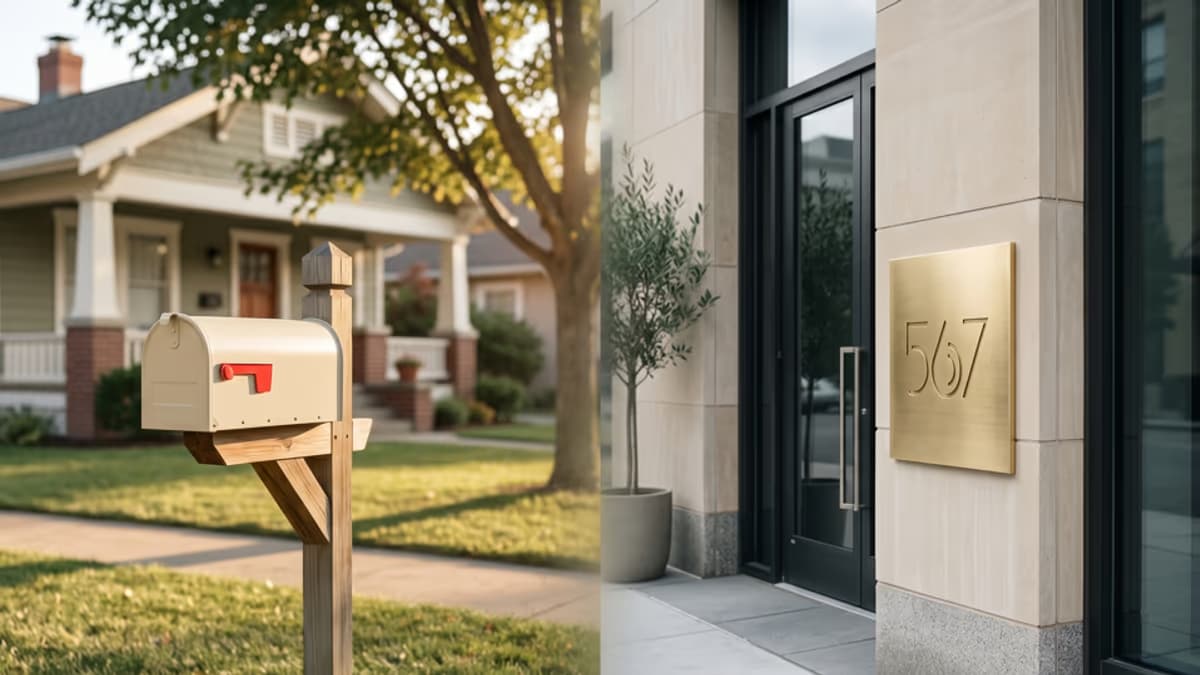
Most US LLCs have three address slots that look similar but do different jobs. The registered agent address receives legal documents. The mailing address collects physical mail. The physical address is where the business operates. Mixing them up can stall a bank application or an IRS form for weeks. And a fourth word, commercial, sits alongside the three without being a slot at all.
Setting up your LLC? See your US address options — no card →
Why Three Addresses Instead of One
Each of the three addresses exists to satisfy a different system. The registered agent address satisfies state law on service of process, the legal procedure for delivering lawsuits and government notices. The mailing address satisfies USPS delivery rules so a real human or mailbox can sign for and receive parcels. The physical address satisfies the IRS, banks, and payment processors that need to confirm the business has a real principal place of operation.
These three systems do not talk to each other much. The state Secretary of State (SOS) does not care where you actually do business, only that the registered agent slot is staffed. The IRS does not care where your mail goes, only that the physical address is real. The bank wants every slot filled and the data to match what is already on record at the SOS. That mismatch is one of the most common causes of bank application holds.
All three slots can be different addresses
The three slots do not have to be three addresses. In practice, a remote founder might use a Wilmington Delaware registered agent, a Tampa virtual office for mailing, and the Tampa virtual office again as the physical address. Three slots, two addresses, no conflict.
Registered Agent Address: The Legal Mailbox
The registered agent is the person or service designated to accept legal documents for the LLC. That includes service of process, the formal delivery of a lawsuit, plus tax notices, annual report reminders, and any other state correspondence that must reach a real human within business hours.
Most states require this slot, New York being the exception that routes process through the Secretary of State instead. Where it applies, the address must be a physical street address inside the state of formation, a P.O. box does not qualify, and someone has to be available there during normal business hours to sign for documents. Miss a delivery and the LLC can face a default judgment in court or get administratively dissolved by the state.
One thing to check before naming anyone: some states name mail services in this slot directly. Wyoming's own guidance says the agent address cannot be a PO box, drop box, mail forwarding service or UPS store, and Texas says a registered office cannot solely be the address of a mailbox service. That rule lives in the state agent requirements, not in the postal record, so read the state's own agent rules rather than inferring it from how an address is classified.
- Required by: most US states, on the LLC formation document. New York is the exception, where the Secretary of State is your agent by statute and naming your own is optional
- Acceptable formats: physical street address inside the state of formation only
- Who sees it: the state, courts, attorneys, anyone who pulls the public LLC filing
- Where it appears: Articles of Organization or Certificate of Formation, annual reports
- Typical cost: $100-300 per year for a professional service
Ready to set up your business address?
See which US cities fit — about a minute, no card needed.
Mailing Address: Where Physical Mail Arrives
The mailing address is the USPS-deliverable address where the business actually receives physical mail, packages, debit cards, and tax forms. It is the slot most people picture when they think of a business address, but it is also the slot with the most flexibility.
The mailing address can be a P.O. box, a virtual office, a home address, or a separate forwarding service. Banks differ here. Mercury requires a physical, USPS-deliverable address even for the mailing slot, which a street address with a mailbox designation satisfies and a P.O. box does not. The IRS treats the mailing address as the destination for refund checks, notices, and correspondence, and it can be updated independently of the physical address using Form 8822-B.
- Required by: USPS, banks, vendors, the IRS for correspondence
- Acceptable formats: P.O. box, virtual office, home address, mail forwarding service
- Who sees it: USPS carriers, vendors, anyone sending physical mail
- Where it appears: bank applications, vendor forms, IRS Form 8822-B for changes
- Typical cost: free for a home address, monthly fee for a virtual mail service (see pricing comparison)
Physical Address: The Real Place of Business
The physical address is the slot the IRS calls the principal place of business. It is the address that says the business has a real footprint, a building someone could walk into, with a suite number tied to a real lease, mail service agreement, or ownership record. This is the strictest of the three slots.
Banks verify this slot the hardest. Most fintech business banks (Mercury, Relay, Bluevine, and others) run automated Know Your Customer (KYC) checks that pull the address through USPS data and third-party verification services. A P.O. box gets rejected at this slot. A residential address can clear, but it leaks the home address into public business records. A commercial street address with a suite number is the format this slot expects.
- Required by: the IRS on Form SS-4 and tax returns, banks for KYC, payment processors, Google Business Profile, insurance providers
- Acceptable formats: real commercial street address with a suite number, sometimes a residential street address
- Who sees it: the IRS, banks, payment processors, customers searching the business online
- Where it appears: EIN application, business bank account, Stripe and PayPal onboarding, Google Business Profile, insurance applications
- Typical cost: free for a home address, $50-200 per month for a virtual office, or $500 per month and up for a traditional commercial lease (depending on city, square footage, and amenities)
Where Each Address Goes: A Form-by-Form Map
The cleanest way to think about the three slots is to look at which form or system asks for what. The same business will fill out a different combination on each one.
| Form or system | Registered agent | Mailing | Physical |
|---|---|---|---|
| Articles of Organization (state SOS) | Required | Optional, varies by state | Varies by state: some ask for a principal office, Delaware asks only for the registered office |
| EIN application (IRS Form SS-4) | Not required | Required | Required as principal business address |
| Business bank account (Mercury, Relay, Bluevine) | Cross-checked from state record | Required for cards and statements | Required, must match state filing |
| State annual report | Required | Sometimes required | Required |
| IRS tax returns (1120, 1065, 1040 Schedule C) | Not required | Required for correspondence | Required as principal place of business |
| Stripe and PayPal onboarding | Not required | Optional | Required, appears on customer receipts |
| Google Business Profile | Not required | Not required | Required, postcard verification |
| State business license or seller's permit | Sometimes required | Sometimes required | Required |
| Commercial insurance application | Not required | Optional | Required, location underwriting |
Which address slot belongs in which form or system.
Match the physical address character for character
Banks compare the physical address on the application against what the SOS has on file letter by letter. 'Suite 200' and 'Ste 200' can trigger a manual review at some KYC providers. Always copy the address exactly as it appears on the state filing.
The Fourth Word Is Not a Slot
Three of the terms in this article are slots. Registered agent, mailing, and physical all answer the same kind of question: which line of which form does this address go on. The fourth term founders keep meeting, commercial, does not answer that question at all. It is not one thing either.
Two different things get shortened to commercial
One is how postal data classifies the building: commercial or residential. The other is a CMRA record, short for Commercial Mail Receiving Agency, which says the address belongs to a service that receives mail on behalf of other people. Those are separate axes. A single address can carry both, one, or neither, and a commercial building is not automatically a CMRA. Neither of them is a slot. Both travel with the address into whichever slot you put it in.
Start with what the service is. A virtual office receives and handles mail on behalf of other businesses. That is not a side feature of it. That is the service. USPS rules require any service that does this to register as a Commercial Mail Receiving Agency. Registration is not optional for that kind of operator. The definition turns on the service, and the flag is a separate thing: a record in postal data. An operator can meet the definition without the address showing the flag, which is why the flag tells you about the record rather than about the whole arrangement.
So read the tag for what it says. An address carrying a CMRA flag is an address whose operator is registered to handle mail for other people, which is what the rules require of anyone doing that work. The flag is closer to a sign of compliance with the mail-handling rules than to evidence against the address. It reads like a warning and is not one.
What the registration comes with
Registration brings a duty that matters to you as the customer: the operator holds a Form 1583 identity record for each person it receives mail for. That record is the reason the arrangement is auditable in the first place. When a reviewer takes an interest in the flag, the flag is pointing at that paperwork, and the paperwork is what answers the question. Separately from the flag, some companies exclude the service category by name rather than reading any classification, and that is a different rule to check. It is a rule about what kind of service an address belongs to, not a reading of the record.
Which is why a virtual address carries most of the address work a new LLC actually files. These three are the places founders ask about most, and they are places it is accepted.
- A bank's mailing address
- The LLC registration address in most states, though Oregon excludes a commercial mail receiving agency, a mail forwarding business and a virtual office from its definition of principal office by name
- The IRS business address
The same three documents cover all of them, and they work as a set rather than one document per review: the mail service agreement, the Form 1583 the operator holds, and an address confirmation letter.
Those three documents are not the same kind of thing, and it is worth keeping them apart. Holding the Form 1583 is a USPS requirement placed on the operator. The mail service agreement and the address confirmation letter are documents a competent provider supplies on request. Ask for all three before you sign up. A service that receives mail for customers should be able to produce each one.
At a bank, the field matters more than the flag
That list starts with a bank's mailing address. Banks collect a mailing address and a customer identification address separately, and the federal rule at 31 CFR 1020.220 asks, for a company, for a principal place of business, local office, or other physical location in the identification field. Read those two fields as one and that line stops being true.
Common Mistakes That Mix Up the Three Slots
- 1(1) Putting the three slots and the classification in one list and trying to pick between them. Registered agent, mailing, and physical are slots you choose between. Commercial is not a choice. It is two records that travel with whichever address you pick. Mistake (6) below is the same error in a different place.
- 2(2) Listing the registered agent address as the physical business address on a bank application. Registered agent services differ on this. Northwest markets a business address as something you can use, while others restrict their address to service of process, so read the specific agreement. Banks can also recognize known registered agent addresses and flag the application.
- 3(3) Putting a P.O. box where the physical slot is required. The IRS bars a P.O. box on lines 5a-5b of Form SS-4. Separately, the federal customer identification rule at 31 CFR 1020.220 asks a bank for a company's principal place of business, local office, or other physical location in its identification field, which is why banks keep that field apart from the mailing address they will send statements to.
- 4(4) Listing the home address as physical, then realizing it is now searchable on the state LLC database for the long term. In most states, old filings remain in the public record even after an address change.
- 5(5) Mismatching addresses between the state filing and the bank application. Update the state first, wait for the change to process, then apply to the bank. The reverse order typically triggers a verification hold.
- 6(6) Reading a CMRA flag as a verdict rather than as a document request. It usually clears with the right paperwork, and the paperwork is the point: the founder who cannot produce the mail service agreement, the operator's Form 1583, or an address confirmation letter is the one who sits in manual review.
Checklist: Map the Three Slots Before You File
Run this checklist before any new state filing, EIN application, or bank application. Each step takes under a minute, and catching a mismatch here is what separates same-day approval from a multi-week hold.
- (1) Registered agent slot: a physical street address inside the state of formation, with someone available during business hours. Confirm the agent will forward documents promptly.
- (2) Mailing slot: USPS-deliverable, with a clear plan for how mail reaches the founder. Scanning, forwarding, or in-person pickup.
- (3) Physical slot: a real building accepted as a principal business address. Check how the address is classified in postal data. Not to change the classification, which is not something you can file for, but so you know in advance whether a document request is likely.
- (4) If a mail service runs your mailing or physical address, have the three documents ready before you apply: the mail service agreement, the Form 1583 the operator holds, and an address confirmation letter.
- (5) Match the physical address character for character on the state filing, the EIN letter, and the bank application.
- (6) Keep a single source-of-truth document listing all three addresses, the forms each one appears on, and the next renewal date for each service.
How a Virtual Office Covers the Mailing and Physical Slots
A virtual office at a real commercial building fills both the mailing and physical slots from one address. The mailing slot is covered by on-site mail handling, scanning, and forwarding. The physical slot is where providers differ. Mercury and Relay both publish that they do not accept a virtual or mailbox address in that field at all. The IRS publishes no such exclusion on Form SS-4, and most state LLC filings do not either. Check the specific reviewer's published rule before you rely on one address for both slots.
The registered agent slot is a separate service in most cases, since it has to be inside the state of formation. Some founders pair a Delaware or Wyoming registered agent with a virtual office in a different state where they actually operate, which is the most common setup for remote LLCs.
save office supplies the documents these reviews ask for, the mail service agreement and an address confirmation letter. Where a mail operator handles your mail, it is also required to keep a Form 1583 identity record for you. Run any address through the save office address checker first to see how it is classified in postal data, on both axes, before it goes on a single form.
Frequently Asked Questions
Not sure what you need?
Two short pages sort it out — what the products actually are, and which situation you're in.
Watch this in 60 seconds
Henry covers the same ground on video.