Short answer
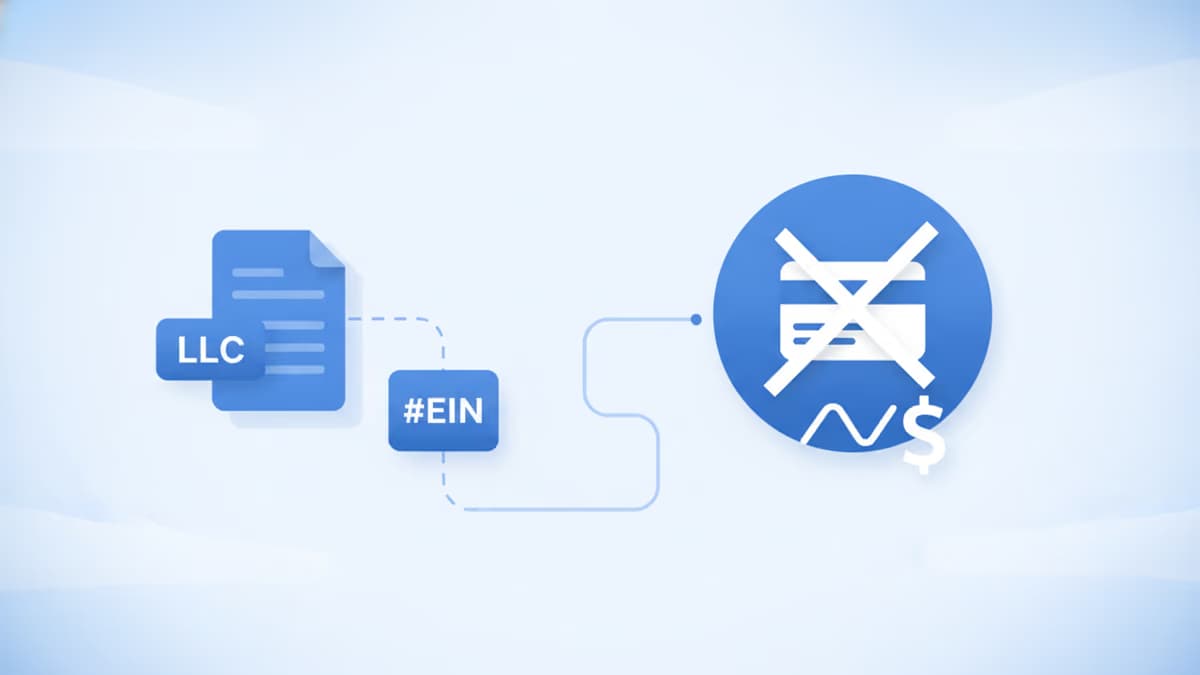
For most Stripe accounts registered as a US business, payouts are expected to land in a bank account that can accept a US domestic transfer. An LLC and an EIN prove the business exists, but they do not give Stripe anywhere to send the money, so without that account the balance stays inside Stripe. Before applying to a provider, confirm with Stripe support or with founders who have done it that the provider’s specific routing and account number will be accepted as a payout destination, and apply to two or three providers in parallel rather than betting on one.
Key takeaways
- An LLC and an EIN (Employer Identification Number) prove the business exists on paper. Getting paid needs a bank, and banks care about geography.
- Stripe holds what your customers pay and sends it on a schedule to the account you connect. For a Stripe account registered as a US business, that is generally a US bank account that can receive a domestic transfer.
- A business account, a prepaid card, and an e-money wallet can sound alike in marketing and behave very differently as a payout destination.
- The question to ask before applying anywhere is whether your processor will accept that provider’s specific routing and account number for a payout.
- Eligibility for non-residents changes by provider and by country, so run two or three applications in parallel and plan for weeks of slack.
The same puzzle shows up every few weeks
Every few weeks, someone posts a version of the same puzzle in a small business forum. A Wyoming LLC, filed correctly. An EIN from the IRS, issued and confirmed. A real product, real customers lined up, sometimes even a Stripe account already approved. And then, at the very last step, nothing moves, because there’s no US bank account behind it, and every neobank they try turns out to have a residency requirement, an unsupported country, or a waitlist. Mercury wants existing or planned US operations and turns away founders living in certain countries. Relay wants a physical US address for every owner. Wise won’t issue USD account details to anyone whose address is in certain countries. Airwallex is “in review.” The business is real. The money has nowhere to land.
It’s worth sitting with why this happens, because the instinct is to treat it as one more form to fill out, and it isn’t.
Why an LLC and an EIN are not a payout rail
An LLC and an EIN prove your business exists on paper. The IRS doesn’t ask where you sleep or which passport you carry. It just wants a legal entity and a taxpayer ID, and both of those can be assembled in a few days by someone who has never set foot in the country. Getting paid asks for something else entirely. It asks for a bank, and banks care very much about geography.
Here’s the mechanism, stripped down: Stripe collects the customer’s payment, holds it, and then batches it out on a schedule to whatever account you’ve connected. For a Stripe account registered as a US business, that receiving account generally has to be a US bank account able to accept a domestic transfer. No account, no payout: the balance just sits inside Stripe, technically yours, practically untouchable. This is the part the LLC formation guides skip, because forming the company and connecting a bank account used to be treated as the same afternoon of work. For a founder without US residency, they’re two separate problems with two separate approval processes, and the second one is the one nobody controls.
Which accounts a payment processor will actually pay out to
This is also where a name like Elevate Pay enters the picture, and where the real question hides. A business account, a prepaid card, an e-money wallet: the marketing language on most of these products sounds interchangeable, and it isn’t. Some of them hand you a genuine US routing and account number that can receive an ACH transfer, which is exactly what a payment processor is looking for. Others give you a card number or a wallet balance that a processor may not accept as a standard payout destination, no matter how the sign-up page describes it. The question that actually matters, before applying anywhere, isn’t whether a provider calls itself a business account. It’s whether Stripe (or whichever processor you’re using) will accept that specific routing and account number for a payout. That’s usually confirmed one of two ways: directly with Stripe support, or by finding other founders who’ve already made the exact combination work.
Ready to set up your business address?
See which US cities fit — about a minute, no card needed.
Run two or three applications in parallel
None of this is really about finding the one magic provider. It’s a search problem with a moving target, because eligibility rules for non-residents change by provider and by country faster than any single blog post can track. The realistic move is running two or three applications in parallel (a US-focused neobank, a multi-currency account, a regional EMI) and building weeks of slack into your plan instead of assuming the first approval lands. The founders who get stuck for months are usually the ones who bet everything on one application and treated the LLC filing as the hard part.
It isn’t. Forming a US company from anywhere in the world takes a few days and a few hundred dollars now. Getting a US institution to actually hold your money for you can take considerably longer, and depends on a passport you didn’t choose. That gap, not the paperwork, is the real product problem in this corner of the internet right now.
Not legal or tax advice
Confirm your specific setup with a CPA or the payment provider’s compliance team before relying on any of this.
Frequently Asked Questions
Sources & References
Primary sources this guide is based on.
- 1Stripe · Receive payouts (accessed September 29, 2026)
- 2Stripe · Requirements for having a US Stripe account (accessed September 29, 2026)
- 3Stripe · Requirements to open a Stripe account in another country (accessed September 29, 2026)
- 4Mercury · Eligibility and requirements for opening a Mercury account (accessed September 29, 2026)
- 5Relay · Required Documents to Open a Relay Account by Entity Type (accessed September 29, 2026)
- 6Wise · Can I get USD account details? (accessed September 29, 2026)
- 7IRS · Instructions for Form SS-4 (accessed September 29, 2026)
Not sure what you need?
Two short pages sort it out — what the products actually are, and which situation you're in.

save office
Published
I'm Henry, a hedgehog in a bow tie who explains the dull, scary parts of building and running a U.S. business.