Key takeaways
- ITIN passes IRS identification, but banks run separate KYC under the Bank Secrecy Act. Whether the LLC opens an account depends on the specific bank's policy on ITIN-only individuals, not on the ITIN itself.
- Mercury, Relay, and Bluevine each accept ITIN-only applicants under different conditions tied to the LLC's formation state, the owner's country of residence, and the address attached to the application. Branch banks (Chase, Wells Fargo, Bank of America) are inconsistent and depend on the local branch's training.
- The four documents every ITIN-only application needs are the ITIN assignment letter (CP565), the passport, the EIN confirmation (CP 575 or 147C), and a real US business address that passes USPS Delivery Point Validation. A weak address breaks the application before the ITIN is even read.
Before you start
- Confirm the ITIN was issued or last used on a US tax return within the past three calendar years, since an inactive ITIN under IRS Notice 2016-48 fails the bank's identity match.
- Confirm the LLC has its own EIN assigned in the LLC's name with the foreign owner listed as the responsible party, since an EIN tied to the owner's prior business creates a KYC mismatch.
- Confirm the LLC's principal business address on the state filing matches the address that will be entered on the bank application, since a mismatch between Secretary of State and bank record triggers a manual review.
Who this is for
- Foreign founders who already received an ITIN and are now opening a US business bank account for the LLC.
- Non-resident LLC owners who were rejected by one US bank and want to know which other banks accept ITIN-only applicants.
- Multi-member LLCs with at least one non-resident member who holds an ITIN but no SSN.
Get set up
Get a business address for your LLC
See which US cities fit your LLC. Takes about a minute — no card to start.
An ITIN gets a foreign owner past the IRS, but US banks decide separately. The Bank Secrecy Act requires each bank to run its own Know Your Customer (KYC) check, and the bank's internal policy controls whether an ITIN-only applicant passes the customer identification program. Mercury, Relay, and Bluevine accept ITIN-only owners under specific conditions; large branch banks are inconsistent. The decision rests on four documents and the address that anchors them.
How this guide differs from the ITIN application guide
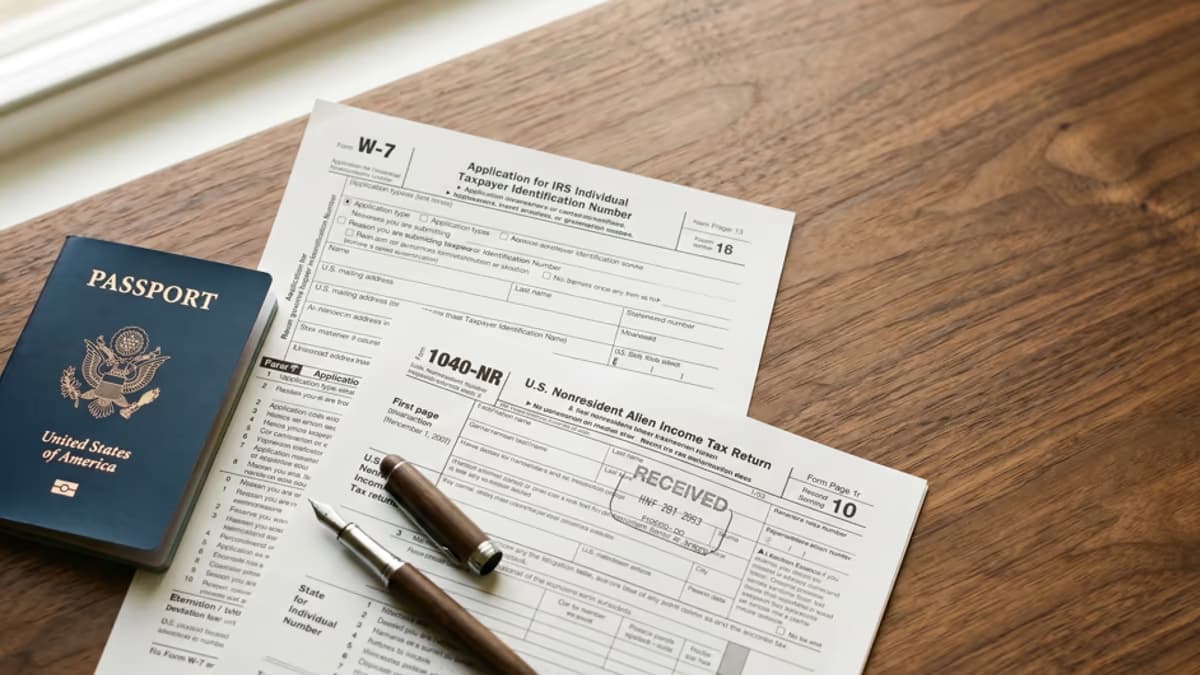
This guide is about the next step after the ITIN is in hand. The application itself, including Form W-7, the Certifying Acceptance Agent path, and the seven-to-fourteen-week processing window, is covered in the ITIN for non-resident LLC owners guide. A founder who has not yet applied for the ITIN should read that guide first.
The general business bank account address rules and the bank-by-bank field mapping are covered in business bank account address requirements. A foreign owner whose primary obstacle is a residential address rather than the ITIN should start there.
Recovery from a specific Stripe or Mercury KYC rejection is covered in Stripe Mercury KYC rejection address recovery. A founder who was already rejected should read that recovery sequence in addition to this guide.
Ready to set up your business address?
See which US cities fit — about a minute, no card needed.
Why banks ask about ITIN before SSN
The Bank Secrecy Act of 1970, as amended, requires every US financial institution to verify the identity of each customer and to keep that record on file, and a separate rule adds the individuals behind a legal entity. The customer identification program rule is 31 CFR 1020.220, and it does not require a specific tax identification number. For a non-US person it accepts a taxpayer identification number, or a passport number and country of issuance, or an alien identification card number, or another government-issued document evidencing nationality or residence. A passport plus an ITIN can satisfy the rule when the bank's internal policy accepts that combination.
Whether a bank accepts that combination is a business decision. Most fintech-backed business banks built their KYC platform around foreign founders and accept ITIN plus passport plus EIN. Most large retail branch banks built their KYC platform around SSN-holders and treat ITIN-only applicants as exceptions that require additional review. Neither is a legal failure of the ITIN; it is a difference in how the bank scaled its identity program.
ITIN is not an inferior SSN
Some founders assume the ITIN ranks below the SSN in the bank's eyes. From a regulatory perspective the ITIN and SSN both serve as taxpayer identifying numbers under IRC §6109. The difference at the bank is operational, not legal. A bank that says no to an ITIN-only applicant is choosing not to onboard, not declaring the ITIN invalid.
The four-document checklist every ITIN-only application needs
Every US business bank account application from an ITIN-only foreign owner needs four documents, in addition to the LLC formation documents. A missing or weak document on any one of these four rows usually ends the application before the bank reads the other three.
| Document | Source | What banks check | Common failure |
|---|---|---|---|
| ITIN assignment letter (CP565) | IRS, mailed after Form W-7 approval | Letter matches the ITIN entered, owner name and address match passport | Owner kept the ITIN number but lost the letter; bank cannot verify |
| Passport | Owner's home country authority | Photo page matches the name on the LLC formation; passport not expired | Passport expired or close to expiration; bank declines until renewed |
| EIN confirmation (CP 575 or 147C) | IRS, sent after Form SS-4 approval | LLC name on the EIN letter matches the state filing; responsible party is the foreign owner | EIN was applied for using the wrong responsible party; the owner has to refile Form 8822-B |
| Real US business address | save office or comparable commercial provider | Address passes USPS Delivery Point Validation and carries the commercial classification; if it also carries the mail-receiving flag, Form 1583 and the mail service agreement are ready | Owner used a residential or PO Box address; bank flags for manual review or declines |
Four-document checklist for ITIN-only LLC banking onboarding.
The CP565 letter is the document most often lost. The IRS does not automatically reissue CP565, but a reissued letter (often labeled CP565A) can be requested by calling the IRS ITIN Unit. While waiting on the IRS, a recent US tax return that shows the ITIN works as evidence, since the bank's KYC will accept that as proof the ITIN is active.
The EIN letter is the second most common gap. A new LLC that opened the EIN application by fax under the no-SSN process (covered in the EIN without SSN guide) receives the CP 575 once. The IRS says that notice cannot be duplicated or recreated, so if the letter is lost you request a replacement. There are now three routes: an entity transcript, a digital CP575 downloadable from an IRS Business Tax Account, which the IRS states is the equivalent of Letter 147C, or a Letter 147C requested by phone. The digital route is worth trying first if you cannot easily call the US business line during its hours. Most banks accept either CP 575 or 147C as the EIN confirmation document.
What Mercury asks for during ITIN-only onboarding
Mercury is a fintech platform whose banking services are provided by partner banks, and its published eligibility page says you do not need to be a US citizen or resident to apply. Worth being precise here, because the internet is not: Mercury does not publish ITIN-specific guidance for business accounts. The only Mercury page that names ITINs covers Mercury Personal, which does not accept them, so treat ITIN handling on the business side as observed applicant practice rather than stated policy. The application is online, with a guided form that requests the LLC's EIN, the owner's ITIN or passport number, the principal business address, and an upload of the formation documents. Mercury's KYC partner runs the identity verification, and a manual review is triggered when any of the four documents above fail an automated check.
- LLC formation documents. Articles of Organization or Certificate of Formation, plus the Operating Agreement when the LLC is multi-member. Mercury wants a clean copy of the state-stamped filing, not the customer copy without the state seal.
- EIN confirmation. Mercury accepts CP 575 or 147C. The LLC name on the EIN letter must match the name on the formation documents, character-for-character.
- ITIN and passport. The ITIN goes on the owner's profile. The passport is uploaded as the identity document. Mercury's verification partner checks the passport against the owner's country of residence and the name on the ITIN.
- Principal business address. Mercury verifies the address against USPS records and publishes what it will not take. For the company legal address it excludes PO Boxes and virtual offices or workspaces, and says it makes no exceptions. For the company physical address it excludes a PO Box, a virtual address, a commercial mail receiving agency, a mail center, and a registered agent address. A verifiable residential address is accepted where the company has no office yet, which is the opposite of what most guides claim.
- Beneficial owner statement. Mercury asks each beneficial owner (any individual with 25% or more ownership) to confirm their tax residency, US tax obligations, and source of funds. That threshold comes from FinCEN's customer due diligence rule, 31 CFR 1010.230, which is a bank onboarding rule and not the same thing as the Corporate Transparency Act report filed to FinCEN.
Mercury's published policy supports founders from many countries, but the list of supported and unsupported countries changes. A founder in a country recently added to the OFAC sanctions list, or in a country Mercury has temporarily paused, sees a different result. The current supported-country list is on Mercury's onboarding pages, and a founder should confirm before starting the application.
How Relay and Bluevine compare to Mercury for ITIN-only applicants
Relay and Bluevine both offer business banking to LLCs and both have processes that have accommodated ITIN-only foreign owners. The acceptance is conditional and not as broadly published as Mercury's, and the experience differs from Mercury in how the manual review is handled.
| Bank | ITIN-only acceptance | Application channel | Typical timeline |
|---|---|---|---|
| Mercury | Published support for many countries; ITIN, passport, and EIN combination accepted on the standard flow | Online; manual review when automated KYC fails | Same-day approval is common when documents are clean; manual review adds three to ten business days |
| Relay | ITIN-only applicants are case-by-case; founders report success when LLC, EIN, and address are all on file with US records | Online; chat support handles edge cases | Two to five business days for clean applications; longer when the support team requests additional documents |
| Bluevine | Bluevine's application help page publishes no citizenship or ITIN rule either way, and says a personal SSN may be used when there is no EIN; ITIN-only non-resident applicants are commonly reported to fall outside its flow, so treat that as observed practice rather than a stated policy | Online; phone follow-up may be required | Outcomes vary; Mercury or Relay are the more common starting points for ITIN-only owners |
Mercury, Relay, and Bluevine compared for ITIN-only LLC banking. Policies change. Confirm with each bank's current onboarding documentation before applying.
A founder who has been rejected by one of these banks should not assume the other two will reject as well. Each bank uses a different KYC vendor and a different internal risk model. A rejection at Bluevine does not predict the outcome at Mercury, and a rejection at Mercury does not predict the outcome at Relay.
Why Chase, Wells Fargo, and Bank of America are difficult
The large retail branch banks are not a single decision. Chase, Wells Fargo, and Bank of America each have national policies, but the application is processed by a local branch, and the branch's experience with ITIN-only LLC owners varies. A branch in a metropolitan area with a large international population is more likely to handle the application without escalation, and a branch in a region with few foreign founders is more likely to ask for an SSN before completing the application.
- Chase opens business checking for LLCs in person at a branch. ITIN-only applicants are typically possible but not guaranteed; the deciding factor is whether the branch banker is trained on the foreign-owner exception or refers it to a manager who is.
- Wells Fargo opens business banking through a relationship banker. ITIN-only applicants are similarly case-by-case; the application sometimes routes to a back-office team that reviews foreign-owner documents.
- Bank of America opens business banking in person; ITIN-only acceptance is documented internally but inconsistently applied at branches without recent foreign-owner volume.
Branch banking is not impossible, but plan a backup
A foreign owner who needs a Chase or Wells Fargo account, for example to access a specific lending program, should call the branch ahead and ask whether they have opened ITIN-only LLC accounts in the past six months. A confirmed yes is worth the branch visit; an uncertain answer is a signal to open a Mercury or Relay account first and revisit the branch later when the LLC has a transaction history.
The ITIN expiration trap and how banks read it
An ITIN that is not used on a federal tax return for three consecutive years expires. The IRS published the rule in Notice 2016-48 and updated the expiration mechanism over the years. An expired ITIN does not legally invalidate the past tax filings, but it does fail the bank's KYC verification because the bank's data provider returns the ITIN as inactive.
Renewal is by filing Form W-7 with the renewal box checked, plus a certified passport copy. The renewal does not require a new tax return for the renewal year, but it requires a current passport. The IRS allows 7 weeks to notify you about the application, and 9 to 11 weeks during tax season, January 15 to April 30, or when you apply from overseas, which is the default case for most readers of this guide. A bank application that depends on a renewed ITIN should wait until the renewal letter arrives.
How a virtual office fills every banking address slot
The address is the variable foreign founders most often underestimate. The ITIN, the passport, and the EIN are objective documents that either exist or do not. The address is a choice the founder makes, and the choice determines whether the bank's automated KYC clears or routes to manual review. A residential address fails for many banks because residential properties do not match the bank's commercial business profile expectation. A PO Box fails because most US banks require a physical address. A free virtual mailbox often fails because the address flags as a Commercial Mail Receiving Agency in the bank's address-classification database.
A save office address is a real commercial street address with mail handling, and using one address consistently across the Articles of Organization, the EIN application, and the bank file is what the bank's risk model looks for. What it does not do is settle the platform question. Mercury's published rules exclude virtual offices from the legal address and exclude virtual addresses and commercial mail receiving agencies from the physical address, and that applies to our addresses the same as to anyone else's, so read the platform's own address page before you apply rather than after. The address is runnable through the free Address Checker beforehand, which tells you the USPS classification the bank will see.
- Delaware (Wilmington). Bank-accepted commercial address for LLCs formed in Delaware that operate remotely, including foreign-owned LLCs that file Form 5472.
- California (San Francisco). Useful for foreign founders building toward fundraising or platform partnerships in the West Coast tech corridor.
- New York. Aligned with Mercury and other fintechs' New York presence; useful when the LLC's billing or investor entity is also New York.
- Florida (Tampa). Useful for founders running e-commerce or import-export with a Florida nexus.
- Washington DC. Useful for federal-facing entities and founders who want a capital-city address on public filings.
- Wyoming (Cheyenne). Useful for asset-protection structures and low-cost annual compliance.
Checklist: documents and confirmations before you apply
- 1ITIN assignment letter (CP565) in hand, or a recent US tax return that shows the ITIN as evidence of active status.
- 2Confirmation the ITIN is not expired under the IRS three-year inactivity rule. If unclear, file Form W-7 with the renewal box before applying to the bank.
- 3Passport that does not expire within six months of the application date. Most banks reject passports nearing expiration.
- 4EIN confirmation document, CP 575 or 147C, with the LLC name matching the state filing exactly.
- 5Articles of Organization or Certificate of Formation with the state seal, plus the Operating Agreement for multi-member LLCs.
- 6Real US business address that has been checked through Delivery Point Validation. Run the address through the Address Checker first.
- 7Beneficial owner information ready: tax residency, ownership percentage, source of funds.
- 8Choice of bank confirmed against the current acceptance posture for ITIN-only applicants. Mercury, Relay, and Bluevine are the most common starting points.
- 9Backup plan if the first bank declines. A second application at a different fintech bank is faster than escalating with the first bank.
When the seven items above are ready, open the save office onboarding to set up the address, then apply to the chosen bank. The same address slot fills the LLC formation, the EIN reissue if needed, the bank application, and the annual KYC refresh, which keeps the LLC's identity record consistent across IRS, state, and bank systems.
Frequently Asked Questions
Sources & References
Primary sources this guide is based on.
- 1Electronic Code of Federal Regulations · 31 CFR 1020.220, customer identification program for banks (accessed August 8, 2026)
- 2Electronic Code of Federal Regulations · 31 CFR 1010.230, beneficial ownership for legal entity customers (accessed August 8, 2026)
- 3IRS · Notice 2016-48, ITIN expiration under the PATH Act (accessed August 8, 2026)
- 4IRS · How to apply for an ITIN, processing windows and notices (accessed August 8, 2026)
- 5IRS · Understanding your CP575 notice, EIN confirmation routes (accessed August 8, 2026)
- 6Mercury · Eligibility and requirements for opening a Mercury account (accessed August 8, 2026)
Not sure what you need?
Two short pages sort it out — what the products actually are, and which situation you're in.