Short answer
An ITIN application comes back as a numbered IRS notice: CP565 assigns the number, CP566 asks for more information within 45 days, and CP567 is a rejection that calls for a new Form W-7 if you still need the number. On the notice pages we read on August 17, 2026, the IRS also states what happens to the tax return you attached, and if the return claims a refund, that answer is what gets it paid.
Key takeaways
- The IRS answers a Form W-7 with a numbered notice. CP565 assigns the ITIN and asks nothing further. CP566 says the IRS needs more information and gives you 45 days from the date of the notice to reply. CP567 says the application was rejected.
- Missing the CP566 deadline turns the application into a rejection. The notice page says that if you do not reply within 45 days, the IRS will reject the application and you will have to submit a new one.
- Your tax return does not die with the application. Both the CP566 and CP567 pages carry the same two sentences: the IRS will process your return without an ITIN, and to get a refund you need to reapply and attach a copy of the return to the new application.
- The document rules the notices point back to: the IRS accepts original documents or copies certified by the issuing agency, it does not accept notarized documents, and a passport is the only document that works alone.
- A spouse is a secondary applicant on Form W-7, and the instructions say a spouse is never considered a dependent. The rule that limits a Certifying Acceptance Agent to passports and birth certificates applies to dependents, so a CAA can certify a spouse's documents, with the one exception the instructions name for everyone: foreign military identification cards.
- Reapplying restarts the same clock: allow 7 weeks for a status notice, or 9 to 11 weeks during tax season or if you applied from overseas. The IRS says original documents come back by mail within 60 days of the notice date.
Before you start
- Every quoted sentence and cited rule in this guide comes from IRS pages read on August 17, 2026: the CP565, CP566, and CP567 notice pages, the Form W-7 instructions, the ITIN document and processing pages, the Internal Revenue Manual section on ITIN notices, and the IRS guidance on recognizing legitimate contact. The IRS revises these pages, so check the notice in your hands against the current text.
- This guide covers what to do after the IRS answers your application. If you have not filed a Form W-7 yet, our guide to the ITIN application for non-resident LLC owners covers the application itself, the exceptions, and the CAA route.
- The 45-day clock on a CP566 runs from the date printed on the notice, and the notice travels by postal mail. Days the letter spends in transit come out of your reply window.
Who this is for
- Applicants holding a CP566 or CP567 notice who want to know exactly what it means and what the next filing is.
- Non-resident founders who filed a W-7 with a tax return and now need to know whether the return, and the refund on it, survived the rejection.
- Anyone who applied through a Certifying Acceptance Agent, got a notice anyway, and wants to understand what the CAA could and could not certify.
The envelope from the IRS holds a numbered notice, and the number in the corner tells you which situation you are in. CP565 means the ITIN, the individual taxpayer identification number, was assigned. CP566 means the IRS wants more before it decides. CP567 means the application was rejected.
The three outcomes are easy to blur together, and the blur causes real damage: a CP566 treated as a rejection wastes a salvageable application, and a CP567 treated as a request for more information wastes weeks waiting for something that will not arrive.
This guide walks through the three notices in order, then answers the question a return-attached filing raises: what happened to the return. The IRS answers that question in writing, on the notice pages themselves, and the answer changes what you send next.
CP565, CP566, and CP567, side by side
The IRS publishes a plain-language page for each of these three notices, and the descriptions are short enough to quote. The CP565 page says: 'We gave you an individual taxpayer identification number (ITIN).' The CP566 page says: 'We need more information to process your application for an individual taxpayer identification number (ITIN).' The CP567 page says: 'We rejected your application for an individual taxpayer identification number (ITIN).'
| Notice | What it means | What it asks of you | Clock |
|---|---|---|---|
| CP565 | Your ITIN was assigned | Nothing. Keep the notice; it is your record of the number | None |
| CP566 | The IRS needs more information before it can decide | Send the corrected form or the right documents | 45 days from the date of the notice |
| CP567 | The application was rejected | Submit a new Form W-7 if you still need an ITIN | No stated deadline for reapplying |
CP565, CP566, and CP567 as described on the IRS notice pages, read on August 17, 2026.
The IRS's own vocabulary for these notices
The Internal Revenue Manual, the IRS's operating handbook, sorts these letters into named tiers in section 3.21.263: CP565 is the assignment notice, CP566 is a suspense notice, and CP567 is a reject notice. The same section lists one more: the hard reject, sent as notice CP574 or Letter 6628. A suspense notice means your file is parked and waiting for you, which is why the reply window matters so much.
CP566: a 45-day clock, and what happens when it runs out
A CP566 is the recoverable outcome. The IRS is telling you the application is incomplete, and the page names the usual reasons in two short sentences: 'You may have sent us an incomplete form. You may have sent us the wrong documents.'
The deadline is explicit: 'You have 45 days from the date of your notice to reply.' The clock starts on the date printed on the notice, and the notice reaches you by mail, so an applicant reading the letter abroad may find two or three weeks of the window already lost to transit.
The page also states what happens if you let the clock run out: 'We will reject your application. You'll have to submit a new application for an ITIN.' A missed CP566 does not stay open. It becomes a CP567, and the fix moves from sending a correction to starting over.
So the reply to a CP566 is narrow: read what the notice says is missing or wrong, and send that. If the notice says the form was incomplete, the fix is the corrected form. If it says the documents were wrong, the fix is documents that meet the rules covered in the document rules section below.
Ready to set up your business address?
See which US cities fit — about a minute, no card needed.
CP567: the path forward is a new application
A CP567 closes the file. The page says plainly: 'We rejected your application for an individual taxpayer identification number (ITIN). You may not be eligible for an ITIN.'
If you believe you are eligible and the rejection came from a fixable defect, the notice page describes one path, and it is a fresh start: 'Send us a new application. Fill it out completely. Answer all the questions. Attach the correct documents.' The page describes no procedure for amending the first application, so the working assumption is that nothing from the rejected file carries over.
The notice page prints no deadline for sending the new application. That said, the tax return question in the next section is a reason to move quickly rather than slowly.
What happens to the tax return you attached
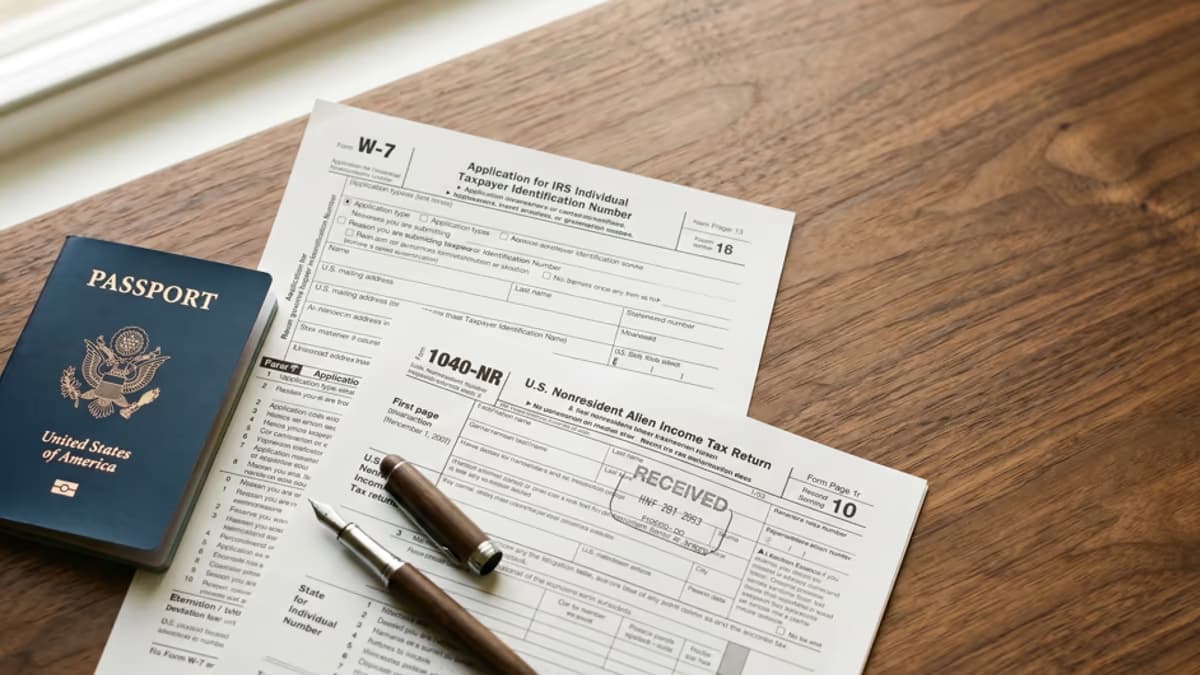
Most first-time ITIN applications travel stapled to a federal tax return, because the W-7 rules require a return unless you qualify for an exception. So when the application is rejected, the natural fear is that the return was rejected with it.
The IRS answers this directly, and the same two sentences appear on both the CP566 and CP567 pages: 'We'll process your return without an ITIN. You'll need to reapply for an ITIN and attach a copy of the return to your application to get a refund.'
Read them twice, because the two sentences point in opposite directions. The first is reassuring: the return you filed is not void. The IRS processes it without the number. The second is the part applicants miss: if that return claims a refund, the refund is tied to the reapplication. The instruction is to file a new W-7 and attach a copy of the same return to it.
The notice pages stop there. They do not say how long a refund waits or what the processing looks like internally, so we will not guess at it either. What the published text supports is a clear action: keep a complete copy of the return you filed, because the reapplication needs it.
Keep the full return copy from day one
The reapplication instruction assumes you can produce a copy of the return you already filed. If a preparer filed it for you, ask for the complete package now rather than during the 45-day window of a future notice.
The document rules the notices point back to
When a notice says the documents were wrong, these are the rules it is pointing at. Three of them do the damage.
First, the certification rule. The ITIN documents page says submissions must 'be original documents or certified copies,' and the W-7 instructions specify that a certified copy comes from the issuing agency, meaning the government office that issued the passport or record. The documents page adds: 'We don't accept notarized documents.' A notary stamp from a local office is an easy substitute to reach for, and it does not meet the rule. Both pages carve out one narrow accommodation: dependents and spouses of U.S. military personnel applying from an overseas or APO/FPO address may submit notarized copies, and that is the only such carve-out they describe.
Second, the stand-alone rule. The documents page says: 'A passport is the only stand-alone document.' Everything else on the 13-item list works only in combination, because the combination must prove both identity and foreign status.
Third, a trap that applies to dependents: the instructions say a passport without a date of entry into the United States is no longer accepted as a stand-alone document for a dependent, unless the dependent is a dependent of U.S. military personnel stationed overseas, or is from Canada or Mexico and claimed for a tax benefit other than the credit for other dependents. Primary and secondary applicants are outside this rule, but a parent applying for a child with a never-used passport walks straight into it.
Rejected through a CAA: the spouse and dependent mix-up
A Certifying Acceptance Agent exists to keep your original passport out of the mail. The W-7 instructions describe the authority precisely: 'A CAA can verify original documentation and certified copies of the documentation from the issuing agency for primary and secondary applicants and their dependents, except for foreign military identification cards. For dependents, CAAs can only verify passports and birth certificates.'
The last sentence is where the mix-up starts. The tighter limit, passports and birth certificates only, applies to dependents. A spouse filing jointly is not a dependent. The instructions say it flatly: 'Your spouse is never considered your dependent.' On a joint return, the spouse is the secondary applicant, and for secondary applicants the CAA can verify the full range the instructions allow.
So a rejection on a spouse's application that arrived despite using a CAA is unlikely to mean the CAA route itself was invalid. The likelier reads are the ones the notices name: a document that was not an original or an issuing-agency certified copy, a form defect, or a certification that did not reach the IRS in the required shape. The fix runs through the same CP566 or CP567 logic as any other application, with the CAA able to certify the secondary applicant's documents on the retry.
One more line from the instructions is worth knowing before you choose the route again: 'The CAA will return the documentation immediately after reviewing its authenticity.' The passport staying in your hands is the design, and it removes the 60-day mail return described in the next section from the equation entirely.
Reapplying: the clocks that apply to round two
A reapplication is a new W-7, so it rides the standard processing timeline. The IRS states it in two sentences on its how-to-apply page: 'Allow 7 weeks for us to notify you about your ITIN application status. It can take 9-11 weeks if it's tax season (January 15 to April 30) or if you applied from overseas.'
Look at the second condition. The longer window applies during tax season or for overseas filers, so an applicant mailing a W-7 from outside the United States is in the 9 to 11 week lane year round. Planning a bank application or a filing deadline around 7 weeks is planning around the wrong number for most non-resident founders.
If you mailed original documents, the return trip has its own published clock. The CP565 and CP567 pages both say the IRS will return your documents within 60 days of the notice date, and the W-7 instructions say that if the originals have not come back within 60 days you can call the IRS: 800-829-1040 from inside the United States, or 267-941-1000 from abroad.
An assigned ITIN has an expiry rule too
Once the reapplication succeeds, the number is not permanent by default. The IRS renewal page says that if an ITIN is not used on a federal tax return for any 3 consecutive tax years, it expires on December 31 after the third year of non-use. Renewal is another Form W-7.
The whole process runs on postal mail
Every stage of this sequence arrives in an envelope. The W-7 instructions say of the address you enter on line 2: 'This is the address the IRS will use to return your original documents and send written notification of your ITIN application status.' The assignment, the 45-day demand, the rejection, and your passport all travel to that one line.
The IRS also tells you what it will not do. Its guidance on recognizing legitimate contact says the agency normally makes first contact by mail delivered by the U.S. Postal Service, and that it emails only when you opt in. An email announcing your ITIN was rejected, with a link to fix it, is a phishing pattern, and the real answer is sitting in the mail.
That design has a practical consequence for applicants outside the United States. The CP566 clock runs from the notice date, so every day the letter spends crossing borders is a day subtracted from your 45. In this process, a mailing address where letters are received, opened, and seen quickly is the difference between a correction and a restart.
This is the part of the process where the address on line 2 deserves real thought. Some applicants use the address of a trusted contact in the United States. Some use a virtual address service that receives the mail and shows them what arrived. Whatever you choose, choose it before filing the new W-7, because changing the address mid-process is one more thing that can go wrong. If you are weighing that option while restarting an application, our guide to the ITIN application for non-resident LLC owners covers where the address fits in the larger setup.
Frequently Asked Questions
Sources & References
Primary sources this guide is based on.
- 1IRS · Understanding your CP565 notice (accessed August 17, 2026)
- 2IRS · Understanding your CP566 notice (accessed August 17, 2026)
- 3IRS · Understanding your CP567 notice (accessed August 17, 2026)
- 4IRS · Instructions for Form W-7 (accessed August 17, 2026)
- 5IRS · ITIN supporting documents (accessed August 17, 2026)
- 6IRS · How to apply for an ITIN (accessed August 17, 2026)
- 7IRS · How to renew an ITIN (accessed August 17, 2026)
- 8IRS · IRM 3.21.263, IRS Individual Taxpayer Identification Number (ITIN) Real-Time System (RTS) (accessed August 17, 2026)
- 9IRS · How to know it's the IRS (accessed August 17, 2026)
Not sure what you need?
Two short pages sort it out — what the products actually are, and which situation you're in.