Short answer
On the three formation forms we read, those of Delaware, Florida, and Wyoming, an LLC does not need a phone number in order to exist: the phone sits in a filer-contact or cover-letter field rather than among the articles themselves. The number starts to matter after formation, and it matters in two separate ways: payment processors publish it to your customers, and verification systems classify it by line type before they trust it.
Key takeaways
- On the Delaware, Florida, and Wyoming LLC forms we read, the phone number is a filer contact, not a company record. Florida's is printed under a heading titled COVER LETTER, and Wyoming's sits below the organizer's signature.
- Payment processors publish a phone number to your customers. Shopify Payments asks for 'the phone number that you want to display on your customer's bank statement,' and Stripe lists a support phone number among the details customers see on card statements and receipts.
- Line-type lookups classify numbers and name names. Twilio's documentation gives Google Voice as its example of a non-fixed VoIP (Voice over Internet Protocol) number, alongside Enflick.
- Carrier capability and sender policy are different things. Telnyx's list of carriers that support short codes includes Google Voice, so a missing one-time passcode is usually a sender's rule rather than a network limit.
- Bank of America's small business Zelle page states that VOIP, landlines, Google Voice numbers, 1-800 numbers, and international numbers are not eligible for Zelle enrollment. That rule sits on a feature you switch on after the account exists.
Before you start
- save office sells a business address and mail handling. An address from us does not change a line-type lookup, and none of the problems in this article are solved by buying one.
- Every rule quoted here was read on July 24, 2026, on the source's own page. Provider pricing and platform policies move; open the linked source before you rely on it.
Who this is for
- New LLC owners who have the EIN and are now looking for a number to give suppliers, banks, and platforms.
- Owners whose one-time passcodes are not arriving, who cannot tell whether the problem is their number or the sender.
- Anyone about to use a personal cell number as the business contact without knowing where that number will be displayed.
Search for a business phone number for your LLC and the results we read all answer the same question: how to get one. Local or toll-free, Google Voice or Grasshopper, free tier or paid plan. The lists are competent and they are all answering the easy half.
What those guides do not separate out is that the number does two different jobs, and the jobs pull in opposite directions. As a published contact, the number goes out to strangers, printed on your customers' card statements by your own payment processor. As an authentication channel, the number gets looked up and classified before a bank or platform will trust it. The number that is safe to publish and the number that passes authentication are not necessarily the same number, and the guides rarely tell you to think about them separately.
On Three State Forms, the LLC Does Not Need a Phone Number. The Filing Needs a Contact
Start by removing a worry that does not belong here. Owners often assume the state wants a business phone on record the way it wants a registered agent. On the three formation forms we opened, that is not what the phone field is.
Florida's Articles of Organization put the phone under a heading that says, in capitals, COVER LETTER. Delaware's LLC formation packet asks you to 'include a cover letter with your name, address and telephone/fax number to enable us to contact you if necessary.' Wyoming's form places 'Contact Person' and 'Daytime Phone Number' below the organizer's signature, after the numbered articles that carry the substance: name, the close-LLC election, registered agent, mailing address, principal office, and certification.
In all three, the phone is how the filing office reaches the human who submitted the paperwork. It is not a company attribute the way the registered agent is.
What we did not verify
California's LLC-1 and New York's Articles of Organization both returned a 403 to us on July 24, 2026, so we could not read them. Nothing above should be read as a claim about those two states, and we are not extending the pattern to all fifty. Check your own state's form.
We also stopped short of a claim we expected to make here. It would be tidy to say the contact phone becomes part of the publicly viewable filing document, and that this is the privacy argument for keeping your cell number off it. We did not verify that, so we are not writing it. The privacy problem is real, and it turns up in the next section with a much better source.
Job One: The Number Your Customers Will Actually See
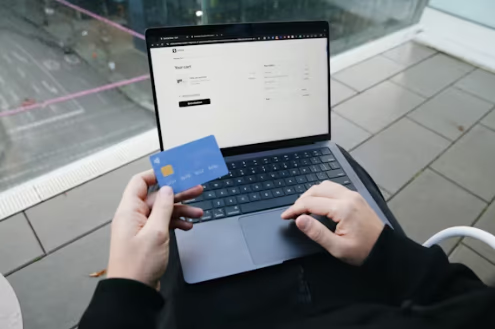
If you take card payments through Shopify or Stripe, the processor asks for a phone number and then shows it to the people who pay you. This is stated plainly on both of the pages we read, and it is the part of the setup flow people click through fastest.
Shopify's account setup page for Shopify Payments asks you to 'Enter the phone number that you want to display on your customer's bank statement.' Stripe's account activation documentation is just as direct: your customers see, on either their card statements or in email receipts, your support email address, phone number, and address.
Read that back with a personal cell number in the field. Each customer who buys from you gets a line item with your mobile number on it, sitting in their banking app for as long as the statement is retained, available to anyone who reads it. Chargeback disputes and refund requests then arrive as calls to a number you also use for your dentist.
This is the strongest reason to separate business and personal numbers, and it has nothing to do with looking professional. It is that the processor is a publisher, and you are choosing what it publishes.
One page each, and only what it says
We read Shopify's account setup page and Stripe's activation docs. Neither page discusses what kind of phone line you may use, and we are not treating that silence as a policy. Help centers spread requirements across several pages, so the absence of a rule on one page is not evidence that no rule exists.
Ready to set up your business address?
See which US cities fit — about a minute, no card needed.
Job Two: The Number a Lookup Has to Approve
The second job is invisible until it fails. When a bank, a marketplace, or a payment platform decides whether to trust a phone number, it can ask a lookup service what kind of line that number is. Those services return a category, and the categories are not neutral.
Twilio's Line Type Intelligence documentation defines nonFixedVoip as 'a virtual phone number obtained online without requiring a physical device,' and it gives two examples by name, Google Voice and Enflick. The neighboring category, fixedVoip, is 'associated with a physical device,' with Comcast and Vonage as its examples.
That is the mechanism people are groping toward when they say a bank 'does not like' Google Voice. The number is not blocked in any general sense. It is classified, by a service the gatekeeper pays for, into a bucket the gatekeeper can then act on.
It is worth noting who is doing the classifying. We could not find Google publishing this label about its own product: the two Google URLs we tried returned 404s, and the rest of the search results were community forum threads, which are user posts rather than a citable policy. On the evidence we could gather, the label lives in the lookup layer rather than in the documentation of the service you signed up for.
Why the Passcode Did Not Arrive, and Why the Usual Explanation Does Not Hold Up
The folk explanation for a missing one-time passcode is that VoIP numbers cannot receive short-code messages. We went looking for the technical basis for that and found evidence pointing the other way.
Telnyx publishes a list of carriers that support short codes. Google Voice is on it. So is Enflick, the other name in Twilio's non-fixed VoIP example. The page does not use the word VoIP at all. On the network side, the message can be delivered.
So when the code does not show up, the more accurate description is that somebody chose not to send it, or chose not to accept the number in the first place. That is a policy decision by the sender, and it is the sender you have to satisfy. It also explains why the same number works for one company and fails at another on the same day, which makes no sense if you believe the network is the obstacle.
Where we stopped
There is a US carrier registration scheme for business text messaging, known as A2P 10DLC, or application-to-person messaging on 10-digit long codes. We could not get a clean primary quote on how it treats recipient number types, so this article makes no claim about it. Advice elsewhere that pins the problem on that scheme may well be right; we did not verify it and are not repeating it.
Where the Refusal Is Actually Written Down
We set out to find a bank saying, in its own words, that it will not accept a VoIP number to open a business account. We did not find one, and the search failing turned out to be more useful than the search succeeding.
Here is what we did find, verbatim, on Bank of America's small business Zelle page: 'You can only enroll authenticated U.S. (or U.S. territory) mobile numbers that belong to you. Voice over IP (VOIP), landlines, Google Voice numbers, 1-800 numbers and international numbers are not eligible for Zelle enrollment.'
That is an explicit, published, named-product exclusion. But look at where it sits. Zelle enrollment is a feature you turn on after the account already exists. It is not the account application.
On the two account-opening requirement pages we checked, Bank of America's guide to opening a business bank account and Chase's page on what you need to open a business account, the words VOIP, Voice over, Google Voice, and landline appear zero times. We are not saying no bank publishes a rule about number type at account opening. We are saying we looked at those pages and did not find one, which is a much smaller claim and the only one we can support.
| Claim | What the source actually says | Status |
|---|---|---|
| Banks refuse VoIP numbers when you open a business account | Not found on the two account-opening requirement pages we read, Bank of America and Chase; neither discusses line type | Unsupported by what we read |
| A named bank excludes VoIP for a specific feature | Bank of America's small business Zelle page excludes VOIP, landlines, Google Voice, 1-800, and international numbers from enrollment | Published and quotable |
| Non-fixed VoIP is a real, named classification | Twilio's Line Type Intelligence names Google Voice and Enflick as its non-fixed VoIP examples | Published and quotable |
| The network cannot deliver short codes to Google Voice | Telnyx's supported-carrier list includes Google Voice; the page never mentions VoIP | Unsupported by the one carrier list we read |
What we could and could not source about phone numbers and financial accounts, as read on July 24, 2026.
The EIN Application Has a Phone Trap of Its Own
Form SS-4 asks for the applicant's telephone number, including area code, in the signature block. Neither the form nor its instructions mention VoIP anywhere, so the line type is not the issue here. A different rule is.
The instructions carry a caution that catches people who use an accountant, a formation service, or a friend as their third-party designee: if the third-party designee's address or telephone number matches the address or telephone number of the taxpayer, the application must be mailed or faxed.
A phone number collision does not cause your application to fail. It removes you from the online channel and drops you into the paper one, which is a materially slower path. If you are sharing a number and an address with the person filing on your behalf, that is worth knowing before you start, not after the online session refuses you.
This is the same class of problem as address collisions, and if you are working through EIN mechanics from outside the US, our guide to opening a US business bank account as a non-resident covers the neighboring steps.
What It Costs
Prices below were read on each provider's own pricing page on July 24, 2026. This category rebrands and repackages often, so treat these as a starting point and check before you buy.
| Provider | Entry price | Note |
|---|---|---|
| Google Voice | Free tier is personal-account only; business plans start at $10 per user per month | Standard $20, Premier $30. This is the product Twilio names as its non-fixed VoIP example. |
| Grasshopper | $14 per month billed annually | The pricing page geo-routes, so the figure shown to us may differ from the US-facing price. |
| Phone.com | $18 per user per month on Basic | Annual billing advertised at a 17% saving. |
| Quo, formerly OpenPhone | $19 per user per month, or $15 billed annually | The brand changed. Guides still calling it OpenPhone are describing the same product under an old name. |
Entry pricing as published on each provider's pricing page, July 24, 2026.
A small thing that dates an article instantly
As of July 24, 2026, OpenPhone presents itself as Quo, and openphone.com/pricing returns a 301 redirect to quo.com/pricing. The change is mid-flight: the page title reads Quo, and the footer carries two company names, one line for Quo, Inc. and another for OpenPhone Technologies, Inc. A comparison post that never mentions the rename at all is, at minimum, not tracking it.
What an Address Does, and What It Does Not
It would be convenient for us to end by connecting all of this to a business address. It does not connect, and pretending otherwise would be the same move we spend most of our writing criticizing.
A business address does nothing for a line-type lookup. It will not get a passcode delivered, it will not make a VoIP number eligible for Zelle, and it will not change which category a lookup service returns. save office sells an address and mail handling. We do not sell registered agent service.
Where the two do sit side by side is in the verification forms themselves. The same account applications that ask for a phone number ask for an address, and the address half is where a mailbox-only location gets you turned down. That is a separate problem with a separate fix, covered in our guide to business bank account address requirements, and you can run any address through our free address checker before you hand it to anyone. The checker tells you how USPS classifies an address. It does not promise that a particular bank will accept it, because no one can promise another company's decision.
The practical takeaway is smaller than a product pitch and more useful. Decide which job each number is doing. Publish one, authenticate with the other, and do not assume a free number does both.
Frequently Asked Questions
Not sure what you need?
Two short pages sort it out — what the products actually are, and which situation you're in.