Short answer
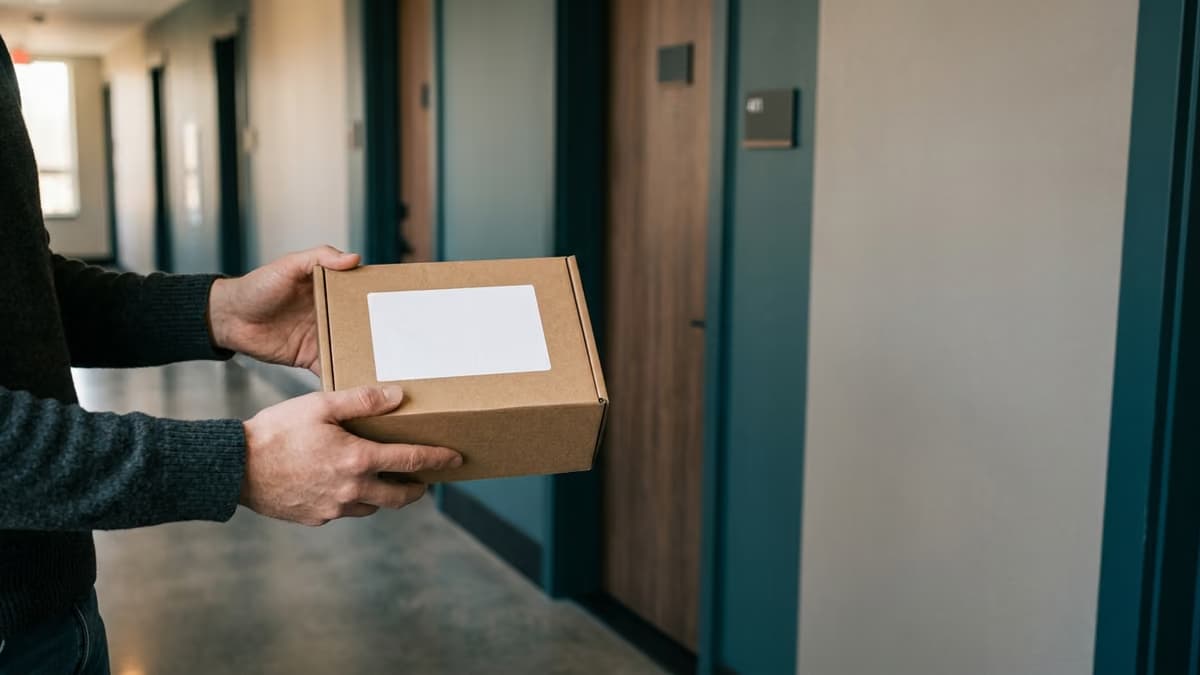
“Delivered, Front Desk/Reception/Mail Room” means the carrier left your package with the front desk, reception area, or mail room at the delivery address. USPS’s scan-event reference for mailers describes it as “The item was delivered to the front desk or reception area of the delivery address.” USPS counts it as a delivery, so the package is now with the building, not with you. A similar status, “Delivered to Agent, Front Desk/Reception/Mail Room,” falls under a separate USPS category called Delivered to Agent. If you cannot find the package, ask the front desk or building management first, then contact USPS.
Key takeaways
- USPS describes the status as “The item was delivered to the front desk or reception area of the delivery address.” The customer message reads “Your item was delivered to the front desk, mail room, or reception area.”
- It is a delivery scan. USPS lists it under the status category Delivered, the same category as Delivered, In/At Mailbox and Delivered, Left with Individual.
- “Delivered to Agent, Front Desk/Reception/Mail Room” is a different status. USPS files it under the category Delivered to Agent and describes it as “The item was delivered to an agent, and the employee indicated that it was left at the front desk or mail room.”
- DMM 508.1.4.1 lets USPS deliver an addressee’s mail to “an employee” or “any person authorized to represent the addressee.” In its section on Priority Mail Express and accountable mail, DMM 508.1.1.7 adds that “USPS responsibility ends when the mailpiece is delivered to the addressee (or another party, subject to 1.0).”
- If the package is missing, check with the building first. USPS says to submit a service request for eligible items if it has been more than one postal business day since the delivered scan, and says Missing Mail search requests can be submitted starting 7 days from mailing.
Before you start
- Copy the tracking number and the exact status wording, including any words after “Delivered,” such as “to Agent.”
- Note the date and time of the delivery scan. The steps below depend on how long ago it was.
Who this is for
- Anyone whose tracking shows a front desk, reception, or mail room delivery and who does not have the package yet.
- Business owners who receive packages at an office building, a coworking space, or another commercial address with a shared front desk.
What “Delivered, Front Desk/Reception/Mail Room” means
The status means the carrier handed the package to a front desk, reception area, or mail room at the delivery address. USPS publishes a reference of its tracking scan events for mailers on its PostalPro site, and its April 2026 edition defines this status.
That reference gives the status the customer message “Your item was delivered to the front desk, mail room, or reception area at TIME on DATE in CITY, STATE ZIPCODE.” Its description reads “The item was delivered to the front desk or reception area of the delivery address.”
In that reference, the status sits under event code 01 with the status category Delivered. So, as far as USPS tracking is concerned, the package has been delivered. The person who has it now should be whoever runs that desk or mail room, such as a receptionist, a building manager, or mail room staff.
You are likely to see this status at addresses that have a shared desk or mail room: office buildings, coworking spaces, apartment buildings, and similar places. USPS Publication 265-B, a USPS guide to centralized mail delivery in commercial buildings, says “A mailroom is a centralized delivery installation for office buildings and shopping malls.”
The status that adds “to Agent” is a different one
A second status uses almost the same words: “Delivered to Agent, Front Desk/Reception/Mail Room.” In the same USPS reference, it is listed under event code 60 with the status category Delivered to Agent, not Delivered. The customer message reads “Your item has been delivered to an agent at the front desk, reception, or mail room at TIME on DATE in LOCATION.” The description reads “The item was delivered to an agent, and the employee indicated that it was left at the front desk or mail room.”
A related status, Delivered to Agent for Final Delivery, is described as “The item has been delivered to an agent of the residence or institution to where it has been addressed (college, hospital, condominium, etc.).” The reference also lists a separate set of agent scans, event codes 61 to 64: Received by Agent, Recipient notified by Agent, Delivered to Recipient by Agent, and Undeliverable to Recipient by Agent. For the notice, the reference says “The agent notified the addressee that an item is waiting and available for pickup at the mailroom.” For the last one, it says “The agent was unable to deliver the item to the addressee and the item will be returned to the sender.”
In practice, when your tracking shows “to Agent,” the package went to someone who receives mail for the place, and that person may post more scans as it moves to you. When it shows only “Delivered, Front Desk/Reception/Mail Room,” USPS tracking describes no further steps after the desk.
One word of caution: “agent” here means a person who receives mail for you or for a building. It is not a registered agent, the person or company an LLC or corporation names to receive legal papers on its behalf. One person can do both jobs, but the two terms come from different rules.
USPS delivered statuses compared
The table quotes the USPS scan-event reference. The last column is our reading of where the package should be. It is not USPS wording.
| Tracking status | USPS description | Where to look first |
|---|---|---|
| Delivered, Front Desk/Reception/Mail Room | “The item was delivered to the front desk or reception area of the delivery address” | The front desk, reception, or mail room of the building. |
| Delivered to Agent, Front Desk/Reception/Mail Room | “The item was delivered to an agent, and the employee indicated that it was left at the front desk or mail room.” | The same desk or mail room. Watch tracking for later agent scans. |
| Delivered, In/At Mailbox | “The item was delivered to the delivery receptacle” | Your mailbox or other mail receptacle. |
| Delivered, Left with Individual | “The item was left with an individual at the delivery address” | People at the address who may have signed for it or taken it in. |
| Delivered, Parcel Locker | “The item was delivered to a USPS parcel locker attached to a Cluster Box Unit” | Your mailbox for a parcel locker key or notice. |
Source: USPS PostalPro, PTR Event Descriptions (April 2026), read October 3, 2026. The last column is our reading, not USPS wording. For Parcel Locker, the reference has a second line for a non-USPS parcel locker. The same reference marks the older wording “Delivered, To Agent” as an event retired in 2020.
Ready to set up your business address?
See which US cities fit — about a minute, no card needed.
Why USPS can hand your package to someone else
The Domestic Mail Manual (DMM) allows it. Section 508.1.4.1 says “Unless otherwise directed, an addressee’s mail may be delivered to an employee, to a competent member of the addressee’s family, or to any person authorized to represent the addressee.” It adds that “A person or several persons may designate another to receive their mail.”
For an office address, section 508.1.5.1 says “All mail addressed to a governmental or nongovernmental organization or to an individual by name or title at the address of the organization is delivered to the organization.” For Priority Mail Express and accountable mail such as Certified Mail, section 508.1.1.7 adds that when the sender has not restricted delivery, mail for a person at a hotel, apartment house, or similar location “may be delivered to any person in a position to whom mail for that location is usually delivered.”
The same section 508.1.1.7 also sets where USPS’s part ends for those pieces: “USPS responsibility ends when the mailpiece is delivered to the addressee (or another party, subject to 1.0).” Section 1.0 is the part of DMM 508 that the rules quoted above come from. If a sender needs to limit who can receive a package, Restricted Delivery is the USPS option for that. Under section 508.1.1.8, postal employees must deliver that mail “only to the addressee or person authorized in writing as the addressee’s agent.”
If tracking says delivered but you do not have the package
Start with the building. Ask the front desk, reception, or mail room whether they logged the package, and give them the tracking number and delivery time. The USPS help page on missing packages suggests the same first step for apartments: “If you live in an apartment/condo, contact your building's management office to see if the package was left with them.”
Then go to USPS. The same help page says “If you still can't find your package and it has been more than one postal business day since the 'delivered' scan, visit the email us page on usps.com to submit a service request to your local Post Office™ for eligible items.” If the package is still missing, the USPS Missing Mail page says “Missing Mail search requests can be submitted starting 7 days from mailing.” For an insured package, the same page says “you must file no later than 60 days from the date of mailing.”
Some shipments come with a delivery record. For Signature Confirmation, USPS says “USPS keeps a delivery record, which you may request via email.” For Certified Mail, USPS says to “Combine with Return Receipt to get an electronic or physical delivery record showing the recipient's signature.” At a building with a front desk, the name in that record may belong to the desk staff, which is useful when you ask the building where the package went.
When the address is a business address in a shared building
If you receive packages at an office building or coworking space, the front desk has to match names to route mail. Under DMM 508.1.5.1, mail for a person at an organization’s address goes to the organization. In a shared building, the desk can be run by the building or the space operator rather than your company, so the desk needs to know your name and your company name to pass the package on. Give senders the same name and suite number the desk has on file.
Names that do not match can turn into returns. The USPS return reason Attempted Not Known is defined as “Delivery attempted; addressee not known at place of address.” Our guide to USPS return to sender reasons covers that one and the others. If the piece comes back marked Insufficient Address instead, see what to do when USPS says Insufficient Address but the address is correct.
Before you give a business address to senders, you can look it up in our free address checker. It shows whether USPS data classifies the address as residential or commercial, whether it is flagged as a commercial mail receiving agency (CMRA), and whether the building uses suite or unit numbers. Our guide to residential vs commercial addresses in USPS data explains the residential and commercial flag.
Not legal advice
This guide quotes the USPS PostalPro scan-event reference (April 2026), DMM 508, and USPS help pages as read on October 3, 2026. USPS updates these documents over time. Your local Post Office can explain a specific delivery scan.
Frequently Asked Questions
Sources & References
Primary sources this guide is based on.
- 1USPS · USPS PostalPro, PTR Event Descriptions (April 2026) (accessed October 3, 2026)
- 2USPS Postal Explorer · DMM 508 Recipient Services, sections 1.1, 1.4, and 1.5 (accessed October 3, 2026)
- 3USPS · USPS FAQ: Where is my package? Tracking Status Help (accessed October 3, 2026)
- 4USPS · USPS Find Missing Mail (accessed October 3, 2026)
- 5USPS · USPS Insurance and Extra Services (accessed October 3, 2026)
- 6USPS · USPS Publication 265-B, Centralized Mail Delivery: Mailroom (accessed October 3, 2026)
Not sure what you need?
Two short pages sort it out — what the products actually are, and which situation you're in.

save office
Published
I'm Henry, a hedgehog in a bow tie who explains the dull, scary parts of building and running a U.S. business.