Short answer
You can, if the bank accepts applicants from your state. The federal customer identification rule asks a bank for your address, and it does not name a state. Each bank sets its own rules on where it opens accounts. Wells Fargo’s business FAQ, asked about opening a business account with no Wells Fargo branch in your state, answers “Yes” and says Wells Fargo “checking and savings customers can open accounts” there. Check the bank’s current page first.
Key takeaways
- The federal customer identification rule lists what a bank must collect before it opens an account, including your address. The rule does not name a state.
- Each bank sets its own rules. Bank of America says business checking requirements “vary by ownership type and the state in which the account is opened.”
- Wells Fargo’s business FAQ answers “Yes” to “Can I open a business account if there are no Wells Fargo branches in my state?” The answer says Wells Fargo “checking and savings customers can open accounts” there. Wells Fargo’s personal online application asks you to “Have a physical U.S. address.”
- Bank of America’s LLC application asks about two states: the “Country & state of legal formation” and the “Country and state of primary business operation.”
- Mercury says your company “must be formed and registered in the United States or a U.S. territory.” Relay says your business “must be legally registered and operating in the United States.”
- The address must be one the bank accepts. Wells Fargo’s business page says the bank does not accept registered agent addresses, virtual addresses, or PO and commercial mailboxes. That limit applies to a virtual address from any provider, including save office.
Can you open a bank account in a different state?
Yes, you can open a bank account in a different state if the bank accepts applicants from where you live. The federal identification rule for banks asks for your address and does not name a state. Each bank sets its own rules on which states it serves.
Bank pages differ on three points: where you can apply, how you apply, and what address you must give. A business account adds questions about where the business was formed and where it operates. The sections below quote the federal rule and the pages of four account providers.
Did this answer your question?
What the federal identification rule asks for
A bank that must run an anti-money laundering program also needs a written Customer Identification Program. The rule for banks is 31 CFR 1020.220, a section of the Code of Federal Regulations. It says the program must include “risk-based procedures for verifying the identity of each customer to the extent reasonable and practicable.”
Before a bank opens an account, it must collect at least a name, an address, and an identification number. For a person, the bank also collects a date of birth. The rule lists two exceptions, for a customer who has applied for a taxpayer identification number and for credit card accounts.
The rule describes the kind of address the bank collects. For a person, it asks for “a residential or business street address.” A person who does not have one can give “an Army Post Office (APO) or Fleet Post Office (FPO) box number, or the residential or business street address of next of kin or of another contact individual.” For a company or other entity, it asks for “a principal place of business, local office, or other physical location.”
The rule does not name a state. We read nothing in it that ties your account to the state where you live.
The rule ties each bank’s procedures to its own risk assessment. It lists factors such as “the various methods of opening accounts provided by the bank” and “the bank’s size, location, and customer base.” That wording suggests two banks can follow the same rule and still give different answers about customers in other states.
The rule also covers accounts opened from a distance. A bank can check your identity with documents or with other methods, such as comparing your details with information from “a consumer reporting agency, public database, or other source.” The procedures for those other methods must address situations where “the customer opens the account without appearing in person at the bank.”
Ready to set up your business address?
See which US cities fit — about a minute, no card needed.
What Bank of America and Wells Fargo say about other states
Bank of America’s business checking page says “Eligibility requirements and the required documentation to open a business checking account vary by ownership type and the state in which the account is opened.” The same page answers “Yes, business checking accounts can be opened online.” The page adds that “some complex business types may require an in person financial center visit.”
Wells Fargo’s business accounts FAQ asks the question directly: “Can I open a business account if there are no Wells Fargo branches in my state?” The answer is “Yes. Wells Fargo checking and savings customers can open accounts in any state.” We read that answer as written for business accounts, because it sits in the business FAQ.
For a personal account, Wells Fargo’s account opening FAQ lists what you need to apply online. One item is “Have a physical U.S. address.” The FAQ also says “If you’re under 18 or a non-permanent U.S. resident, you’ll need to make an appointment to apply in person at a Wells Fargo branch.”
Your ID may still show an address in your old state. Wells Fargo’s list of primary IDs includes a “State or U.S. territory issued driver’s license.” For proof of address when you apply in person, the FAQ says “If neither your primary nor secondary identification (ID) contains your current residential address, you’ll need to provide separate proof of your physical U.S. address (we cannot accept a P.O. Box or Private Mailbox as a residential address).”
These quotes come from different pages for different accounts. A rule on a business page may not apply to a personal account, so read the page for the account you want.
What Mercury and Relay say about who can apply
Mercury and Relay offer business accounts that you apply for online. Neither company is a bank insured by the Federal Deposit Insurance Corporation (FDIC). Mercury’s page says “Mercury is a fintech company, not an FDIC insured bank.” Relay’s page says “Relay is a financial technology company and is not an FDIC-insured bank.”
Mercury’s eligibility page opens with this rule: “To open a Mercury account, your company must be formed and registered in the United States or a U.S. territory.” Relay’s account opening guide says “Your business must be legally registered and operating in the United States, and every beneficial owner must have a valid SSN.” SSN means Social Security number.
Both pages name the country, and neither page names a state. Mercury’s page lists industries it cannot open accounts for, and Relay’s page points to its prohibited industries list, so read the full page before you apply.
The table puts the location and address wording from each page side by side. Each row quotes the pages of the provider it names.
| Provider and account | What the page says about location | What the page says about the address |
|---|---|---|
| Bank of America, business accounts | Requirements “vary by ownership type and the state in which the account is opened.” The application for a limited liability company (LLC) asks for the “Country and state of primary business operation (in the U.S.)” | “The address and phone number of your company (must be valid and verifiable)” |
| Wells Fargo, business accounts | Answers “Yes” to opening a business account when “there are no Wells Fargo branches in my state” | Wells Fargo asks for a physical address and rules out registered agent addresses, virtual addresses, and PO or commercial mailboxes |
| Wells Fargo, personal accounts | To apply online: “Have a physical U.S. address” | For proof of address in person: “we cannot accept a P.O. Box or Private Mailbox as a residential address” |
| Mercury, business accounts | “your company must be formed and registered in the United States or a U.S. territory” | For the company physical address: “We don’t accept a P.O. box, virtual address, commercial mail receiving agency, mail center, or registered agent address.” |
| Relay, business accounts | “Your business must be legally registered and operating in the United States” | Asks for a business address, and for each owner’s “residential address” |
Opening a business bank account in another state
Bank of America’s business application asks about two states. Its LLC application requirements list “Country & state of legal formation (must be formed in the U.S.)” and “Country and state of primary business operation (in the U.S.).” An LLC can be formed in one state and run from another, so the two answers can differ.
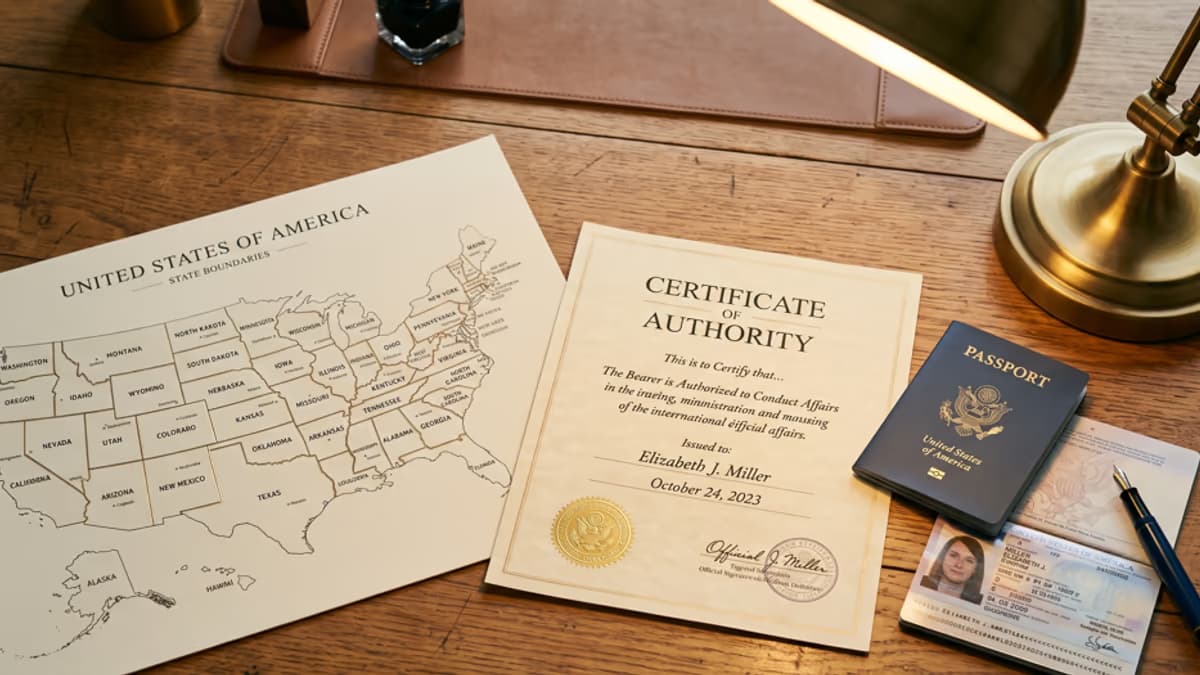
Bank of America’s guide to opening a business account names a document for that case. It describes a Certificate of Registration, also called a Certificate of Authority, as “Authorization for a business formed in another state” to “legally operate in the registering state.” The guide then says “Banks require it when an out-of-state entity opens accounts locally.”
We read that line as something to ask the bank about. If your LLC was formed in one state and you open the account at a branch in another, ask whether the bank needs that certificate. Whether the LLC must register in the second state is a separate question under that state’s law. Our guide on living in a different state than your LLC explains when a home state may require a foreign registration.
Wells Fargo asks for proof that the business exists. Its business document page asks for “A document to verify your business is registered with a government agency, such as Secretary of State or other state/county agency.” Bank of America’s guide adds that “A banker can help confirm which documents are needed based on your business type and location.”
Mercury and Relay also ask about operations. Mercury asks for “Details about your current or planned U.S. operations.” Relay asks for a business that is “legally registered and operating in the United States.”
Which address to give a bank in another state
The address you give must be one the bank accepts under its identification rules. The federal rule asks for a street address for a person and a physical location for a company. Bank pages then add their own limits, and some of them name address types.
Wells Fargo’s business page asks for a physical address and says the bank does not accept registered agent addresses, virtual addresses, or PO and commercial mailboxes. In its list of proof documents, a lease comes with the note “restrictions apply, virtual offices are not acceptable.”
Mercury asks for “A physical address where you operate.” Its eligibility page adds that “this can be commercial or residential; in some cases, documentation may be required.” For the company physical address, Mercury’s address requirements page says “We don’t accept a P.O. box, virtual address, commercial mail receiving agency, mail center, or registered agent address.” Mercury also asks each owner for “the physical address where that person currently lives.”
Wells Fargo and Mercury both list a virtual address among the addresses they do not accept for those fields. Those limits apply to a virtual address or a virtual office from any provider, including save office. A mailing address in another state lets you receive mail there. The pages above still ask where you live and where your business operates.
Bank of America’s guide to opening a business account lists “The address and phone number of your company (must be valid and verifiable)” among the items you may need. Ask a banker which address types it accepts for each field. Our guide to business bank account address requirements explains each address field on a business application.
Before you apply, our free address checker shows how the U.S. Postal Service (USPS) classifies an address. A USPS classification is not a bank decision, so read the bank’s own address rule as well.
Checklist before you open an account in another state
Use these steps before you apply at a bank in another state, or online from the state where you live:
- Find the bank’s page on who can apply. Look for the states it serves and whether you can apply online.
- Check the address the application asks for. Wells Fargo’s personal online application asks you to have a physical U.S. address.
- If your ID shows an old address, bring proof of your current address. Ask the bank which documents it accepts.
- For a business account, know the state where the business was formed and the state where it mainly operates.
- If the business was formed in another state, ask whether the bank needs a Certificate of Registration or Certificate of Authority.
- Give each address field an address of the type it asks for. Read the bank’s own list of addresses it does not accept.
Not legal or tax advice
This guide summarizes 31 CFR 1020.220 and the Bank of America, Wells Fargo, Mercury, and Relay pages named above, as read on November 14, 2026. Bank rules and page wording can change. Check the current page, and ask the bank, a lawyer, or a tax professional about your situation.
Frequently Asked Questions
Next step
Reserve your US business address
Pick a city and a plan. Your mail goes to a real commercial address and is scanned when you ask.
Sources & References
Primary sources this guide is based on.
- 1Electronic Code of Federal Regulations (National Archives) · 31 CFR 1020.220, Customer identification program requirements for banks (accessed November 14, 2026)
- 2Bank of America · Business checking accounts (accessed November 14, 2026)
- 3Bank of America · LLC Application Requirements (accessed November 14, 2026)
- 4Bank of America · How to Open a Business Bank Account (accessed November 14, 2026)
- 5Wells Fargo · Checking and Savings FAQs, Small Business (accessed November 14, 2026)
- 6Wells Fargo · How to Open a Business Bank Account: What You Need (accessed November 14, 2026)
- 7Wells Fargo · What Do You Need to Open or Close a Bank Account? (accessed November 14, 2026)
- 8Mercury · Eligibility and requirements for opening a Mercury account (accessed November 14, 2026)
- 9Mercury · Company address requirements (accessed November 14, 2026)
- 10Relay · How to Open a Relay Business Account (accessed November 14, 2026)
Not sure what you need?
Two short pages sort it out — what the products actually are, and which situation you're in.

save office
Published
I'm Henry, a hedgehog in a bow tie who explains the dull, scary parts of building and running a U.S. business.