Key takeaways
- Address inconsistency across the seven business records (state SOS, IRS EIN letter, Stripe legal, Mercury KYB, state tax filings, FinCEN BOI, registered agent) is the most common KYC rejection trigger that founders can fix without legal counsel.
- Recovery typically follows a Day 1, Day 7, Day 30 cadence: gather evidence in the first day, file Form 8822-B and amend state records within the first week, then submit the consolidated appeal package to the platform within the first month.
- A pre-rejection address screen through a USPS Delivery Point Validation and commercial mail receiving check catches the addresses that downstream KYC vendors will flag, well before Stripe or Mercury runs the same lookup.
Before you start
- Pull the original Stripe rejection email and the Mercury account closure notice; both messages contain a reference code that the appeal team uses to retrieve the case file.
- Locate the CP 575 EIN confirmation letter; the address on the EIN letter is the source of truth that every other record has to match character-for-character.
Who this is for
- Founders who received a Stripe charge account decline or a Mercury account closure citing 'unable to verify business information' or 'address inconsistency'.
- Non-resident founders formed through Stripe Atlas who used the Atlas registered agent address and later struggled to open the linked Mercury account.
- Operators who already swapped business addresses and now face a downstream cascade across Stripe, Mercury, payment processors, and the IRS.
Address mismatch is the leading trigger when Stripe declines a charge account or Mercury freezes a deposit account. Seven address records must agree before either platform clears Know Your Customer (KYC) review, and the difference between 'Suite 100' and 'Ste 100' can route the case to manual review for weeks.
Setting up your LLC? See your US address options — no card →
Why Stripe and Mercury reject: the seven address triggers
Stripe and Mercury both run Know Your Business (KYB) and Know Your Customer (KYC) reviews against third-party vendor data. Neither platform publicly discloses its exact vendor stack, though industry analyst reports identify providers such as Middesk, Persona, and Socure as the dominant players in fintech onboarding verification. The vendors pull the entity's business address from the Secretary of State filings, the IRS Business Master File, FinCEN's Beneficial Ownership Information registry where applicable, and commercial datasets, then compare every address against the address the founder typed into the Stripe or Mercury signup form. Any mismatch routes the application to the manual review queue.
The seven address records that the KYB vendors cross-check are the Secretary of State business registration, the IRS EIN confirmation letter, the Stripe Legal Entity address on the Atlas or direct application, the Mercury KYB address, the state-level tax registrations, the FinCEN Beneficial Ownership Information report, and the registered agent address on file with the state. When even one of these seven shows a different street, suite number, or ZIP code, the vendor flags the discrepancy.
- 1Secretary of State business registration address.
- 2IRS EIN confirmation letter CP 575 mailing address.
- 3Stripe Legal Entity address on the Stripe Atlas or direct charge account.
- 4Mercury KYB address on the deposit account application.
- 5State-level tax registration addresses, including sales tax permits and employer withholding.
- 6FinCEN Beneficial Ownership Information report address.
- 7Registered agent address on file with the state.
Address mismatch decoder: identify which source is wrong
Before filing any amendment, identify which of the addresses is the outlier. The most common pattern for non-resident founders formed through Stripe Atlas is that the state SOS, the EIN letter, and the Stripe Legal Entity all show the Stripe Atlas Delaware registered agent address, while the founder typed their actual virtual office or coworking address into the Mercury signup. Mercury's KYB then checks against the SOS and flags the inconsistency.
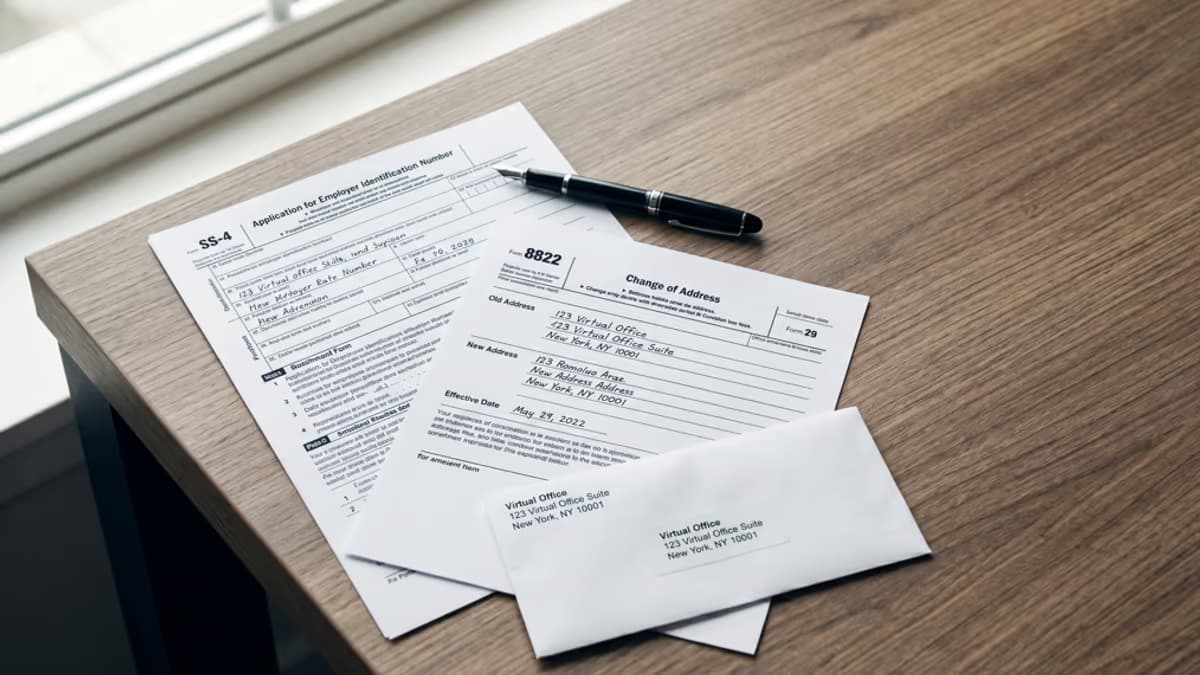
The decoder starts by treating the CP 575 EIN letter as the source of truth. Every other record needs to either match the CP 575 character-for-character or have a documented amendment trail showing the change. If the CP 575 itself shows the wrong address because the SS-4 was filed with an Atlas address that no longer reflects the business, Form 8822-B is the IRS-side amendment that updates the EIN letter address.
| Source record | How to retrieve the current address | How to amend |
|---|---|---|
| State SOS | Search the state's business entity database with the LLC name or EIN. | File the state's amendment form, typically a Certificate of Amendment; fee typically $20-200 depending on the state (Delaware is $200, California $30, New York $60 as of 2026). |
| IRS EIN letter (CP 575) | Retrieve the original letter from email or request a 147C verification letter by phone. | Form 8822-B; file promptly (60-day deadline applies to responsible-party changes per the form's current instructions). |
| Stripe Legal Entity | Dashboard > Settings > Business > Legal entity. | Update directly in the dashboard; triggers re-verification. |
| Mercury KYB | Email Mercury support requesting the current address on file. | Mercury portal address update or support ticket; triggers re-verification. |
| State tax registrations | Each state Department of Revenue portal. | State-specific change-of-address form; varies by state. |
| FinCEN BOI report | FinCEN BOI E-Filing portal; download the most recent submission. | For foreign-formed reporting companies only: file an updated BOI report within 30 days. US-formed LLCs are exempt under FinCEN's final rule of August 14, 2026 (Beneficial Ownership Information Reporting Requirement Revision, 91 FR 52508). |
| Registered agent | State SOS registered agent record. | State-specific change-of-registered-agent form; fee usually $25-50. |
The CP 575 EIN letter is the source of truth. Match every other record to that address character-for-character, or document the amendment trail.
Ready to set up your business address?
See which US cities fit — about a minute, no card needed.
Day 1 to 7 to 30: the recovery timeline
Recovery follows a typical three-phase cadence. Day 1 is evidence gathering. Day 2 through Day 7 covers the amendments that have to clear before the platform appeal goes in. Day 8 through Day 30 is the consolidated appeal submission and the platform's re-verification window. The full cycle typically takes 4 to 6 weeks for a clean case, longer when state amendments stack with FinCEN deadlines.
Day 1 evidence checklist
Retrieve the original rejection email reference code, the CP 575 EIN letter, the current state SOS print-out, the Mercury and Stripe address screenshots, and the most recent BOI submission confirmation. The appeal letter pulls evidence from this packet; missing one item adds a week to the cycle.
- Day 1: gather rejection notice, CP 575 letter, SOS print-out, BOI confirmation, current Stripe and Mercury address screenshots.
- Day 2-7: file Form 8822-B with the IRS if the EIN address is wrong, file the state Certificate of Amendment if the SOS address is wrong, and, for foreign-formed reporting companies, update the FinCEN BOI within the 30-day window (US-formed LLCs are exempt under the August 2026 final rule).
- Day 8-14: wait for state amendment confirmation, typically 3-10 business days, faster in DE and WY, slower in CA and NY.
- Day 15-21: submit the consolidated appeal package to Stripe through the dashboard re-verification flow or directly to Mercury support with all amended documents attached.
- Day 22-30: platform re-verification window; Stripe typically responds within 7-10 business days, Mercury within 5-7 business days.
Appeal letter and re-verification email structure
Stripe's appeal flow runs through the dashboard re-verification interface, which accepts a free-text explanation field and a document upload area. Mercury's appeal runs through email or the support portal. Both platforms expect a consolidated narrative that explains the original mismatch, lists every amendment filed, and confirms that the address now matches across all seven records.
The structure below is a sample that founders have used to restore the accounts. It is not an official Stripe or Mercury template; the platforms do not publish a standard format. The structure works because it answers the three questions the manual review team is checking: what was the original discrepancy, what did the founder do to fix it, and what is the current state of the records.
Sample appeal letter structure
Paragraph 1: reference the original rejection code and date. Paragraph 2: identify the specific address discrepancy. Paragraph 3: list the amendments filed with dates and confirmation numbers. Paragraph 4: attach the updated documents, including the CP 575 reissue or 147C verification, the amended state filing, and the updated BOI confirmation. Paragraph 5: request re-verification with the corrected records. Keep the total under 400 words; brief, focused appeals tend to clear faster than long narratives.
Address swap path: when the current address has to change
Sometimes the recovery requires more than aligning records to the existing address. The current address itself may be the problem, particularly when the address is a Stripe Atlas registered agent address that the founder never intended to use as the business address, or when the address carries a commercial mail receiving classification that downstream KYC vendors automatically score as elevated risk.
A virtual office address replaces the flagged address quickly enough that the platform re-verification can run on the new address rather than the old one. The seven address records then update to the new address in the same recovery cycle, and the appeal letter references the address swap as part of the remediation. Many virtual office providers take 3 to 7 business days to activate; the difference matters when the platform is holding deposits.
Verify the new address before the swap
Running the candidate replacement address through the save office Address Checker before signing the virtual office contract confirms USPS Delivery Point Validation status, the commercial mail receiving classification, and whether the address sits within a high-volume operator ZIP. The last of those is the one that repeats a rejection: a fresh address inside the same operator ZIP the platform already declined is the mistake to avoid.
When this is SOS-triggered instead: route to the reinstatement playbook
Not every Stripe or Mercury rejection traces back to address mismatch. Stripe and Mercury both monitor the state Secretary of State good-standing status automatically and freeze accounts when the LLC slips into 'not in good standing' from a missed annual report, unpaid franchise tax, or a registered agent gap. The trigger looks similar from the founder's side because both result in account freezes, but the recovery path is different.
When the rejection notice cites 'not in good standing', 'state administrative dissolution', 'missed annual report', or 'registered agent issue', the recovery routes through the LLC reinstatement guide instead of this address-recovery playbook. The reinstatement guide covers the state-by-state reinstatement procedure, the Stripe and Mercury restart sequence after reinstatement, and the Brex, Ramp, D&B, and Net30 vendor recovery cycle.
Form 8822-B: file the IRS-side change promptly
The IRS treats Form 8822-B as the official notice of a business address change. The 60-day filing deadline that the form documents in its current instructions applies explicitly to responsible-party changes; for address-only changes, the IRS does not publish a hard deadline but recommends filing promptly. The practical risk of delay is the same either way: when the IRS mails a CP14 underpayment notice or other quarterly correspondence to the old address and the founder never receives it, the issue can escalate to a lien or levy before the founder knows the notice exists.
For founders deep in the recovery cycle, the Form 8822-B filing is easy to defer because the immediate priority is restoring the Stripe and Mercury accounts. The mitigation is to file Form 8822-B in parallel with the state amendment, not after the platforms re-verify. The Form 8822-B walk-through in the change-of-address guide covers the filing process and the common mistakes that delay processing.
Preventing the next rejection: pre-screen every address
The address that triggered the rejection likely failed a USPS Delivery Point Validation lookup or a commercial mail receiving classification check that any downstream vendor will repeat. Pre-screening the address before submitting to Stripe, Mercury, or any payment processor is the lowest-cost intervention that catches the issue before the platform does.
A pre-screen runs the candidate address through USPS Delivery Point Validation, checks the commercial mail receiving classification, and identifies whether the ZIP is one of the high-volume operator clusters that KYC vendors automatically flag. The save office Address Checker runs all three checks against a USPS-licensed dataset and returns the results in seconds, with a known-operators database of 28 high-volume operators plus an indexed dataset of nearly 3,000 high-volume virtual office and reseller addresses.
How save office fits the recovery cycle
save office operates real US business addresses in its cities, each in a working office building, verified through USPS Delivery Point Validation and classified commercial. The Address Checker tool runs the same screen that the KYC vendors behind Stripe and Mercury rely on, and returns the result before the founder ever submits the address to a platform.
For founders mid-recovery, the activation flow replaces a flagged address quickly enough to fold into the same appeal cycle. The city coverage gives founders the option to swap to a different state when the original state's KYC reputation is the root cause. For the pre-rejection setup phase, the payment processor address guide covers the four address fields Stripe and Mercury ask for during the initial application.
Not legal or tax advice
This article is for general informational purposes only and does not constitute legal, tax, or accounting advice. IRS forms, FinCEN rules, and state amendment procedures change periodically; consult a licensed CPA or attorney for your specific situation.
Frequently Asked Questions
Not sure what you need?
Two short pages sort it out — what the products actually are, and which situation you're in.
Watch this in 60 seconds
Henry covers the same ground on video.