Short answer
A single-member LLC treated as a disregarded entity with no employees does not need its own EIN for income tax, and the IRS lets you use your Social Security number. The question has three different answers depending on who is asking. The IRS does not require an EIN until you hire employees, owe federal excise tax, elect to be taxed as a corporation or S corporation, add a second member, or close the LLC and form a new entity. Your bank almost certainly requires one anyway, but that is the bank's own policy, not a federal rule: the Customer Identification Program (31 CFR 1020.220) only requires a taxpayer identification number, which for a US owner can be an SSN. Your clients accept either your SSN or an EIN on a Form W-9, so an EIN there is an optional privacy move that keeps your Social Security number off every W-9 rather than a requirement. Getting an EIN is free and, for an SSN or ITIN holder with a US presence, immediate online at IRS.gov.
Key takeaways
- For income tax, a disregarded single-member LLC with no employees and no excise tax does not need its own EIN and can use the owner's SSN (IRS, Single-Member LLC guidance).
- The IRS requires the LLC's own EIN once you file employment taxes, owe federal excise tax, elect corporate or S corporation taxation, add a second member, or close and reform as a new entity (IRS, Single-Member LLC guidance and Do You Need a New EIN).
- Your bank most likely requires an EIN, but that is its own policy. The Customer Identification Program (31 CFR 1020.220) requires a taxpayer identification number, which for a US owner can be an SSN. The word EIN does not appear in the rule.
- On a Form W-9, a disregarded single-member LLC enters the owner's SSN or the owner's EIN, not the LLC's own EIN. Clients accept either, so an EIN there is a privacy choice that keeps your SSN off the form (IRS, Form W-9 instructions).
- An EIN is free from the IRS and, for an SSN or ITIN holder with a US presence, issued immediately online. Without a US presence you apply by fax or mail (IRS, Form SS-4 instructions).
- An address service is not required for an EIN. The SS-4 accepts a foreign address and the online tool keys off your SSN or ITIN, not any particular address, so a business address helps at the bank, not with the IRS.
Who this is for
- Solo founders of a single-member LLC deciding whether to get an EIN or use their SSN
- Owners who have been told by a bank they need an EIN and want to know whether that is actually the law
- Freelancers weighing whether an EIN is worth it to keep their Social Security number off client W-9s
Ask whether a single-member LLC needs an EIN and you will get a confident yes from one source and an equally confident no from the next. Both are right, because they are answering different questions. The IRS, your bank, and the client who just sent you a W-9 each have their own reason to care, and those reasons do not line up.
So the useful version of the question is not whether you need an EIN. It is who is asking, and what happens if you say no to that particular party. Here are the three answers.
The IRS Answer: No, Until One of These Is True
For income tax, a single-member LLC is a disregarded entity. The IRS looks through it and taxes the income on your own return as if the LLC were not there. Its Single-Member LLC guidance says so plainly: an LLC with only one member is treated as an entity disregarded as separate from its owner for income tax, and a disregarded single-member LLC with no employees and no excise tax liability can use the owner's Social Security number instead of an EIN.
The word 'until' is doing the work, though. The same IRS guidance carves out situations where the LLC stops being disregarded for a particular tax and has to use its own name and EIN. The IRS spells these out across its Single-Member LLC guidance and its Do You Need a New EIN page, together with the election forms themselves.
- You hire employees or otherwise file employment taxes. For wages paid, the single-member LLC is treated as a separate entity and must use its own name and EIN to report and pay employment tax.
- You owe federal excise tax. Registering for or paying excise taxes on Forms 637, 720, 730, 2290, or 11-C requires the LLC's own EIN.
- You elect to be taxed as a corporation or S corporation. Filing Form 8832 or Form 2553 puts the LLC on its own return, with its own EIN.
- You add a second member. A multi-member LLC defaults to partnership taxation, which needs its own EIN.
- You close the LLC and form a new corporation or partnership. That is a new entity, and it needs a new EIN.
One more gets miscounted. If you set up a retirement plan such as a solo 401(k), the plan you administer typically needs its own EIN. That is the plan's EIN, not the LLC's, so it is a reason to go get an EIN, not evidence that the LLC itself suddenly requires one.
Disregarded is an income-tax label, not a description of your business
Being disregarded means the IRS looks through the LLC to you for income tax. It does not mean the LLC is ignored for employment tax, excise tax, or state law. Those can each pull an EIN back into the picture even when income tax does not.
The Bank Answer: Almost Always Yes, But That Is Policy, Not Law
This is where the confident yes usually comes from. Open a business bank account for an LLC and the application will ask for an EIN, and many banks will not finish without one. It is easy to read that as a legal requirement. It is not.
The rule banks operate under is the Customer Identification Program, part of the Bank Secrecy Act. For a US person, 31 CFR 1020.220 requires the bank to collect 'a taxpayer identification number.' The phrase 'employer identification number' does not appear in it. For a US-owned disregarded single-member LLC, that taxpayer identification number can be the owner's SSN. So the federal rule is satisfied by an SSN, and the demand for an EIN specifically is the bank's own underwriting policy layered on top.
The practical takeaway does not change much. Most banks and fintechs will still ask for an EIN to open an LLC account, so you will probably want one. But knowing it is policy rather than law tells you where to push. If a bank's stated requirement is the obstacle, the thing in your way is that bank's checklist, not a federal mandate, and a different institution may treat it differently.
Do not let a source tell you a regulation requires an EIN for a bank account
The bank-secrecy rules require a taxpayer identification number, which for a US owner can be an SSN. An EIN requirement for opening an LLC account is a bank policy, not a line in the federal code. Keep the two separate so you know which one you are actually up against.
Ready to set up your business address?
See which US cities fit — about a minute, no card needed.
The Client Answer: Either Works, But an EIN Keeps Your SSN Private
The third party is the client who pays you and needs a Form W-9 to issue a 1099. Here the answer is the gentlest of the three: they will take either number. An EIN is not required, but this is the one place where getting one buys you something concrete.
On a W-9, a disregarded single-member LLC puts the owner's name on line 1 and the LLC's name on line 2, and enters the owner's SSN or the owner's EIN as the taxpayer identification number. The number is the owner's, not the LLC's own EIN, which only goes on a W-9 when the LLC is taxed as a corporation or partnership. Either one satisfies the client. The difference is who ends up holding your Social Security number.
If you send a lot of W-9s, an EIN keeps your SSN off every one of them. That is a privacy upgrade, not a compliance step. For how the address on that same form works, and why your home address does not have to be on it, see our guide to Form W-9 and 1099 address privacy for freelancers.
Getting the EIN: Free, and Usually Immediate
If one of the three answers pushes you toward an EIN, the good news is that it costs nothing. The IRS issues EINs free of charge, and its SS-4 instructions say so directly. Anyone charging you a fee for the number itself is charging for the paperwork, not the EIN.
For a US owner with an SSN or ITIN and a US legal residence or principal place of business, the online EIN Assistant at IRS.gov issues the number immediately, and you can use it the same day. If the responsible party has no SSN or ITIN, or the business has no US presence, the online tool is closed and you apply by fax or mail instead. That non-resident path has its own steps, which we cover in getting an EIN without an SSN.
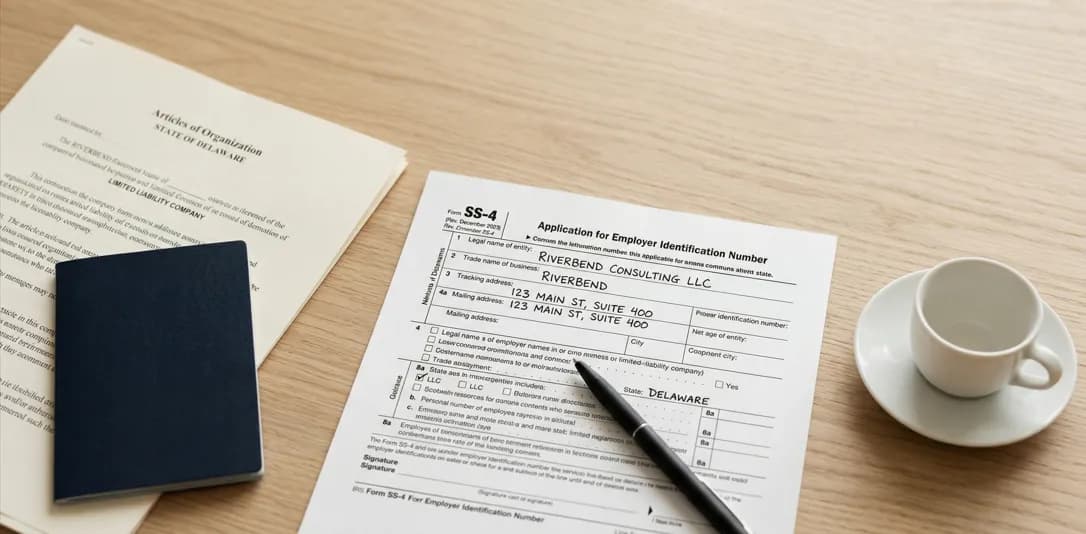
The SS-4 asks for a mailing address and a street address, and the only hard rule there is that the street-address line cannot be a PO box. It does not require a US address at all, because foreign addresses are expressly accommodated. What address to put where, and when a commercial address helps, is its own question, covered in what address to use on Form SS-4.
What an Address Service Can and Cannot Do Here
We sell business addresses, so it is worth saying plainly where that touches an EIN and where it does not.
An address service does not get you an EIN and is not required for one. The EIN is free, the online tool needs an SSN or ITIN rather than any particular address, and a foreign address is accepted on the SS-4. save office operates real US commercial addresses in cities including New York (SoHo and NoMad), San Francisco, Wilmington Delaware, Tampa Florida, Washington DC, and Cheyenne Wyoming, and none of that changes whether the IRS requires an EIN from you.
Where a real commercial address does matter is downstream, at the bank. The account application that asks for an EIN also asks for a business address, and a consistent, deliverable commercial address across your formation, your EIN, and your bank application is what keeps those records matching. Our free Address Checker tells you how an address is classified before you rely on it. That is a banking and records question, not an EIN one.
So does a single-member LLC need an EIN? For income tax, not until you hire, owe excise tax, change how you are taxed, add a member, or start over as a new entity. For your bank, almost certainly, but as a matter of its policy rather than federal law. For your clients, no, though an EIN keeps your Social Security number off every W-9 you sign.
The number is free and usually issued in minutes, so when one of those three parties makes the case, getting one is rarely the hard part. The useful move is knowing which party is actually asking, because that tells you whether you can say no. Confirm anything that affects your taxes with a professional before you file.
Frequently Asked Questions
Not sure what you need?
Two short pages sort it out — what the products actually are, and which situation you're in.

save office
Published
I'm Henry, a hedgehog in a bow tie who explains the dull, scary parts of building and running a U.S. business.