Key takeaways
- DBA filings happen at the county level in CA, NY, TX, and FL, while DE uses a state-level Fictitious Name filing through the Secretary of State.
- Virtual office addresses are accepted for DBA filings in all 5 states, but each state verifies the address differently.
- DBA renewal cycles range from no automatic renewal (NY) to 5 years (CA, FL) and 10 years (TX); missing a renewal can void the DBA without notice.
Before you start
- Confirm the county where you operate; DBA filings in CA and NY go to the county clerk where the business is located.
- Check whether your state requires DBA publication on top of the filing.
Who this is for
- LLC owners adding a DBA to operate under a brand different from the LLC name.
- Multi-state operators filing DBAs in two or more states.
A DBA, or Doing Business As name, lets a sole proprietor, partnership, LLC, or corporation operate under a brand name that is different from the legal entity name on file with the state. The address slot on the DBA filing is the part that varies the most from state to state, and it is usually the line item that bounces a bank application, a marketplace seller registration, or an IRS notice when it does not match the rest of the business records.
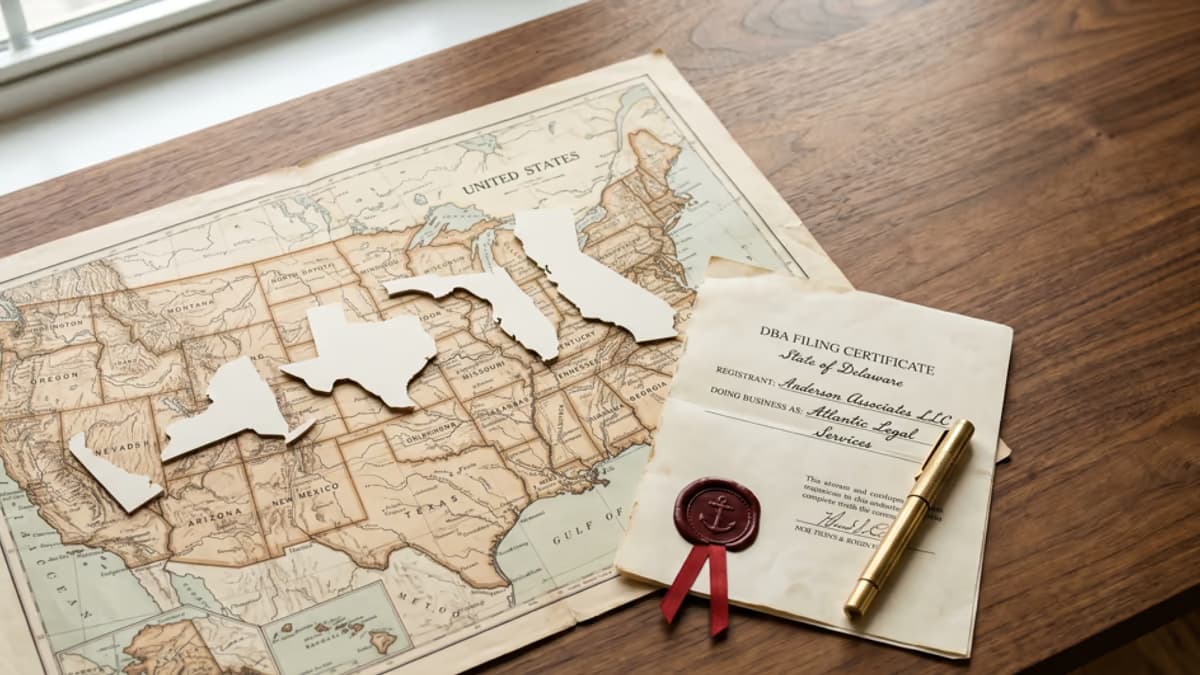
California, New York, Texas, Florida, and Delaware cover most of the cases that come through save office, and each state handles the DBA differently. The level of filing (county vs state), the renewal cycle, whether publication is required, and whether a virtual address is accepted are all decided by state law, not by the business owner. This guide compares the five states side by side so the DBA on file matches the address that actually receives mail and shows up on bank, IRS, and FinCEN records.
Setting up your LLC? See your US address options — no card →
Your DBA address is not the same as your LLC address
Every business filing in the United States touches three address slots, and a DBA touches a fourth one on top. Mixing them up is the most common reason a DBA filing comes back rejected or fails a bank verification check months later.
| Slot | What it is | Where it lives | Public record |
|---|---|---|---|
| LLC formation address | The principal office address listed on the Articles of Organization filed with the Secretary of State | State Secretary of State entity database | Yes, on the entity search |
| Registered agent address | A street address in the formation state where service of process can be delivered during business hours | Same state filing record as the LLC formation | Yes, on the entity search |
| DBA address | The address tied to the assumed name filing, registered with the county clerk or the state office that handles fictitious names | County clerk public search or state assumed name database | Yes, on the county or state DBA search |
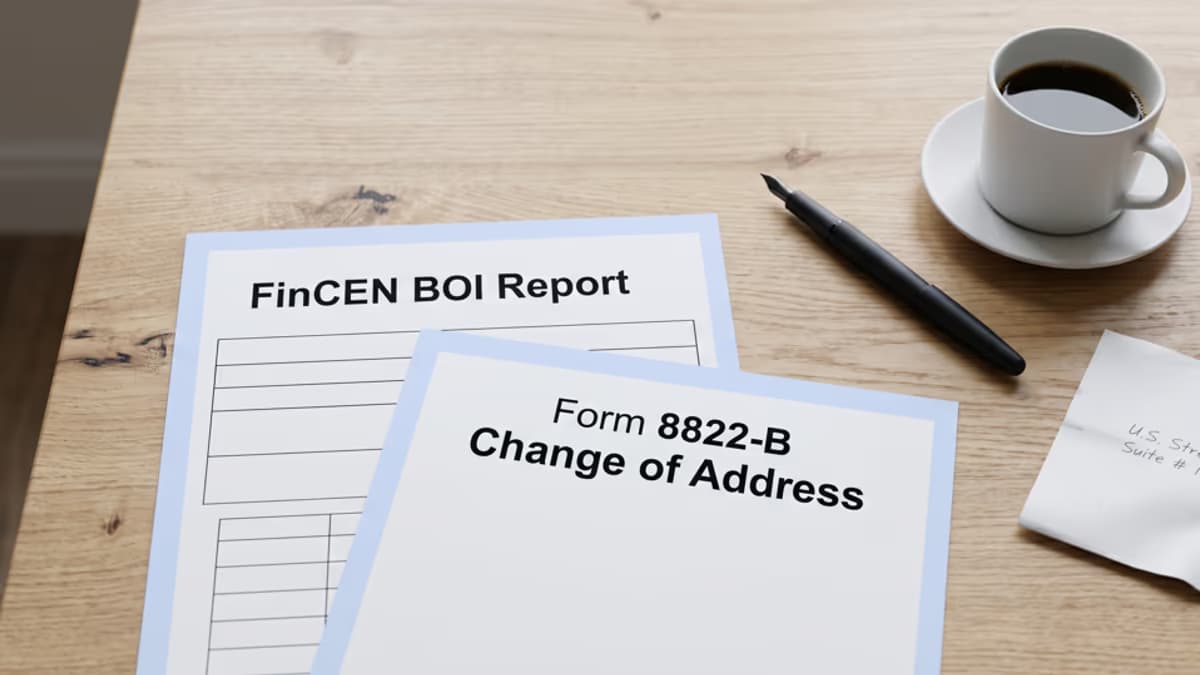
| Operating address (mailing, banking, marketplaces) | The street address used on the bank account, the IRS Form 8822-B, marketplace seller accounts, and BOI report | Bank, IRS, FinCEN, and marketplace internal records | Mostly non-public, except the IRS address used on a Form 1099 sent to a vendor |
Four address slots that show up around a DBA filing.
The DBA address can match the LLC formation address, but it does not have to. What matters is that the DBA address is in the jurisdiction the filing requires (a county for county-level filings, the state for state-level filings) and that it can receive mail. A virtual office that meets both conditions is generally accepted.
State vs county: where the DBA actually gets filed
The first decision that drives every other DBA rule is whether the state runs DBA filings at the county level, the state level, or both. The level decides which office accepts the form, which fee schedule applies, and whether the same DBA name can be used in multiple parts of the state without re-filing.
- California: county clerk only, in the county where the business operates. A statewide DBA does not exist in California, so a business operating in three counties files three Fictitious Business Name (FBN) statements.
- New York: split by entity type. Sole proprietors and general partnerships file a Certificate of Assumed Name with the county clerk where the business is located. LLCs and corporations file the Certificate of Assumed Name with the New York Department of State (NY DOS) at the state level.
- Texas: split by entity type. Sole proprietors and general partnerships file an Assumed Name Certificate with the county clerk in each county where business is conducted. LLCs, corporations, and other registered entities file Form 503 with the Texas Secretary of State.
- Florida: state level only, through the Florida Division of Corporations (Sunbiz). One fictitious name registration covers all 67 counties, no county filing needed.
- Delaware: state level (as of February 2, 2026). Delaware replaced the county-by-county prothonotary system with centralized statewide registration through the Division of Revenue's Delaware Trade Name Registry, at a $25 flat fee. The reform came in SB 291 (84 Del. Laws c. 459) and the February 2, 2026 start date was set by HB 177. Note that registration is mandatory for individuals and unincorporated firms but optional for corporations and LLCs under 6 Del. C. section 3108.
Terminology varies, the concept does not
California uses Fictitious Business Name (FBN), New York and Texas use Assumed Name, Florida uses Fictitious Name, and Delaware uses Trade Name. They all describe the same legal mechanism: registering a business name that is different from the legal entity name. Banks and marketplaces treat them as equivalents.
Ready to set up your business address?
See which US cities fit — about a minute, no card needed.
Can a virtual address be used for a DBA?
The short answer is yes in all five states, with different fine print in each. The DBA address has to be a real street address that can receive mail and is located in the jurisdiction the filing requires. A virtual office generally meets both conditions, because those addresses are real US commercial buildings with mail handling on site. The table below sets out what each of the five states asks for, which is a separate question from which of those states any one provider actually operates in.
| State | Virtual address accepted? | Jurisdiction rule | What banks usually look for |
|---|---|---|---|
| California | Yes, county-by-county | Address has to be in the same county as the filing county clerk | An LA County FBN works for an LA bank account if the address is in LA County |
| New York | Yes | Entity-level filings need a New York address; sole prop county filings need an address in the filing county | NY DOS Certificate of Assumed Name with a NY address clears most NY bank checks |
| Texas | Yes | Form 503 asks for the entity's principal office address, which does not have to be in Texas, and lists the operating counties separately; county sole prop filings need an address in the filing county | TX SOS Form 503 with a Texas address is accepted by Texas banks |
| Florida | Yes | The registration lists the mailing address of the business, and the county of the principal place of business decides which county newspaper runs the required advertisement | FL fictitious name with a FL address clears most FL bank checks |
| Delaware | Yes | Address has to be in Delaware (statewide registry via Delaware One Stop as of February 2, 2026) | DE trade name with a DE address is generally accepted by Delaware banks for business account opening |
Virtual address acceptance for DBA filings, by state.
P.O. Boxes are rejected in all five states for DBA filings. A street address with mail receiving capability is required in every case, which is why a virtual office tends to work where a P.O. Box does not.
The 5-state breakdown table
Use the table below to size up the DBA process before starting any of the filings. Fees are typical ranges; check the state office for the current fee on filing day, since county clerks set their own schedules.
| State | Filing level | Fee range | Renewal cycle | Publication required | Filing office |
|---|---|---|---|---|---|
| California | County | $26-50 per county for one owner | Every 5 years | Yes, 4 consecutive weeks in a county-approved newspaper within 45 days | County clerk where business operates |
| New York (LLC) | State | $25 flat to NY DOS (no per-county fee for LLCs or LPs) | No automatic renewal, amend on change | No | NY Department of State (Division of Corporations) |
| New York (corporation) | State + county | $25 to NY DOS + per-county fee ($25 outside NYC, $100 for each NYC borough) | No automatic renewal, amend on change | No | NY Department of State + county clerks |
| New York (sole prop) | County | $25-100 county fee, higher in NYC boroughs | Indefinite, refile on changes | No | County clerk |
| Texas (entity) | State | $25 Form 503 | Every 10 years | No | Texas Secretary of State |
| Texas (sole prop) | County | $15-25 county fee per county | Every 10 years | No (statewide rule) | County clerk in each operating county |
| Florida | State | $50 fictitious name registration | Every 5 years (renewal due Dec 31 of expiration year) | Yes, one-time newspaper notice in the county of principal place of business | Florida Division of Corporations (Sunbiz) |
| Delaware | State | $25 flat statewide | No renewal (perpetual until withdrawal) | No | Delaware Division of Revenue (Delaware Trade Name Registry) |
DBA filing requirements across California, New York, Texas, Florida, and Delaware.
California: county clerk filing and the 5-year clock
California is a pure county-level state. The Fictitious Business Name (FBN) statement is filed with the clerk of the county where the principal place of business is located. Any additional county where the same name is used requires a separate filing in that county.
- 1File the FBN statement at the county clerk in the operating county. Filing fees typically run $26-50 for one registrant, with a small per-additional-owner charge.
- 2Within 45 days of filing, publish the FBN statement in a county-approved newspaper of general circulation, once a week for four consecutive weeks. The newspaper files an affidavit of publication with the county clerk to close the loop.
- 3Renew the FBN statement every 5 years. The clock starts on the original filing date, and the renewal can skip re-publishing only if nothing in the statement changed and the refiling lands within 40 days of expiration. Note also that the statement expires 40 days after any change in the facts it records, not just at the 5-year mark.
- 4If the business operates in another California county, file a separate FBN statement in that county with the same publication requirement.
Skipping publication makes the FBN voidable
California Business and Professions Code §17918 bars a business operating under an unpublished FBN from maintaining a court action on contracts made in that fictitious name until the statement has been executed, filed, and published as required by the chapter. Banks may catch the missing publication during the account opening compliance review.
New York: state level for entities, county for sole prop
New York splits the DBA process between two systems. LLCs and corporations file the Certificate of Assumed Name with the New York Department of State at the state level. The additional per-county fees that get quoted everywhere are collected from corporations only, so an LLC or limited partnership pays the state fee and nothing more. Sole proprietors and general partnerships file with the county clerk in the operating county only.
| Filing component | Fee | Notes |
|---|---|---|
| Certificate of Assumed Name to NY DOS | $25 base | One filing covers the entity statewide |
| Per-county fee outside NYC | $25 per county, corporations only | Collected from corporations for every county where business is conducted under the assumed name. LLCs and LPs do not pay it |
| Per-county fee in NYC boroughs | $100 per borough, corporations only (Bronx, Kings, New York, Queens, Richmond) | NYC boroughs are billed at four times the standard county rate. LLCs and LPs do not pay it |
New York Certificate of Assumed Name fees, entity-level filing.
An LLC operating under one assumed name in Manhattan, Brooklyn, and Queens pays the $25 state fee and nothing else. A corporation doing the same thing pays $25 (NY DOS) + $100 + $100 + $100, or $325 total for the original filing, because the per-county fees are written against corporations. Sole proprietors avoid the state-level fee but pay county-level fees in every operating county, which is why most NY-based LLCs find the state-level entity filing simpler than a multi-county sole prop registration.
The NY publication rule does not apply to DBAs
The famous NY publication requirement (6 weeks in 2 newspapers) applies to LLC formation, not to the Certificate of Assumed Name. New York DBA filings have no publication step.
Texas, Florida, Delaware: simpler but with traps
The other three states share a similar shape (one main filing, longer renewal cycle than California, no or limited publication) but each carries a specific gotcha that catches first-time filers.
- Texas Form 503 entity assumed name: $25 to the Texas Secretary of State, valid for 10 years. The trap is that sole proprietors are not on Form 503 at all. Sole prop DBAs are filed at the county clerk in every operating county, and Texas county clerks have varying fee schedules and forms. An LLC that converts from a sole prop without re-filing the assumed name at the state level keeps an unenforceable county-only DBA.
- Florida Sunbiz fictitious name: $50 statewide, valid for 5 years, renewable any time during the expiration year before December 31. The trap is the publication step. Florida requires certification that the intention to register was advertised at least once in a newspaper in the county of the principal place of business. Sunbiz does not check, but the registration is technically defective without the advertisement, and the statute bars the business from maintaining a suit until it complies.
- Delaware trade name: $25 flat statewide registration through the Delaware Trade Name Registry at the Division of Revenue, as of February 2, 2026. The previous county-by-county prothonotary system was retired. Registration is mandatory for individuals and unincorporated firms and optional for corporations and LLCs.
Common mistakes that void a DBA filing
- 1Filing in the wrong jurisdiction. A California FBN filed in the wrong county is invalid. A New York corporation's Certificate of Assumed Name without the per-county fees for every operating county leaves that filing incomplete in those counties, though LLCs and limited partnerships are not charged those fees at all.
- 2Skipping the publication step. California (4 weeks county newspaper), Florida (one-time county newspaper), and several other states without DBAs in the top five (Arizona, Georgia, Minnesota, Nebraska, Pennsylvania) require publication. A bank or court can refuse to recognize a DBA without proof of publication.
- 3Address mismatch with the bank account or marketplace seller account. The address on the DBA filing should match the business address on the bank account, the IRS Form 8822-B, the BOI report, and any Amazon, Etsy, or eBay seller registration. Mismatches surface during periodic Customer Identification Program (CIP) reviews and trigger account holds.
- 4Letting the renewal lapse. California and Florida (5 years), Texas (10 years) require renewals. A lapsed DBA is not automatically deleted from the state record, but it loses legal protection for the business name in court and on contracts signed under the DBA.
- 5Not updating the DBA when the LLC address changes. The DBA address is filed independently of the LLC formation address. Updating the LLC address with the Secretary of State does not update the DBA filing. File an amendment with the DBA office whenever the operating address changes.
- 6Confusing trade name (Delaware) with DBA (everywhere else). Same legal mechanism, different filing office, and different force. A Delaware LLC that operates in California may register a Delaware trade name (DE Division of Revenue, statewide as of Feb 2, 2026), which 6 Del. C. section 3108 makes optional for LLCs and corporations, but the California FBN is mandatory in the operating county if it uses the assumed name there.
- 7Filing the DBA without updating the BOI report (foreign reporting companies only). The BOI report (FinCEN) lists any DBA names the LLC uses. Under FinCEN's August 2026 final rule, US-formed LLCs are exempt from BOI reporting; foreign-formed entities registered to do business in the US still must update the BOI report within 30 days of filing the DBA, with a civil penalty of up to $606 a day for a willful failure (effective January 17, 2025; indexed annually).
save office provides real US street addresses in its cities, accepted as the DBA address in New York (NYC), Florida (Tampa), Delaware (Wilmington), Washington DC, San Francisco, and Cheyenne, Wyoming. save office is a single flat plan at $70 per month ($699 per year, the same in every city), and the address is matched to the entity formation document and the bank account on file. The companion guide on filing a DBA in a different state from your LLC walks through the cross-state case in detail.
Frequently Asked Questions
Sources & References
Primary sources this guide is based on.
- 1California Legislative Information · Business and Professions Code, Chapter 5 on Fictitious Business Names (accessed August 8, 2026)
- 2New York State Senate · General Business Law section 130, certificates for assumed names (accessed August 8, 2026)
- 3Texas Secretary of State · Form 503, Assumed Name Certificate for a filing entity (accessed August 8, 2026)
- 4The Florida Senate · Fla. Stat. 865.09, fictitious name registration (accessed August 8, 2026)
- 5Delaware Code Online · Delaware Code Title 6 Chapter 31, registration of trade names (accessed August 8, 2026)
- 6Delaware General Assembly · 85 Del. Laws c. 30, effective date of the trade name registry (accessed August 8, 2026)
Not sure what you need?
Two short pages sort it out — what the products actually are, and which situation you're in.