Key takeaways
- A DBA alone works in another state only when the LLC is not 'doing business' there legally; online sales alone usually do not trigger foreign qualification.
- Foreign LLC qualification is required when the LLC has employees, owns property, or maintains a physical presence in the other state.
- A target-state virtual office address satisfies the address requirement for both DBA filing and foreign qualification when needed.
Before you start
- Run the 'doing business' test against your activity in the target state before choosing DBA vs foreign qualification.
- Estimate the cost difference: DBA + virtual office vs full foreign qualification with annual reports.
Who this is for
- LLC owners expanding to a second state and deciding between a DBA and foreign qualification.
- Operators selling online into multiple states from a single formation state.
Most LLCs are formed in one state and stay there. The owner lives, banks, sells, and signs contracts in the same state where the Articles of Organization were filed, and the DBA filing (when the business uses a brand name different from the legal entity name) goes to the same state's county clerk or Secretary of State. Cross-state DBA filings are the exception, and they are the most common reason a save office customer asks where to file.
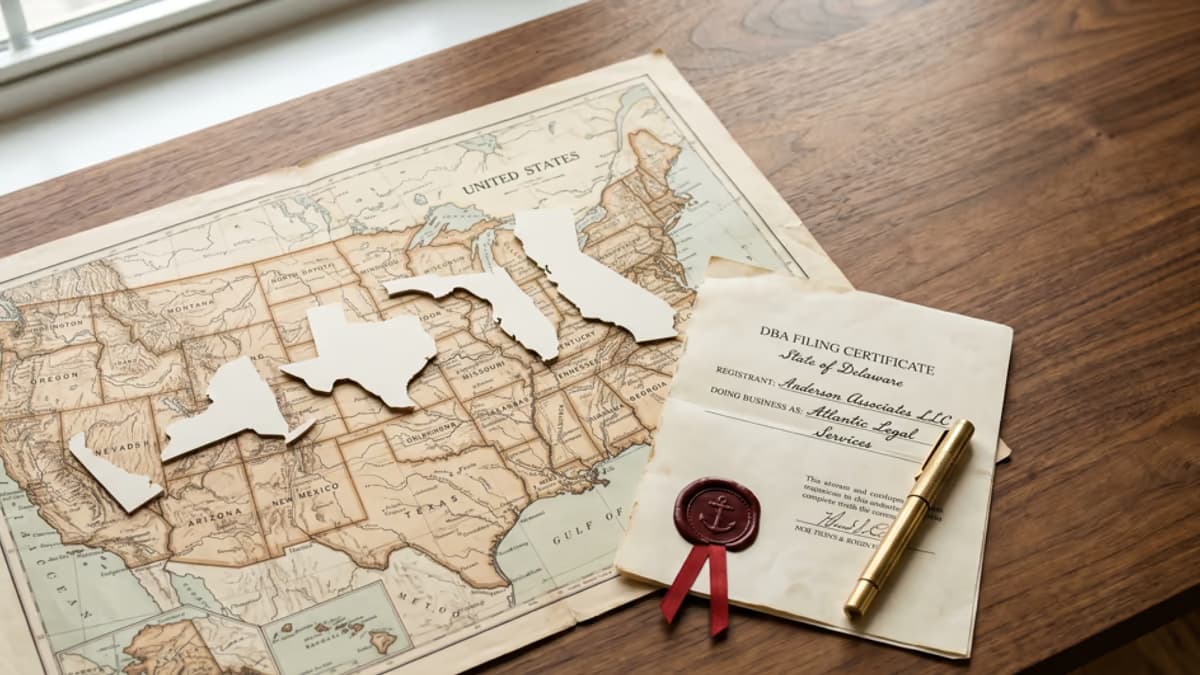
The exception happens when the business expands physically (an office, a warehouse, employees), files for foreign qualification, or starts marketing under a different brand name in a state where the LLC was not formed. The address rule on the DBA filing in the target state is the line item that quietly decides whether the bank account opens, the marketplace seller registration clears, and the foreign qualification stays in good standing. This guide walks through when a DBA alone works, when foreign qualification is required first, and how to file a cross-state DBA in California, New York, Texas, Florida, and Delaware.
Setting up your LLC? See your US address options — no card →
When 'doing business' in another state actually starts
Every state has its own definition of doing business inside its borders, and that definition decides whether the LLC needs to register as a foreign LLC, file a DBA, or both. The triggers below appear in some form in nearly every state's statutes.
- Physical office or warehouse in the state. A leased space, a coworking membership with a fixed desk, or a fulfillment center counts.
- Employees who work in the state, including remote employees whose primary work location is the state. Independent contractors usually do not trigger this rule, but state-by-state interpretation varies.
- A bank account opened in the state is not a trigger by itself, but combined with revenue collection it usually is.
- Continuous solicitation of customers in the state, beyond ad placement. Trade show appearances, repeat sales calls, and a state-specific website with a state-specific phone number generally count.
- Renting commercial space, even short-term, including pop-up retail and event-based sales over a sustained period.
- Real property ownership in the state, including investment property held by the LLC.
Online sales alone usually do not trigger 'doing business'
Selling online from a home-state LLC to customers in other states almost never triggers a foreign qualification or DBA requirement in the customer's state. Sales tax registration (Wayfair economic nexus) is a separate question with its own thresholds, covered in the upcoming sales tax permit guide.
DBA only vs Foreign Qualification vs both
The decision tree below covers the three patterns that surface most often when an LLC starts operating outside its formation state.
| Situation | Foreign Qualification | DBA in the new state | Why |
|---|---|---|---|
| Same LLC name, no physical presence in target state, online sales only | No | No | Online sales from a home-state LLC do not generally trigger doing business in the customer's state |
| Same LLC name, physical presence in target state (office, employees, warehouse) | Yes | No | Foreign qualification authorizes the LLC to operate; no DBA needed since the legal entity name is being used |
| Different brand name, no physical presence in target state | No | Maybe | If the brand name is used in the target state on contracts or marketing, some states require a DBA filing where the name is used |
| Different brand name AND physical presence in target state | Yes | Yes | Foreign qualification first, then DBA filed in the target state under the foreign LLC's authority |
| Selling on Amazon, Etsy, or eBay using a different brand name shipped from a target-state warehouse | Yes | Yes | The warehouse triggers foreign qualification; the brand name on the marketplace listing triggers the DBA |
Which filing your situation actually requires.
Foreign qualification is the legal step that gives the LLC permission to operate in a state where it was not originally formed. The DBA is the separate step that registers a brand name. The two filings are sequential, not interchangeable. Foreign qualification almost always comes first, since most states will not accept a DBA from a foreign entity that is not yet authorized to do business in the state.
Ready to set up your business address?
See which US cities fit — about a minute, no card needed.
The DBA address rule everyone gets wrong
The most common cross-state DBA mistake is using the home-state LLC address on a DBA filing in another state. Most states reject this. The DBA address has to be in the jurisdiction where the DBA is filed: the county for county-level filings, the state for state-level filings. The home-state address belongs on the LLC formation record, not on the target-state DBA.
| State | Address jurisdiction rule | Common mistake |
|---|---|---|
| California | The filing county follows your California principal place of business; a registrant with no California place of business files with the Sacramento County Clerk, and filing in an additional county is expressly permitted | Filing an LA County FBN with a Wyoming home-state LLC address, which leaves the filing county unsupported by any California business location |
| New York | Entity-level Certificate of Assumed Name needs a New York street address; sole prop county filings need an address in the filing county | Listing a Delaware LLC home-state address on the NY DOS Cert of Assumed Name |
| Texas | Assumed name certificate filed with the Texas Secretary of State on Form 503, which asks for the entity's principal office and lists the operating counties separately | Assuming the principal office on Form 503 must be a Texas address, or skipping the county list |
| Florida | The registration asks for the mailing address of the business, and the county of the principal place of business decides which county newspaper runs the required advertisement | Advertising in the wrong county paper, or filing before the entity is registered and in active status with the Division |
| Delaware | Filed statewide with the Division of Revenue, and the certificate carries no county address requirement | Assuming the retired county prothonotary process still applies, or skipping the Delaware business license the new process requires |
Where the DBA address has to be located, by state.
The fix is a target-state address before the DBA filing goes in. A virtual office in the target state meets the address requirement and gives the bank, the registered agent service, and the marketplace seller account a single consistent address to verify against.
5-state cross-state DBA matrix
The table below shows what a foreign LLC needs in each of the five states to file a DBA legally. Foreign qualification is assumed to be filed first in every case where doing business is triggered.
| Target state | Foreign qualification fee | DBA filing fee | Address requirement | Annual maintenance |
|---|---|---|---|---|
| California | $70 Application to Register (Form LLC-5); $20 biennial Statement of Information (Form LLC-12) is filed separately | $26-50 per county FBN | California county address (virtual works) | $800 annual franchise tax + Statement of Information every 2 years + FBN every 5 years |
| New York | $250 Application for Authority + biennial $9 + six-week publication in two county newspapers | $25 NY DOS (per-county fees apply to corporations only) | New York street address (virtual works) | Biennial Statement + amend Cert of Assumed Name on changes |
| Texas | $750 Application for Registration | $25 Form 503 | Texas address (virtual works) | Annual Public Information Report + Form 503 every 10 years |
| Florida | $125 foreign LLC qualification | $50 fictitious name + newspaper ad | Florida street address (virtual works) | $138.75 annual report + fictitious name every 5 years |
| Delaware | $200 foreign LLC certificate | $25 statewide trade name (Division of Revenue) | No county address requirement in the statute | $400 annual franchise tax + trade name perpetual |
Filing a DBA in each state from a foreign LLC.
Foreign qualification is not optional once doing business is triggered
States have separate penalties for operating without foreign qualification, including back fees, interest, late penalties, and the inability to enforce contracts in state court until the LLC is in good standing. The DBA filing does not substitute for foreign qualification, even if the target state accepts the DBA without proof of foreign qualification.
Using a virtual address to file a DBA in another state
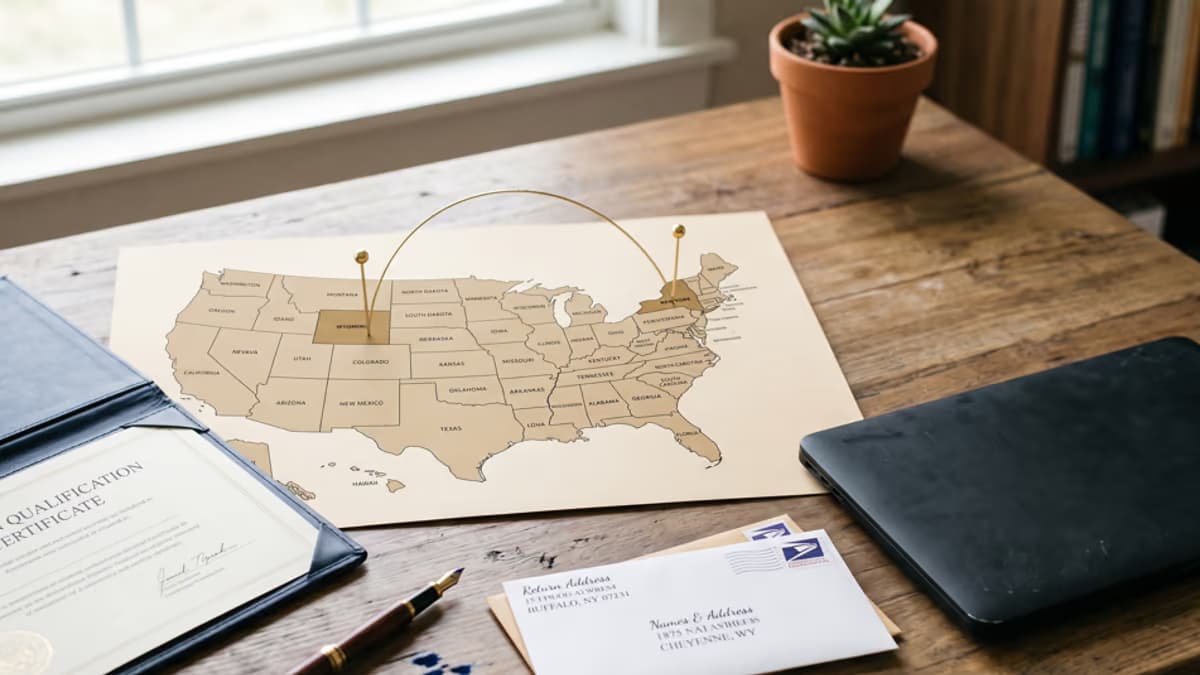
The pattern below covers the typical save office multi-state setup. The example uses a Wyoming home-state LLC expanding to New York, but the same sequence works for any home state and any target state in the matrix above.
- 1Get a target-state business address. A virtual office in New York City clears the New York address requirement on both the Application for Authority (foreign qualification) and the Certificate of Assumed Name (DBA).
- 2Foreign qualify the Wyoming LLC in New York. File the Application for Authority with NY DOS, $250 filing fee. The statute requires a certificate of existence from the formation state and the New York county where the office will be located. NY DOS asks for a recent certificate, so verify the current recency rule before ordering rather than assuming a fixed window. The NY business address goes on the Application as the office of the LLC in New York.
- 3Budget for the New York publication step, which most guides skip. Within 120 days of the Application for Authority, LLC Law 802(b) requires publication once a week for six successive weeks in two newspapers of the county where the New York office sits, designated by the county clerk, followed by a Certificate of Publication. In New York City counties this is the most expensive line item in the whole sequence.
- 4Appoint a New York registered agent. The same NY business address can serve as both the office address on the Application for Authority and the registered agent address, if the address is staffed during business hours. A separate registered agent service also works.
- 5File the Certificate of Assumed Name with NY DOS using the NY business address. $25 to NY DOS, and that is the whole state fee for an LLC. The per-county fees people quote are collected from corporations only.
- 6Open a New York bank account using the matching NY business address. The bank's CIP review pulls the foreign qualification record, the assumed name certificate, and the address from all three filings; matching addresses pass without follow-up.
The same pattern works in reverse, in parallel, or in stages. A Wyoming LLC can hold a New York DBA, a California DBA, and a Florida DBA simultaneously, with virtual addresses in each target state, as long as foreign qualification is in place before each DBA is filed.
Cross-state DBA notes by city
The save office cities below each have specific cross-state DBA mechanics that are worth scanning before the filing goes in. Each link goes to the city's deeper guide.
- California: Foreign LLC files Statement and Designation by Foreign LLC ($70) with the California Secretary of State, then files an FBN at the LA County Recorder/Clerk in Norwalk. Publication required, 4 weeks. See Los Angeles virtual office address for LLCs.
- New York City: Foreign LLC files Application for Authority with NY DOS ($250), then Certificate of Assumed Name with NY DOS ($25 flat, and the per-county fees apply only to corporations, not LLCs or LPs). Foreign-formed LLCs (formed outside the US) authorized in New York are also subject to the NY LLC Transparency Act (NYLTA, effective January 1, 2026) and must file a separate beneficial ownership disclosure. LLCs created in the United States stay outside the Act: the Governor vetoed the decoupling bill in December 2025, which left the Act's cross-reference to the federal definition intact. See New York virtual office address for LLCs.
- Washington DC: Not a state, but DC requires foreign LLCs to file Form FN-1 ($220) with DLCP (the Department of Licensing and Consumer Protection, which took over business filings from DCRA in October 2022), then a Trade Name Registration ($55, renewable every 2 years). See Washington DC virtual office address for LLCs.
- San Francisco, California: Foreign qualification is the same statewide CA filing. The FBN goes to the SF County Clerk-Recorder at City Hall. Publication in an SF-approved newspaper, 4 weeks. See San Francisco virtual office address for LLCs.
- Tampa, Florida: Foreign LLC files Florida Foreign Limited Liability Company application ($125) with the Division of Corporations, then a fictitious name registration ($50) with the same office. Newspaper notice in a Hillsborough County paper before filing. See Tampa virtual office address for LLCs.
- Wilmington, Delaware: Foreign LLC files a Certificate of Registration of Foreign LLC ($200) with the DE Division of Corporations. A Trade Name is then optional rather than required for an LLC, and the Division of Revenue now runs it statewide at a $25 flat fee as of February 2, 2026, replacing the county Prothonotary filings and adding a Delaware business license to the process. See Wilmington Delaware virtual office address for LLCs.
- Cheyenne, Wyoming: As a home state, Wyoming hosts the LLC formation. As a target state for cross-state operations, file a foreign LLC application ($150) with the Wyoming Secretary of State and a Trade Name registration ($100, 10-year term, $50 renewal fee under W.S. §40-2-105). See Cheyenne Wyoming virtual office address for LLCs.
The compliance stack you cannot skip
A cross-state DBA never sits alone. It rides on top of three other filings that all have to be in place and consistent for the bank and the IRS to recognize the business in the target state (FinCEN BOI reporting applies only to foreign-formed reporting companies under FinCEN's August 2026 final rule).
- 1Foreign qualification. Filed with the target state's Secretary of State or equivalent agency. Authorizes the LLC to legally operate. Without it, the DBA is built on sand.
- 2Registered agent in the target state. A street address staffed during business hours where service of process can be delivered. The registered agent address can be the same as the business address if a person is on site, or a separate registered agent service.
- 3DBA / fictitious name / trade name filing. Filed with the appropriate office (county clerk, state Secretary of State, or Division of Corporations). Registers the brand name in the target state.
- 4Bank account address that matches. Bank CIP review during account opening pulls the foreign qualification, the DBA filing, and the IRS records. Matching addresses across all four pass; mismatches usually trigger a hold and follow-up documentation request.
Step-by-step: filing your first cross-state DBA
The 8-step playbook below works for any of the five states in the matrix. The order matters, since some states reject DBAs from foreign LLCs that are not yet qualified.
- 1Confirm the activity actually triggers doing business in the target state. Use the trigger list at the top of this guide to walk through office, employees, warehouse, repeat solicitation, and real property.
- 2Get a Certificate of Good Standing from the home-state Secretary of State. Recency requirements vary widely, commonly somewhere between 30 days and one year depending on the state. These windows are set by each filing office rather than by statute, so verify the specific target state's current rule before ordering rather than working from a number you read somewhere.
- 3Get a target-state business address. A virtual office at a save office city address satisfies the address requirement on both the foreign qualification application and the DBA filing.
- 4File the foreign qualification application with the target state's Secretary of State. Pay the filing fee ($70 CA, $250 NY, $750 TX, $125 FL, $200 DE).
- 5Appoint a registered agent in the target state. Use the virtual office address if it is staffed during business hours, or a separate registered agent service.
- 6File the DBA / fictitious name / trade name with the appropriate office in the target state, using the target-state business address. Pay the filing fee and complete any publication step: California and Florida for the DBA itself, and New York for the foreign qualification that precedes it.
- 7Update the IRS Form 8822-B if the principal business address has changed. The 60-day window starts from the move date, not the DBA filing date.
- 8If the LLC is a foreign-formed reporting company still subject to FinCEN BOI under FinCEN's August 2026 final rule, update the BOI report within 30 days to add the new DBA name and any updated company address. US-formed LLCs are exempt and no BOI update is required. Open the target-state bank account using the same address.
save office offers real US street addresses in its cities (New York, Washington DC, San Francisco, Tampa, Wilmington Delaware, and Cheyenne Wyoming) that work as the target-state address on every step of this playbook. Multi-city plans let one customer hold addresses in three or four states at the same time, which is the typical setup for an LLC operating across state lines under different brand names. The companion guide on DBA address requirements by state covers the within-state filing rules in depth.
Frequently Asked Questions
Sources & References
Primary sources this guide is based on.
- 1California Legislative Information · Cal. Bus. and Prof. Code section 17917, fictitious business name publication (accessed August 8, 2026)
- 2California Legislative Information · Cal. Bus. and Prof. Code section 17915, county of filing and Sacramento fallback (accessed August 8, 2026)
- 3New York State Senate · NY General Business Law section 130, assumed name certificates and fees (accessed August 8, 2026)
- 4New York State Senate · NY LLC Law section 802, foreign LLC authority and publication (accessed August 8, 2026)
- 5Delaware Division of Revenue · Trade Names FAQs, statewide Delaware DBA registry (accessed August 8, 2026)
- 6The Florida Senate · Fla. Stat. 865.09, fictitious name registration and advertisement (accessed August 8, 2026)
Not sure what you need?
Two short pages sort it out — what the products actually are, and which situation you're in.