Key takeaways
- Banks, Stripe, and foreign qualification filings each ask for a Certificate of Good Standing at different points; the document confirms the LLC is current on filings and fees.
- Fees range from $5 (California, Florida LLCs) to $50 (Delaware, DC, New Jersey), with turnaround from minutes online (CA, FL, WY) to 1-2 weeks by mail (NY, which has no online self-service for the Certificate of Status).
- A CoGS becomes invalid the moment the LLC misses a filing; banks typically accept documents dated within the last 30-60 days.
Before you start
- Confirm your LLC is current on all state filings and fees before requesting the CoGS.
- Identify which receiving party (bank, Stripe, state) needs the CoGS and their accepted date range.
Who this is for
- LLC owners opening a business bank account or applying for Stripe.
- Operators completing foreign LLC qualification in a second state.
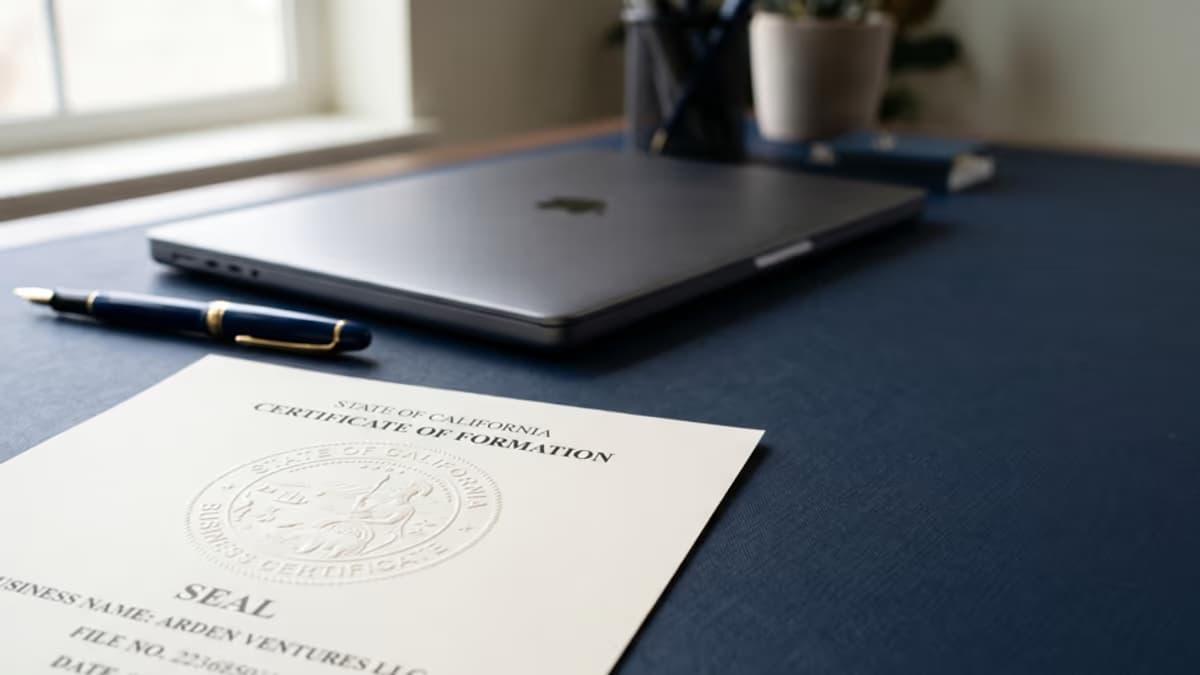
A Certificate of Good Standing for a limited liability company (LLC) is a state-issued document confirming the LLC is registered, current on its filings, and authorized to transact business in that state. Banks, payment processors, target states, and lenders request one to verify the company is active and compliant.
The certificate goes by different names across states. Delaware, Florida, Texas, and most other states call it a Certificate of Good Standing. New York issues it as a Certificate of Status, also referred to as a Certificate of Existence. California labels its version Certificate of Status as well. Despite the naming, the documents serve the same function: proof the entity exists, has filed what the state required, and is not under administrative dissolution or revocation.
What the certificate verifies is narrower than the name suggests. It confirms the LLC has filed its annual or biennial report, paid franchise tax or annual fee, maintained a registered agent on record, and is not currently dissolved. It does not verify financial health, the absence of lawsuits, contract performance, or operational quality. An LLC can sit in perfect good standing with the state and still be facing private litigation, late on vendor invoices, or running at a loss. The certificate is a state filing receipt, not a credit report.
This guide covers when the document is actually requested, how it is issued in the 10 states that account for most LLC formations, the validity windows that decide whether a 60-day-old certificate is still accepted at a bank, what 'not in good standing' means and how to restore it, and the apostille step foreign founders need on top of the certificate itself.
Setting up your LLC? See your US address options — no card →
When you actually need one
Most LLCs go years without ever requesting a Certificate of Good Standing. The request is event-driven, triggered by a counterparty that needs to verify the LLC's compliance status before extending credit, opening an account, or accepting a registration. The eight situations below account for nearly every CGS request a save office customer logs in a typical year.
- Opening a business bank account at a fintech. Mercury, Relay, Bluevine, and Brex usually do not require a CGS at the initial application stage, but they can ask for one during enhanced due diligence or high-risk industry review.
- Payment processor onboarding or reactivation. Stripe, PayPal Business, and Square typically rely on automated KYC and BOI matching, but a manual review unlocked by a chargeback dispute, a 1099-K mismatch, or a high-risk merchant category code can trigger a CGS request as supporting documentation.
- Foreign qualification in another state. Every state that accepts a foreign LLC registration requires a CGS from the home state, with recency rules that vary widely (e.g., 60 days in Wyoming, 90 days in Florida, 6 months in California, 1 year in New York). This is the single most common reason for a CGS request.
- SBA loan, line of credit, or commercial mortgage applications. Bank lenders verify the LLC is active and authorized in its home state before underwriting. The CGS is a standard checklist item, usually requested with the formation documents and the operating agreement.
- M&A due diligence. Buy-side counsel asks for a CGS from every state the target LLC is authorized in, to confirm there are no dissolution orders, suspended status, or unpaid franchise taxes that would survive the transaction.
- SAM.gov government contracting registration renewal. Federal contractor registrations require proof the LLC is active in its formation state, refreshed annually.
- Professional license renewal. Insurance, real estate, healthcare, and other licensed industries verify entity good standing as part of license renewal in many states.
- Reinstatement after administrative dissolution. When an LLC missed annual reports and was dissolved, the reinstatement file usually requires a fresh CGS from any state the LLC is authorized in, plus payment of back fees.
Companion guides cover several of these triggers in depth. The bank account address requirements guide walks through the items Mercury, Relay, and Bluevine actually verify, the payment processor guide covers Stripe, PayPal, and Square verification address rules, and the cross-state DBA guide details foreign qualification's CGS requirement state by state.
How to get one: 10-state filing matrix
The CGS request is filed with the state agency that maintains the LLC's formation record, the Secretary of State (SOS) or its equivalent: Department of State in New York, Division of Corporations in Delaware and Florida. Most states accept online requests through their SOS portal and deliver a PDF within hours. A handful still require paper or fax for the original embossed certificate that some courts and international filings demand. The matrix below covers the 10 states where save office customers form their LLCs most often.
| State | Online fee | Processing | Online portal | Paper original |
|---|---|---|---|---|
| Delaware | $50 | 3-5 business days standard; expedite tiers $100-$1,500 | Division of Corporations e-Service | $50, mail returns the certified original |
| New York | $25 | Mail/fax only (no online self-service) | Mail or fax (518-473-1654) to NY DOS | $25, returned by first-class mail; +$25-$150 for expedite |
| California | $5 | 1 business day | bizfileOnline.sos.ca.gov | $5, expedite available |
| Florida (LLC) | $5 | Instant PDF | Sunbiz.org | $5 for LLCs ($8.75 for corporations and other entities), mailed in 1-3 business days |
| Wyoming | $20 | Instant PDF | Wyoming SOS Online Filing | $20, mailed in 1 business day |
| Washington DC | $50 | 1-3 business days | CorpOnline (DLCP) | $50 standard, expedite extra |
| Texas | $15 | ~2 hours via SOSDirect; 1 business day for mail/email | SOSDirect or SOSUpload | $15, mail or in-person pickup |
| Pennsylvania | $40 | 1-3 business days | PA Business One-Stop Hub | $40 standard |
| Tennessee | $20 | 1-3 business days | TN SOS business filings portal | $20, mail by request |
| New Jersey | $50 | Same-day PDF | Business Records Service portal | $50, expedite extra for paper |
Certificate of Good Standing fees and processing times by state. Online ordering with PDF delivery is the most common path; expedite and original embossed copies cost extra in most states.
Fees and processing times can change
State fees and turnaround times update on a fiscal-year basis and during portal migrations. Always confirm the current number on the state's SOS website at the time of the request, especially before relying on the certificate for a closing date.
Ready to set up your business address?
See which US cities fit — about a minute, no card needed.
Filing the request in the four most common states
The four states below cover the majority of CGS requests for save office customers: Delaware, the default formation state for funded startups; New York, the largest market; California, with its high LLC density and high franchise tax exposure; and Wyoming, the privacy and registered-agent friendly default. The procedures below describe the standard online path. Expedited and certified original copies follow a separate intake in each state.
Delaware. Delaware files through the Division of Corporations e-Service portal. The request requires the entity file number, which appears on the original Certificate of Formation and on Delaware franchise tax notices. Online orders deliver a PDF in 1-3 hours during business hours, with an embossed paper original mailed in 1-3 business days for the same $50 fee. Delaware does not check apostille status during the standard request; the apostille step is filed separately with the Secretary of State after the CGS issues.
New York. New York issues through the Department of State (DOS), Division of Corporations. The Online Filing System processes Certificate of Status requests at $25, delivered as a PDF within 24-48 hours. New York is one of the few states where the online certificate is digitally signed and sealed, and most banks and target states accept the digital version, which removes the paper-original step. Paper requests take 1-2 weeks. The certificate confirms the entity exists and is current on the biennial Statement filing required for LLCs.
California. California files through bizfileOnline.sos.ca.gov, the modern portal that replaced the paper-only Certificate of Status process. The fee is $5 with most certificates issued within 1 business day. California's certificate confirms the LLC has filed its Statement of Information, due every two years for LLCs, and paid the $800 annual franchise tax. An LLC that has not paid the franchise tax cannot receive a Certificate of Status, even if its other filings are current.
Wyoming. Wyoming SOS issues the Certificate of Good Standing through its online filing portal at $20 with instant PDF delivery. Wyoming is the only state in this list that also offers a free public business search at sos.wyo.gov that confirms an entity is active. The free search is not a Certificate of Good Standing for legal purposes, since it does not bear the SOS seal, but it works for informal verification. Banks and target states require the $20 sealed certificate, not the public lookup.
How long the certificate stays valid
The certificate itself does not expire. The state record it represents does, since LLCs continuously file annual reports and pay franchise taxes. What 'expiration' means in practice is the validity window the receiving party (a bank, a target state, a lender) is willing to accept. The windows below are the ones save office customers run into most often.
- Foreign qualification filings. Most states require the CGS to be dated within 60 days of the foreign qualification application. A handful (Texas, North Carolina) accept up to 90 days. None accept older than 90.
- Bank account opening at fintechs. Mercury, Relay, Bluevine, and Brex generally accept a CGS dated within 90 days. Brick-and-mortar banks (Bank of America, Chase, Wells Fargo business accounts) sometimes require 30-60 days.
- SBA loans and lines of credit. Most lenders require a CGS dated within 60 days of the loan application or closing date, refreshed if the closing slips by more than 90 days.
- M&A closings. Buy-side counsel typically requires a CGS dated within 30-60 days of closing, with a fresh bring-down request the day of or one business day before signing.
- Apostille requests. No window is required for the underlying certificate, but the apostille step adds 1-3 weeks on top of it, which compresses the practical window for international filings.
The 60-day rule is the most defensible default. Order the CGS no more than 60 days before the date the receiving party will use it, and if the timeline slips, order a fresh certificate rather than relying on the original to age into rejection. The PDF delivery times in the matrix above mean a fresh request rarely costs more than 1-3 business days, even with same-week deadlines.
What 'not in good standing' means and how to restore
An LLC falls out of good standing when one or more of the state's compliance items lapses. The state's response is a status downgrade visible on the public business record, which the SOS will refuse to certify until the underlying issue is fixed. The four triggers below cover the majority of cases.
- Missed annual or biennial report. The most common trigger. States generally allow some time after the deadline before flagging the LLC, and the distance from there to administrative dissolution varies by state, from 60 days in Wyoming to over five years in California, with New York not administratively dissolving LLCs at all. Reinstatement requires filing the missed reports and paying late fees.
- Unpaid franchise tax or annual fee. Delaware ($400 annual), California ($800 annual), and Texas (which requires a Public Information Report (PIR) or Ownership Information Report (OIR) annually after SB 3 (2023) discontinued the No Tax Due Report for the 2024 report year; entities at or below the no-tax-due threshold no longer owe franchise tax but must still file the information report) all flag the LLC the same year the tax or report goes unfiled. Reinstatement requires paying the back tax, interest, and reinstatement fee.
- Missing or expired registered agent. When the registered agent resigns, dies, or has its commercial registration suspended, the SOS notifies the LLC and gives 30-60 days to appoint a replacement. After that, the entity is flagged.
- Voluntary dissolution that was never withdrawn. An LLC that filed Articles of Dissolution and then continued operating is technically in dissolved status. Reinstatement requires filing Articles of Reinstatement and paying any back fees that accrued during the dissolved period.
Reinstatement timelines run 1-4 weeks in most states. Delaware can reinstate in 24-48 hours through the e-Service portal once the back franchise tax is paid. California can take 4-6 weeks during peak filing season. The reinstatement file is what restores the LLC's good standing; the fresh CGS request that follows is a separate filing.
Reinstatement does not retroactively cure every contract signed during dissolution
Some states allow contracts signed by a dissolved LLC to be enforced once the LLC is reinstated. Other states do not, which can leave gaps in enforceability for the dissolution window. If the LLC continued operating during a dissolution window, work with state-specific counsel before assuming reinstatement cures the entire period.
Certificate of Good Standing for foreign founders
Founders forming a US LLC from outside the United States hit a second step that domestic founders usually skip: the apostille. The apostille is a separate authentication issued under the 1961 Hague Convention that makes the certificate recognizable in another Hague-member country without further legalization. Foreign banks, foreign tax authorities, and overseas commercial registries usually require the apostilled version, not the SOS-only certificate.
The apostille is filed with the Secretary of State of the issuing state, the same office that issued the underlying CGS, not with the federal government. The fee typically runs $20-50 with processing times of 1-3 weeks depending on the state's backlog. Some states (Delaware, Florida, New York) offer same-day or expedited apostille service for an additional fee. The apostilled certificate is the original embossed paper, not a PDF, since the apostille itself is a stamped page attached to the back of the certificate.
- Hague Convention countries including most of Europe, the United Kingdom, South Korea, Japan, Mexico, Brazil, and 120 other states accept the apostille on its own.
- Non-Hague countries including the United Arab Emirates, Iraq, Jordan, and Vietnam require additional steps, usually legalization through the destination country's consulate or embassy in the US, on top of the apostille. China joined the Convention on 2023-11-07, Canada on 2024-01-11, and Saudi Arabia on 2022-12-07; documents to those countries now use the apostille directly. Verify the receiving country's current status at hcch.net/en/instruments/conventions/status-table/?cid=41 before filing.
- Translation is sometimes required by the receiving country. The translated copy is usually attached separately and notarized; some countries require a sworn translation done in the destination jurisdiction.
Foreign founders building a US LLC for international banking, ITIN application, or cross-border invoicing should plan a 4-6 week buffer for the CGS plus apostille plus shipping plus, when needed, consulate legalization. The companion guide on getting an EIN without an SSN walks through the parallel federal step that usually runs alongside the CGS request for foreign-founder LLCs.
How your business address affects the request
The address used to request a CGS is the requester's delivery address, where the certificate is sent if a paper copy is ordered. The address that matters for the underlying good standing status is the LLC's registered agent address and principal business address on file with the SOS. Mismatches between those addresses and the addresses on file with the IRS, BOI, banks, and contracts are one of the quiet sources of compliance friction.
- SOS principal business address has to match the address on the most recent annual report.
- Registered agent address has to be a current, staffed location during business hours where the agent can accept service of process. PO Box addresses are rejected as registered agent addresses in nearly every state.
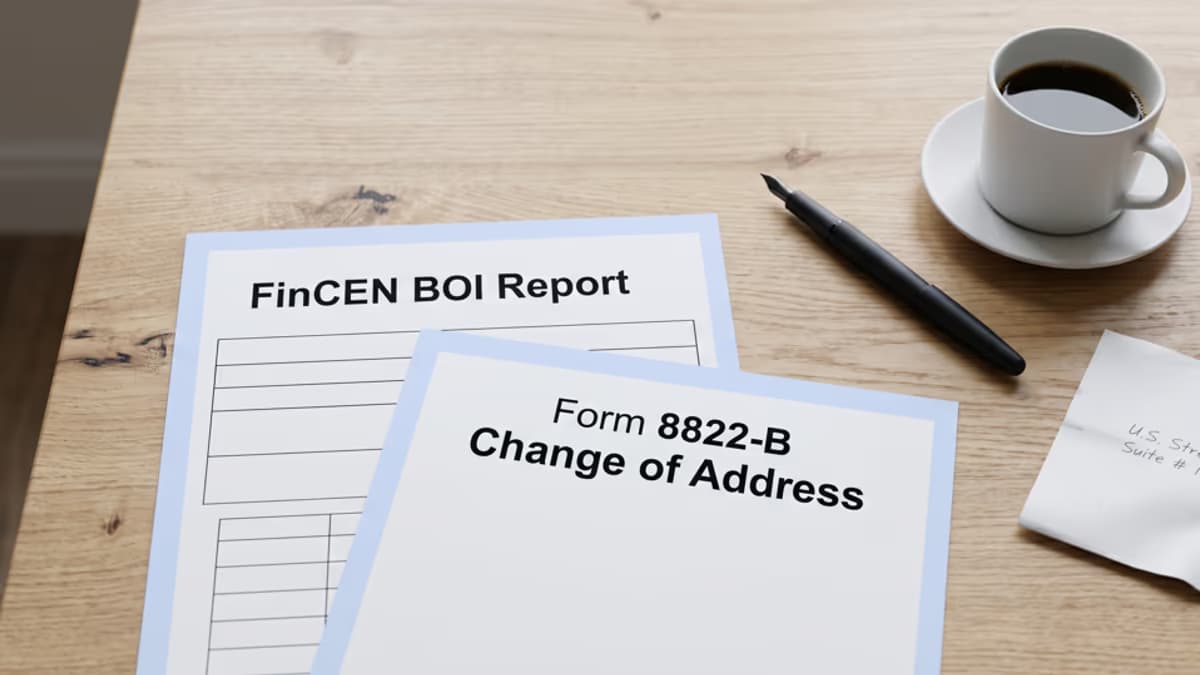
- IRS principal business address filed on Form 8822-B has to match the SOS principal business address within 60 days of any change.
- BOI principal place of business address (foreign reporting companies only, under FinCEN's August 2026 final rule) should line up with the IRS and state records as housekeeping, with a 30-day update window for any change to the information actually reported. US-formed LLCs are exempt from BOI reporting.
- Bank verification address has to match what is on the SOS record at account opening. A mismatch later, after a move, usually triggers a re-verification request rather than account closure.
A real US business address from save office, with locations in New York, Washington DC, San Francisco, Tampa, Wilmington Delaware, and Cheyenne Wyoming, satisfies the address requirements on the SOS principal business address line, the BOI principal place of business line, and the bank verification line. The registered agent slot is a separate requirement with its own state-by-state rules, and save office does not sell registered agent service. Multi-city plans let one LLC hold the formation-state address and a target-state address at the same time, which is the typical setup for a foreign-qualified LLC operating in two states.
Frequently Asked Questions
Not sure what you need?
Two short pages sort it out — what the products actually are, and which situation you're in.