Short answer
A sole proprietor has no registered agent address to worry about. A registered agent is required of a filing entity, meaning a business that filed a formation document with the state, and a sole proprietorship files none. The addresses that actually become searchable public records are the ones on your DBA, or doing business as, registration and your local business license. The addresses on your tax paperwork, including Schedule C and your application for an Employer Identification Number, are confidential under Internal Revenue Code section 6103.
Key takeaways
- Registered agent requirements attach to filing entities, not to business types. A sole proprietorship never files a formation document, so there is no registered agent field to fill in. Most of the advice you will find answers a question you do not have.
- The address a law requires and the address the public can search are two different lists. Your tax filings are sealed. Your DBA and your business license are indexed.
- New York goes furthest: its assumed name certificate asks for the residence address of each individual, the county clerk indexes it, and a certified copy has to be posted at the place of business.
- Getting an EIN lets you put that number on a W-9 instead of your Social Security number. It does not hide your name, which still has to appear on line 1.
- A sole proprietor has no liability separation to fall back on. That makes address separation the only separation available, not a redundant one.
Before you start
- Check whether you are actually registering a business name. If you operate under your own legal name, you may have no DBA filing at all, and the public exposure picture changes completely.
- Look up your own county clerk's assumed name form before you assume anything about what it asks for. These requirements are set at the state and county level and they differ more than people expect.
Who this is for
- Freelancers, photographers, consultants, and trades working under their own name or a DBA, with no LLC and no plans to form one yet.
- Anyone who searched for a business address as a sole proprietor and kept landing on articles about registered agents.
Search for what address a sole proprietor needs and you will be told, within about two results, to use a registered agent address rather than your home. It sounds authoritative. It is a category error, and following it wastes money on a service you cannot use.
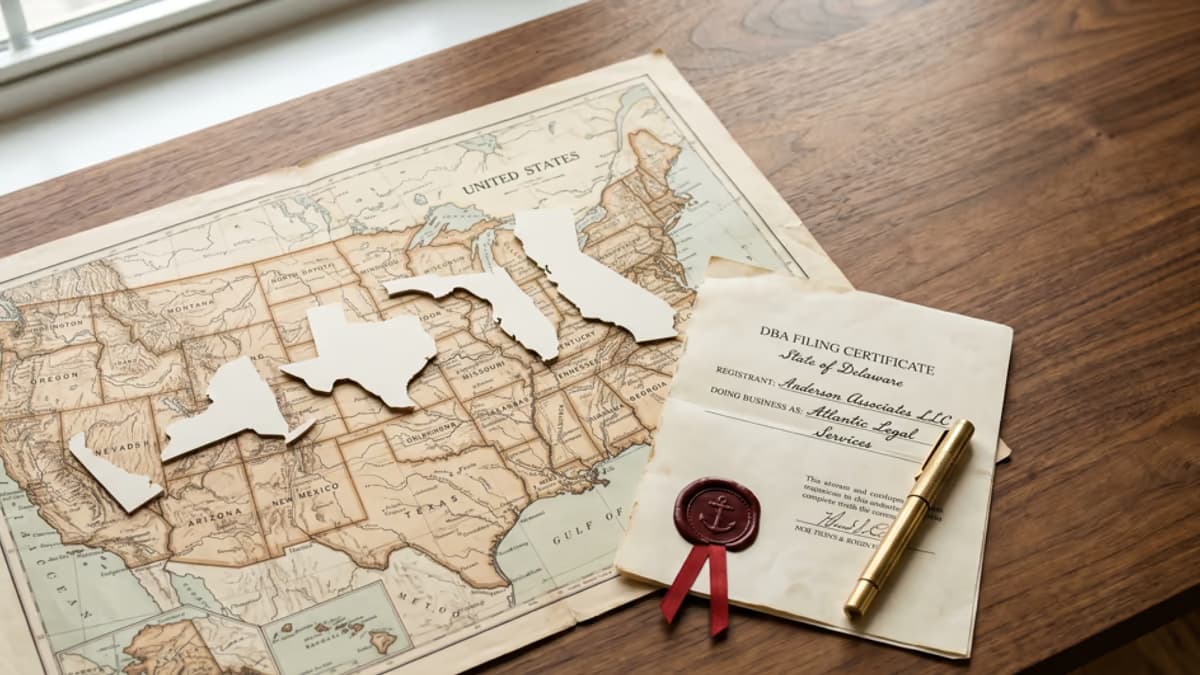
A registered agent is not something a business type has. It is something a filing entity has. Texas puts it about as plainly as a secretary of state ever does: a domestic or foreign filing entity is required to continuously maintain a registered agent and registered office in Texas. A filing entity is a business that created itself by submitting a formation document to the state. An LLC did that. A corporation did that. A sole proprietorship did not, and that is the entire definition of one. The Small Business Administration describes it as a structure that does not produce a separate business entity, a structure you fall into automatically if you do business without registering as anything else.
So there is no registered agent box on your paperwork, because there is no paperwork of that kind. If you have been trying to work out what to put in that box, you have been worrying about a field on a form that does not exist for you. The real question is different, and nobody seems to be answering it: your address still ends up in a few specific places, and only some of those places are public.
The Address a Law Requires Is Not the Address People Can Find
Almost every article on this topic gives you one undifferentiated list of forms that ask for an address, which is useless, because those forms do very different things with it. Some of them seal the address. Others index it and put it in a drawer the public can open. Sorting them is the whole job.
| Where your address goes | Is it public? | What actually happens to it |
|---|---|---|
| DBA or fictitious name registration | Public, and this is the big one | The entire purpose of the filing. Florida's Division of Corporations says the sole purpose of registration is to inform the public which individual or business entity is transacting business under a particular name, and the record is searchable by owner name. |
| Local business license | Usually public, varies by city | In the Office of Finance treats business name and address as disclosable under the California Public Records Act, and the city publishes an open dataset of active businesses. |
| EIN application, Form SS-4 | Confidential | Internal Revenue Code section 6103 makes returns and return information confidential, and its definition of taxpayer identity expressly includes the mailing address. |
| Schedule C, line E | Confidential | Same section 6103 protection. Worth noting the instruction itself: if you run the business from the home address already shown on page 1 of your return, you do not complete line E at all. |
| Form W-9 given to clients | Not a public record | But every client who requests one gets it. Line 5 exists so the requester knows where to mail your information returns, which means the address travels to each customer individually. |
| Google Business Profile | Your choice | Google verifies with an address but tells service-area businesses to hide it. Its own guidance says a plumber running the business from a residential address should clear the address from the profile. This is a setting, not an exposure. |
Only two of these six get indexed for strangers to search. Most guides treat all six the same way.
Read the table again and the shape of the problem changes. The IRS, the agency people are most nervous about, is the one that seals your address by statute. The county clerk, who takes a modest filing fee and hands you a stamped copy, is the one who publishes it.
Ready to set up your business address?
See which US cities fit — about a minute, no card needed.
What the DBA Filing Actually Asks For
If you register a business name, this is where your address becomes findable, and the requirements are stronger than most people expect. Three states, three different ways of making the same point.
- New York asks for the address where the business is conducted and, under General Business Law section 130, the residence address of each individual behind the name. The county clerk keeps an alphabetical index of it, and a certified copy has to be posted at the place of business. Your home address, in a public index, on a document pinned to your wall.
- California requires the street address and county of the registrant's principal place of business under Business and Professions Code section 17913, then section 17917 requires the statement to be published in a newspaper of general circulation. Not merely filed. Printed.
- Florida registers the name for the express purpose of telling the public who is behind it, and Sunbiz lets anyone search the record by owner name.
These forms ask for the place where the business is actually conducted. California's statute asks for a street address, and Los Angeles says plainly that it takes no PO Boxes on a business registration. Whether a box number is accepted elsewhere depends on the state and often the county, so pull your own clerk's form before you fill anything in. Do not take a blanket answer from anyone, including this article.
None of this is a reason to skip the DBA. It is a reason to decide which address goes on it before you are standing at the counter, because that is the moment the decision gets made for most people, and the default is whatever address is on their driver's license.
The EIN Does Less Than You Think, and More
A sole proprietor with no employees and no excise tax obligations does not need an EIN at all. The IRS is clear that such a person simply uses their Social Security number as the taxpayer identification number. Which means that without one, every client who asks you for a W-9 gets your Social Security number on it.
Get an EIN and the W-9 instructions permit something better. If you are a sole proprietor and you have an EIN, you may enter either your SSN or your EIN. Ten clients, ten copies of a number that is not your Social Security number, sitting in ten different filing systems of unknown quality.
An EIN masks the number, not the name. Line 1 of the W-9 still has to show your individual name as it appears on your Form 1040. The DBA name goes on line 2. This is number privacy, not anonymity, and anyone selling it as the latter is overselling.
The Objection Worth Taking Seriously
Here is the argument against everything above, and it is a fair one. A sole proprietor has no liability shield. The SBA says it directly: you can be held personally liable for the debts and obligations of the business. So if the law already treats you and your business as the same person, what is the point of giving them different addresses? It sounds like theater.
It is the opposite, and the reason is structural. An LLC owner has an entity to hold things. The address in the public record is the company's address, and the company is a separate thing from the person. A sole proprietor has no such container. Every address field defaults to you, and in practice that means your home. New York's residence address requirement is that structure showing its teeth.
So the absence of liability separation does not make address separation pointless. It makes it the only separation still on the table. Two different things are being separated here and they should not be confused: liability separation is what an LLC does, and address separation is about who can find you. A sole proprietor cannot have the first. That is precisely why the second stops being optional.
To be explicit, because this gets blurred in marketing copy everywhere: a business address does not protect your personal assets. It does not create liability separation, and no address ever will. If personal liability is your actual concern, the answer is forming an entity, not changing your mailing address.
What to Do Before You File Anything
The sequence matters more than the choice, because two of the documents below are hard to unwind once filed. A DBA sitting in a public index does not become unpublished when you move.
- 1Decide whether you are filing a DBA at all. Operating under your own legal name often means no assumed name filing, which removes the largest public exposure entirely.
- 2If you are filing one, settle the address first. This is the record that gets indexed, published, and in New York, posted on your wall.
- 3Get the EIN before you send your first W-9, so your SSN never enters a client's filing system in the first place.
- 4Check the local license requirement in your city, separately, because that is a second public record with its own rules.
- 5Leave your tax filings alone. Schedule C and the SS-4 are sealed by section 6103, and there is nothing to defend there.
If the address you want on the public records is not your home, you need a real street address, not a box number. save office provides one in its US cities, active within 24 hours, with mail received and forwarded to wherever you actually work. Run it through the address checker before you file, because the time to find out that an address will not be accepted is before it is sitting in an alphabetical index at the county clerk's office, not after.
Not legal advice. DBA and licensing requirements are set state by state and often county by county, and this article names three states out of fifty. Confirm your own county's form before filing.
Frequently Asked Questions
Not sure what you need?
Two short pages sort it out — what the products actually are, and which situation you're in.

save office
Published
I'm Henry, a hedgehog in a bow tie who explains the dull, scary parts of building and running a U.S. business.