Key takeaways
- The CP 575 is the one-time EIN confirmation notice the Internal Revenue Service (IRS) mails when an Employer Identification Number (EIN) is first issued. The IRS does not print a second copy. The EIN Verification Letter, called a 147C, is the official replacement and is treated by banks and payment processors as equivalent to the original CP 575.
- A 147C is requested by phone from the IRS Business and Specialty Tax Line at 800-829-4933, after the caller passes identity verification as the responsible party or an authorized person. The IRS can fax it during the same call or mail it. A mailed 147C typically takes about 10 to 14 business days, roughly two to three weeks, and goes only to the address the IRS has on file.
- If the address on file is wrong, the 147C can be undeliverable and the request effectively fails. Form 8822-B updates the business mailing address, business location, and responsible party with the IRS, and the IRS asks for roughly four to six weeks to process it, so the address has to be correct before the 147C is requested, not after.
- Banks, Stripe, and Mercury compare the address on the EIN letter against the formation documents and the application. A mismatch is a common Know Your Customer (KYC) rejection reason, so the EIN letter address should match the rest of the stack exactly.
Before you start
- Confirm who the IRS has on record as the responsible party for the EIN. Only the responsible party or a person with a valid authorization, either a Form 2848 Power of Attorney or a Form 8821 authorization, can pass the phone verification to request a 147C.
- Check the business address the IRS currently has on file before calling. The 147C is mailed only to that address, and the phone agent will not redirect a mailed letter to a different address on request.
- Have the legal entity name, EIN if known, and formation details ready. If the EIN itself is unknown, the same call can confirm it after identity verification.
Who this is for
- Founders who were asked for an EIN confirmation letter by a bank, Stripe, or Mercury and cannot find the original CP 575.
- Foreign founders who never received a mailed CP 575 because the EIN was issued by fax or online and the paper copy went to an address they no longer control.
- LLC owners who moved the business address and need the IRS record corrected before the EIN letter will arrive.
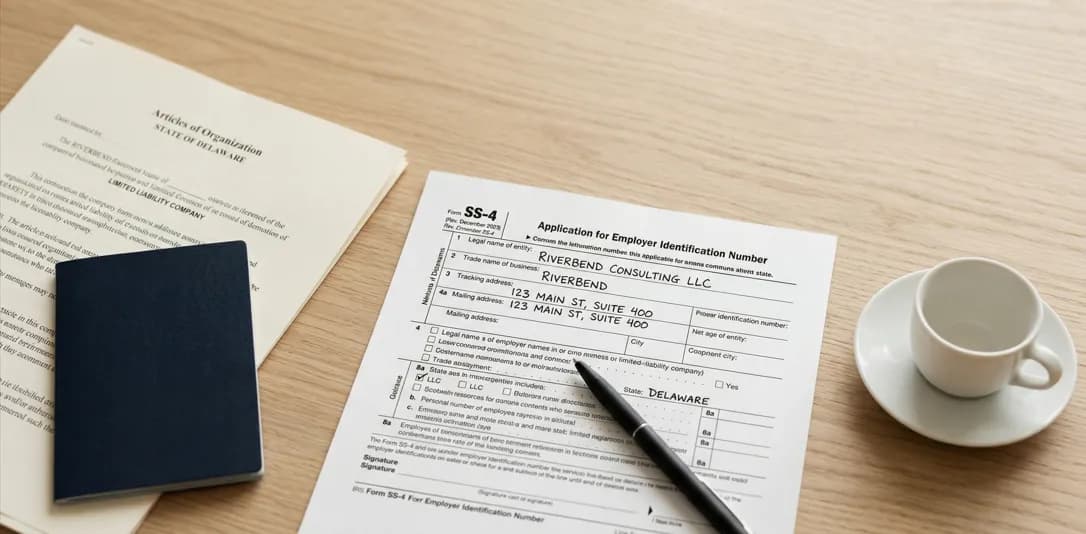
The CP 575 is the one-time confirmation notice the IRS mails when an EIN is first issued, and it is never reissued. The official replacement is the 147C letter, requested by phone at 800-829-4933, and it is sent only to the address the IRS has on file.
Setting up your LLC? See your US address options — no card →
What a CP 575 is and what a 147C letter replaces
The CP 575 is the EIN confirmation notice. When the IRS assigns an Employer Identification Number to a business, it generates a single CP 575 notice that states the legal entity name, the EIN, and the address on record at the time of issuance. The notice is produced once. The IRS does not keep a reprintable copy and does not mail a duplicate CP 575 if the original is lost.
The 147C letter, formally the EIN Verification Letter, is the document the IRS issues when a business needs proof of its EIN after the CP 575 is gone. It contains the same core information: the legal entity name and the EIN. Banks, payment processors, and state agencies treat a 147C as equivalent to the original CP 575 for verification purposes, so a lost CP 575 is recoverable.
The practical issue is not whether a replacement exists. It is that the replacement is delivered through a narrow channel, by phone request and then by fax or mail to a fixed address, and the channel can fail if the address on record is wrong.
CP 575 vs 147C: the difference that confuses founders
Founders often assume the CP 575 and the 147C are different in legal weight. They are not. Both confirm the same EIN for the same legal entity. The difference is procedural: the CP 575 is issued automatically at EIN assignment, and the 147C is issued on request afterward.
A second point of confusion is whether a bank will accept a 147C. Most banks and payment processors explicitly accept the 147C as an EIN confirmation document, because the IRS issues it precisely for that purpose. The acceptance question is usually not about the document type. It is about whether the address and entity name on the letter match the rest of the application.
| Attribute | CP 575 | 147C letter |
|---|---|---|
| When issued | Automatically, when the EIN is first assigned | On request, any time after the EIN exists |
| How to obtain | Mailed once at EIN issuance, not reissued | Phone request to 800-829-4933, then fax or mail |
| Information shown | Legal entity name, business address on file, EIN | Legal entity name, business address on file, EIN |
| Bank and processor acceptance | Accepted as EIN proof | Accepted as equivalent EIN proof |
| Reissue if lost | Not reissued | Can be requested again |
The CP 575 and the 147C confirm the same EIN. The 147C is the standard replacement when the CP 575 is lost.
Ready to set up your business address?
See which US cities fit — about a minute, no card needed.
How to request a 147C letter, step by step
The 147C is requested by phone. There is no online form that issues a 147C directly, and the IRS does not email it. The request runs through the IRS Business and Specialty Tax Line.
- 1Call the IRS Business and Specialty Tax Line at 800-829-4933. The line generally operates Monday through Friday during business hours in the caller's local time zone. Wait times can be long, especially close to filing deadlines.
- 2Pass identity verification. The agent confirms the caller is the responsible party on file for the EIN or a person with a valid Form 2848 Power of Attorney or Form 8821 authorization. Expect questions about the legal entity name, address, and formation details.
- 3Ask specifically for a 147C EIN Verification Letter. Use the exact phrase 147C, EIN Verification Letter, since agents sometimes confuse it with other EIN-related notices.
- 4Choose fax or mail. If a fax number is available during the call, the IRS can typically fax the 147C immediately, which is the fastest path. If mail is chosen, the letter goes only to the address the IRS has on file.
- 5Confirm the legal entity name and address the agent reads back. If the address on file is wrong, the mailed letter can be undeliverable, so this is the moment to catch a stale address before the letter is sent.
Fax is faster than mail
When a fax destination is available, the IRS can usually send the 147C during the same call, which removes the delivery delay entirely. A receiving service that converts an inbound fax or mailed letter to a scan the same day can turn a multi-week wait into a same-day document.
Why the address on file decides whether you ever receive it
Whether the 147C actually arrives depends on one thing: the address the IRS has on record. A mailed 147C is sent there and nowhere else. The phone agent will not redirect a mailed letter to a new address during the call, because the mailing address is pulled from the IRS record, not from what the caller says on the phone.
When the business has moved, or when the EIN was issued with a temporary or third-party address that the founder no longer controls, the 147C can be mailed into a void. The request appears to succeed on the call, but the letter never reaches the founder.
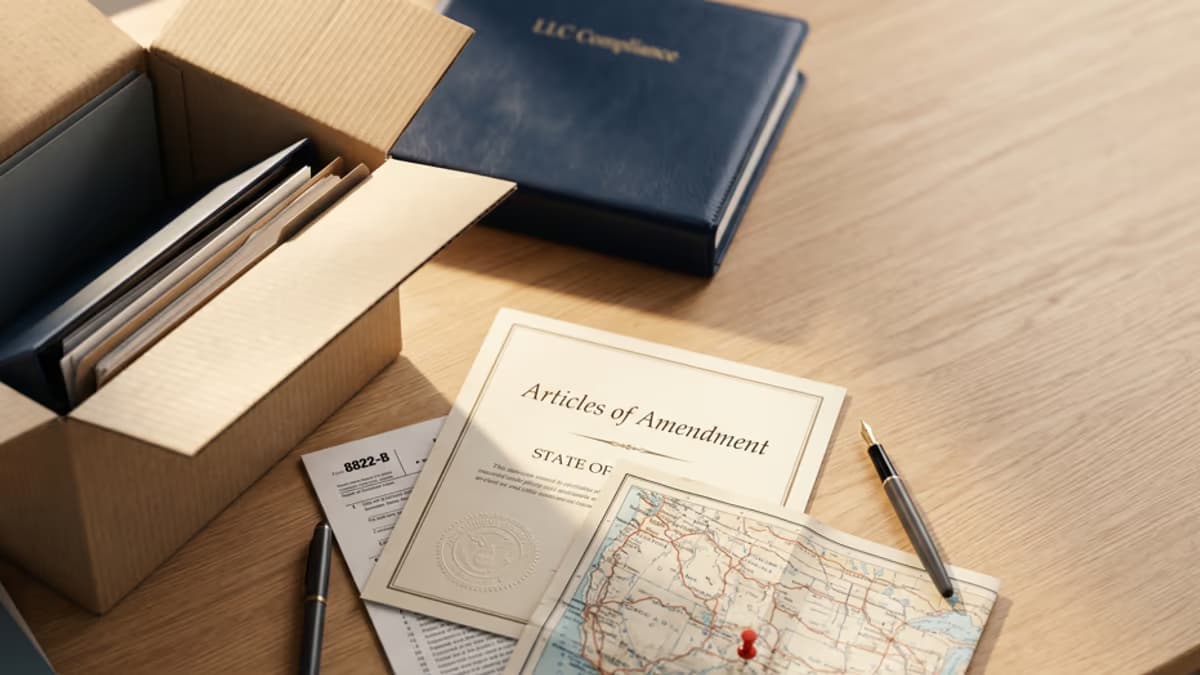
Form 8822-B is the fix, and it has to happen first. Form 8822-B updates the business mailing address, the business location, and the responsible party with the IRS. The IRS asks filers to allow roughly four to six weeks for the change to process. That processing window is why the address correction has to lead the 147C request rather than follow it. Requesting the 147C first and the address change second usually means the letter is already gone to the old address. The change of LLC business address guide covers the Form 8822-B mechanics and the related state and FinCEN deadlines.
Order matters: address first, 147C second
If the IRS address on file is wrong, file Form 8822-B and wait for it to process before requesting a mailed 147C. Requesting the letter first sends it to the old address, where it cannot be recovered or redirected.
What Stripe, Mercury, and banks check on an EIN letter
The EIN letter is rarely requested in isolation. Banks and payment processors ask for it as part of a Know Your Customer review, alongside the formation documents and the business address. The verification is not only that the EIN exists. It is that the EIN letter is internally consistent with everything else in the application.
Stripe onboarding compares the legal entity name and EIN on the letter against the formation filing and the connected bank account. Mercury, as a banking platform, runs a similar check during account opening and again if the business profile changes later. A 147C that shows the correct EIN but an old or mismatched entity name can still trigger a manual review or a rejection, because the name and EIN pair has to line up with the state record.
Address mismatches are the less visible reason applications get rejected. Like the CP 575, the 147C prints the legal entity name, the business address the IRS has on file, and the EIN under the IRS letterhead. When a bank cross-references that address against the formation filing and the application, three different addresses across three documents is a common KYC flag. The Stripe and Mercury KYC rejection recovery playbook covers the evidence checklist when an application is already rejected on an address mismatch.
- Legal entity name on the 147C matches the state formation record exactly, including suffix such as LLC or Inc.
- EIN on the 147C matches the EIN entered in the bank or processor application.
- Business address used across the IRS record, the formation filing, and the application is the same address, with no variation in the suite or unit line.
- Responsible party on file with the IRS is a real person the platform can verify, not a stale or placeholder name.
The foreign founder problem: requesting 147C without a US phone
For foreign founders, the same problems are harder to work around. Many never received a paper CP 575 at all, because the EIN was issued by fax or through a third-party filing and the paper notice went to an address abroad or to a service that did not forward it. The 147C is then the only EIN proof available, and the phone channel is harder to reach from outside the United States.
The 800-829-4933 line is a US toll-free number that is not always reachable from international carriers, and the business-hours window is in US time zones. A founder several time zones away, without a US phone line, can struggle to complete the call and the identity verification in one sitting.
There are two practical paths. The first is authorizing a US-based representative with a Form 2848 Power of Attorney or a Form 8821 authorization, so a representative can make the call and request the 147C on the entity's behalf. The second is fixing the delivery side: a stable US address with reliable mail and fax receipt means that once the 147C is requested, it actually arrives and gets converted to a scan quickly. The EIN without an SSN guide for foreign founders covers the upstream EIN application path that determines where the original CP 575 was sent in the first place.
How save office handles IRS mail and the address match
save office operates real US business addresses in its cities and receives mail and packages through a professional carrier network covering the United States Postal Service (USPS), United Parcel Service (UPS), FedEx, and DHL. For a 147C, the relevant capability is reliable receipt of IRS correspondence at a fixed US address and same-day conversion to a scan, rather than a letter sitting in an uncontrolled mailbox or returning undelivered.
The address-on-file problem is the reason the address match matters across the whole stack. When the IRS record, the state formation filing, and the bank application all point to the same business address, the 147C arrives where it is expected and the address that banks cross-reference is consistent. The Address Checker tool runs USPS Delivery Point Validation on the address before it goes on the IRS record or the bank application, which catches an undeliverable or flagged address before it becomes a returned 147C.
Moving the business between cities is simpler when the address of record does not fragment. Instead of the IRS, the bank, and the state record drifting to three different addresses after a move, the operating address can shift between cities while staying a single consistent address of record. The get-started flow sets up the address, so the address can be in place and validated before Form 8822-B is filed and before the 147C is requested.
Not legal or tax advice
This article is for general informational purposes only and does not constitute legal, tax, or accounting advice. IRS procedures, phone line hours, and processing times change periodically. Confirm the current 147C request process and Form 8822-B processing time on irs.gov, and consult a licensed tax professional for the specific situation.
Common mistakes that delay a 147C
- Requesting a mailed 147C before correcting the IRS address: the letter ships to the old address on file and cannot be redirected, so the request effectively fails. File Form 8822-B first and let it process.
- Assuming a 147C can be obtained online: the IRS issues the 147C by phone request, then by fax or mail. There is no self-service online download of a 147C.
- Calling without authorization: only the responsible party on file or a person with a valid Form 2848 or Form 8821 can pass verification. An unauthorized caller will not pass verification, and the IRS will not release the letter.
- Treating the 147C as a different document than the CP 575 for a bank: most banks and processors accept the 147C as equivalent EIN proof. Pushing back that only a CP 575 is acceptable usually means the requesting party is misinformed, since the 147C is the official replacement and IRS guidance confirms this.
- Letting the entity name or address drift across the IRS record, the state filing, and the application: a mismatch across the three is a common KYC rejection trigger even when the EIN itself is correct.
- Foreign founders relying only on the US toll-free line: the 800 number and US business hours can be hard to reach internationally. Authorizing a US-based representative or fixing the mail receipt side is usually faster than repeated call attempts.
Frequently Asked Questions
Not sure what you need?
Two short pages sort it out — what the products actually are, and which situation you're in.